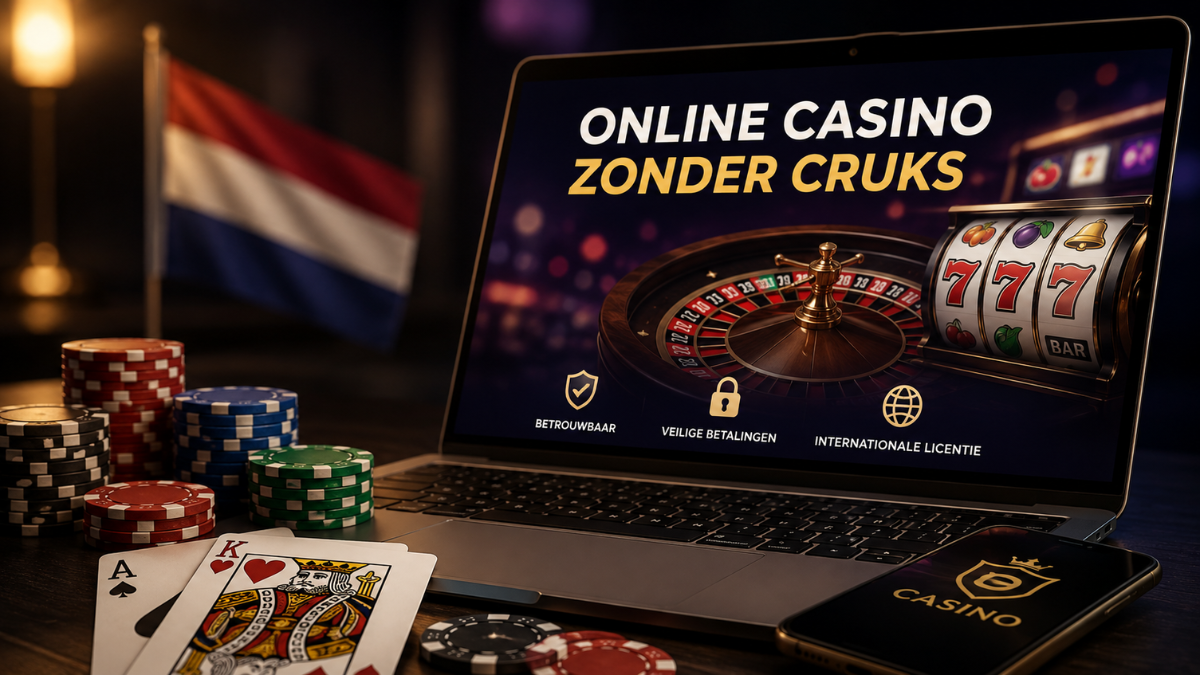
An online casino zonder Cruks is generally a foreign gambling website that operates outside the Dutch Cruks self-exclusion system. The important distinction is that being accessible without a Cruks check does not mean a casino has permission to offer online gambling in the Netherlands.
For Dutch players, four questions should be separated from the start: Can you access the website? Does it hold a foreign gambling licence? Does it have a licence from the Dutch Kansspelautoriteit (Ksa)? And what protection do you have if something goes wrong?
Those questions matter more than bonus size, game variety or promises of fast withdrawals. A foreign casino may have meaningful regulation in another jurisdiction, but foreign licensing and Dutch market authorisation are not interchangeable.
What Is an Online Casino Zonder Cruks?
What does “zonder Cruks” mean in simple terms?
“Zonder Cruks” means “without Cruks.” Cruks stands for Centraal Register Uitsluiting Kansspelen, the Dutch Central Register for Exclusion from Gambling.
Someone who takes a gambling stop through Cruks is excluded from gambling websites, gambling halls and casinos operating with a Dutch licence. The current minimum exclusion period is six months, although users can choose a much longer period.
An online casino zonder Cruks therefore normally refers to an operator that is outside the Dutch licensed system and does not perform the same mandatory Cruks check.
That definition does not answer whether the casino is safe, well managed, licensed somewhere else or legally authorised to target Dutch customers. Those are separate questions.
Why are these casinos outside the Dutch Cruks system?
For an online gambling company seeking a Dutch licence, a functioning and tested connection to Cruks is part of the licensing process. Dutch casinos and gambling halls that require licences must also participate in the system.
A foreign operator without a Ksa licence is outside that Dutch regulatory structure. It may instead be supervised by a regulator in Curaçao, Malta, Kahnawà:ke or another jurisdiction.
The practical distinction is simple: a foreign regulator may supervise the company under its own rules, but that does not make the company a Dutch-licensed gambling operator.
Is a casino without Cruks automatically an unlicensed casino?
Not necessarily in a global sense.
A casino may hold a valid foreign gambling licence while lacking Dutch authorisation. The Ksa’s Kansspelwijzer identifies operators that are permitted to offer gambling in the Netherlands.
This is why “foreign licensed” and “legal Dutch casino” should never be used as synonyms.
A foreign licence tells you something about the operator’s position in another jurisdiction. A Ksa licence tells you whether the operator has been authorised for the Dutch regulated market.
How Does Cruks Work in the Netherlands?
What is the Central Register for Exclusion from Gambling?
Cruks is a player-protection mechanism rather than a casino rating system.
People registered in Cruks are prevented from gambling with operators that are required to consult the register. The system is intended to create an enforceable break from gambling across licensed Dutch online and land-based environments.
Cruks should therefore not be confused with a gambling licence, payment-security certificate or assessment of game fairness.
A Ksa licence regulates an operator. Cruks restricts access for an excluded player.
When do Dutch casinos check Cruks?
Dutch-licensed gambling businesses must integrate Cruks checks into access to regulated gambling. For online applicants, a successfully tested Cruks connection is required during the licensing process.
The requirement is actively enforced. In June 2026, the Ksa warned Betnation after finding that some required Cruks checks had not been carried out. In July 2026, it reported a €25,000 fine against Casino Zoetermeer for admitting players registered in Cruks.
These cases illustrate that Cruks is not merely a voluntary responsible-gambling feature added by individual casinos. It is part of the Dutch regulatory framework.
Who can be registered in Cruks?
A person can voluntarily take a gambling stop through Cruks. Dutch rules also provide procedures connected with involuntary registration where serious gambling-related concerns arise.
For most readers, the most important practical point is that a voluntary registration immediately blocks access to participating Dutch-licensed gambling environments for the chosen period.
How long does a Cruks exclusion last?
As of August 2026, the minimum gambling-stop period is six months. The Ksa states that users can select periods ranging from six months up to 99 years and can extend an existing gambling stop. A stop cannot simply be cancelled during its first six months.
The Dutch government announced additional proposed changes to gambling policy on June 12, 2026, including changes intended to strengthen Cruks. Those measures should be treated as policy proposals until the relevant legislative changes take effect.
That distinction between current rules and announced reforms is important when reading older or promotional gambling content.
Why Do Players Look for an Online Casino Zonder Cruks?
Searches for casinos without Cruks come from different motivations.
Some users are comparing international casinos because they expect different game catalogues, payment methods, bonuses or account limits. Others are specifically looking for gambling access after being excluded through Cruks.
Those two audiences should not be treated as identical.
A person researching foreign gambling regulation is making a comparison decision. A person attempting to regain gambling access while actively excluded is dealing with a player-protection issue.
Fewer restrictions can also mean fewer protections
Foreign casinos may apply different account limits or gambling controls depending on their regulator and internal policies.
That can be marketed as greater flexibility. However, fewer restrictions are not automatically a consumer advantage. Some restrictions exist specifically to reduce gambling harm or intervene when spending patterns become dangerous.
This creates an important trade-off: increased freedom may come with reduced protection.
Bigger bonuses need more scrutiny, not less
International casinos may promote welcome bonuses, cashback, free spins or loyalty offers under conditions that differ from Dutch requirements.
A headline number tells you very little about a bonus’s real value.
The practical questions concern the deposit required, wagering multiple, eligible games, maximum permitted stake while wagering, expiry period and any restrictions on withdrawing winnings.
For Dutch-licensed operators, the Ksa requires bonus conditions to be communicated clearly.
The Dutch government also announced in June 2026 that it intends to prohibit online-gambling bonuses as part of a broader reform package, but that announcement should not be misrepresented as proof that every proposed measure is already in force.
Fast registration does not necessarily mean no KYC
One of the most common misconceptions around a casino without Cruks is that less friction during signup means complete anonymity.
Registration and withdrawal verification are different stages.
An operator may allow a customer to create an account quickly and later request identity documents, address evidence, payment ownership information or source-of-funds documentation before processing a withdrawal.
That distinction matters because a player may discover the verification burden only after depositing or winning money.
“No Cruks check” should therefore never be interpreted automatically as “no identity checks.”
Is an Online Casino Zonder Cruks Legal in the Netherlands?
The answer depends on what exactly is being asked.
A website can be technically accessible from the Netherlands without being authorised to offer gambling within the Dutch regulated market.
The Ksa maintains the Kansspelwijzer so consumers can determine which operators are permitted to offer gambling in the Netherlands.
That official licensing status should carry more weight than an operator describing itself as “internationally licensed,” “European,” “trusted” or “regulated.”
Dutch Ksa licence versus a foreign gambling licence
A Ksa licence places the operator within the Dutch regulated gambling market and subjects it to Dutch licensing and player-protection requirements.
A foreign licence establishes a regulatory relationship with the foreign authority that issued it.
For example, the Curaçao Gaming Authority licenses online gambling conducted under its current legal framework and requires licensed operators to comply with applicable regulatory requirements. Its current conditions cover approved domains, responsible gambling, player accounts, security, game certification and other operational obligations.
Similarly, the Malta Gaming Authority maintains a searchable register where consumers can check operators by licence holder, authorisation status, URL or gaming service.
These are genuine regulatory systems. But neither a Curaçao nor an MGA licence substitutes for Ksa authorisation to operate in the Dutch regulated market.
Can foreign casinos legally accept Dutch players?
The crucial question is not simply whether a website technically allows someone in the Netherlands to create an account.
Dutch authorisation is determined through the Ksa licensing framework.
The Ksa’s official register should therefore be the first check when assessing whether an operator is authorised in the Netherlands.
Accessibility, language availability, acceptance of Dutch addresses or availability of a familiar payment method should not be used as substitutes for licence verification.
What protection is different without Ksa supervision?
A Dutch-licensed operator is subject to Dutch requirements concerning matters such as Cruks, player protection and regulatory oversight.
A foreign casino without Ksa authorisation instead operates according to whichever legal and licensing framework applies to it.
That does not mean every foreign jurisdiction lacks consumer safeguards. It means the safeguards, complaint mechanisms and enforcement authority may be different.
This distinction becomes particularly important during disputes. A Dutch player should know before depositing which regulator, dispute-resolution mechanism and governing law actually apply.
Gambling Tax Can Be an Overlooked Difference
Tax is one of the most important practical issues surrounding online casinos without a Dutch licence.
The Dutch Tax Administration distinguishes online gambling with a Ksa-licensed provider from online gambling with an operator that does not hold a Ksa licence.
For online gambling with a provider without a Ksa licence, the Belastingdienst states that a player must file a gambling-tax return if winnings during a calendar month exceed the amount staked during that month. The gambling-tax rate has been 37.80% since January 1, 2026.
That makes taxation more than a minor legal footnote.
A casino may advertise a large bonus or attractive payout, but the player’s actual financial position can also depend on applicable Dutch tax obligations.
Anyone dealing with substantial winnings should rely on current Belastingdienst guidance for their circumstances rather than assuming that information on a casino or affiliate website is sufficient.
What Licences Do Casinos Zonder Cruks Use?
Foreign casinos frequently refer to licences from jurisdictions such as Curaçao, Malta or Kahnawà:ke.
The correct question is not simply, “Does the website show a licence logo?”
The better question is, “Can the claimed licence, company and exact domain be independently verified with the regulator?”
Curaçao Gaming Authority
Curaçao’s online-gambling framework has undergone major regulatory changes.
Under the current Curaçao Gaming Authority system, operators need the appropriate online gaming licence to offer online gambling in or from Curaçao. The authority’s current licence conditions cover approved domains, compliance obligations, secure handling of player data, responsible gambling and certification of games.
An important practical detail is that domains matter.
The licence conditions specify that approved domains and subdomains associated with the licensee form part of the regulated operation.
That means copying a regulator’s logo onto a website does not prove that the website itself is authorised.
Malta Gaming Authority
The Malta Gaming Authority provides a public licence register allowing users to search by licensee name, authorisation status, URL or gaming service. It also publishes information about unauthorised websites and enforcement actions.
The MGA also has a formal channel through which players can lodge complaints concerning MGA-licensed operators. It recommends first trying to resolve the issue directly with the operator before submitting a complaint.
This provides a meaningful layer of regulatory accountability.
It still does not turn an MGA licence into a Ksa licence.
Kahnawà:ke Gaming Commission
The Kahnawà:ke Gaming Commission also operates a regulatory framework for interactive gaming.
It accepts complaints concerning gaming operators holding its permits and maintains a dispute-resolution process.
Its player-protection framework also includes comprehensive self-exclusion across interactive gaming sites licensed and regulated by the Commission.
The wider lesson is that “foreign licence” should not be treated as one uniform category. Regulatory requirements and complaint mechanisms vary significantly between jurisdictions.
What Are the Potential Benefits of an Online Casino Zonder Cruks?
The perceived benefits generally relate to flexibility rather than stronger Dutch consumer protection.
Depending on the individual operator, players may encounter different games, different promotions, alternative payment methods, cryptocurrency support or different account limits.
Those features can matter to a consumer, but each should be evaluated together with its practical trade-off.
A wider game catalogue does not prove that withdrawals will be handled fairly.
A larger bonus does not mean better value if its conditions are restrictive.
A quicker signup process does not prove that verification will not happen later.
A cryptocurrency withdrawal can move quickly on a blockchain after approval, but the casino may still have an internal review process before releasing it.
The useful question is therefore not simply, “What extra features does this casino offer?”
It is, “What protections or obligations change in return for that flexibility?”
What Are the Biggest Risks of Gambling Without Cruks?
Reduced protection against harmful gambling
For someone already registered in Cruks, this is the most serious issue.
Cruks is intended to stop access to licensed gambling during an exclusion period. Using a casino outside that system because Cruks is blocking access removes the very barrier that the gambling stop is designed to create.
This makes Cruks-registered users fundamentally different from ordinary comparison shoppers.
If the reason for searching for an online casino zonder Cruks is specifically to continue gambling during an active gambling stop, comparing bonuses and payment methods misses the central risk.
Withdrawal problems can become jurisdiction problems
Withdrawal complaints are not unique to foreign casinos, but jurisdiction becomes especially important when something goes wrong.
A player needs to know which rules control the relationship, who can review the dispute and what authority the regulator has over the operator.
With an MGA-licensed casino, for example, a player can use the MGA complaint process for a licensed operator.
Kahnawà:ke has its own dispute-resolution procedure for permit holders.
Curaçao’s current regulatory framework contains requirements concerning player terms and regulated operation.
These mechanisms may provide recourse, but they are different from supervision under the Dutch Ksa framework.
Bonus conditions can invalidate expectations
A large bonus can become worthless if a player misunderstands wagering rules.
Relevant terms may concern wagering multiples, restricted games, maximum stakes during wagering, expiry periods or withdrawal limitations.
The practical lesson is to read conditions before depositing rather than after a withdrawal has been rejected.
Account blocking may occur after a win
An account can be restricted for various reasons, including verification requirements, suspected duplicate accounts, prohibited activity, payment issues, bonus disputes or anti-money-laundering checks.
The key question is whether the operator explains its rights and the player’s rights clearly.
Before depositing, a user should understand what documents can be requested, when funds can be frozen, what happens to the balance if an account is closed and how a decision can be challenged.
Online Casino Zonder Cruks vs. Dutch Licensed Online Casino
The most meaningful difference is regulatory accountability.
A Dutch-licensed online casino operates under Ksa authorisation and must comply with requirements associated with the Dutch market, including Cruks participation.
An international casino without a Ksa licence may instead rely on a foreign regulatory system.
That changes several parts of the player relationship.
With a Dutch-licensed operator, Dutch regulatory supervision is directly relevant. With a foreign operator, the applicable foreign regulator and jurisdiction become much more important.
Cruks applies within the Dutch licensed environment. A foreign operator outside that environment does not provide the same centralized Dutch exclusion mechanism.
Complaint procedures can also differ. A foreign regulator may provide a complaint service, but the process, legal basis and enforcement powers are those of that jurisdiction.
Tax treatment can differ as well. Dutch players using an online provider without a Ksa licence can face filing obligations when monthly winnings exceed monthly stakes.
For a Dutch consumer prioritizing predictable local regulation, the Ksa licence is therefore a high-impact decision factor.
How Can You Identify a More Trustworthy Foreign Casino?
No checklist can guarantee that an offshore casino will perform perfectly, but some checks are substantially more meaningful than others.
Verify the licence before judging the website
The highest-priority check is independent licence verification.
Do not rely only on a logo, badge or text in the footer.
If the website claims MGA regulation, check the MGA’s official register, which supports searches by operator and URL.
If it claims Curaçao regulation, verify that the operator and relevant domains fall within the regulator’s current framework.
This is more useful than relying on a review site saying that a casino is “fully licensed.”
Identify the actual operating company
A casino brand name may not be the legal company holding the licence.
The operator name, registered company and licensed website should match the regulator’s information.
If the terms name one business, the licence seal names another and the domain cannot be verified, that inconsistency deserves more attention than any promotional feature.
Read the withdrawal terms before depositing
Withdrawal rules have more practical impact than most homepage claims.
Check whether the terms explain identity verification, payment ownership, processing periods, minimum withdrawals, fees, account restrictions and circumstances in which winnings may be withheld or investigated.
“Fast withdrawals” should be treated as a marketing claim unless backed by verifiable evidence or genuine independent testing.
Treat known game providers as a supporting signal
Recognizable game suppliers may be relevant when evaluating game provenance, but they should not replace regulatory verification.
A casino can display reputable games while still having poor account, withdrawal or customer-service practices.
Software quality and operator reliability are related but separate questions.
Look for real responsible-gambling controls
Responsible-gambling features matter especially at a casino outside Cruks.
Useful controls can include deposit limits, time-outs and self-exclusion, depending on the regulatory framework.
For example, Kahnawà:ke provides an exclusion mechanism covering interactive gaming sites under its regulation.
Foreign safeguards can therefore exist, but they should be verified rather than assumed.
Which Payment Methods Do Casinos Zonder Cruks Accept?
International gambling sites may support combinations of bank cards, transfers, e-wallets or cryptocurrencies, but payment availability varies between individual operators.
It can also change according to country, banking relationships, regulatory policy and payment-provider rules.
That makes broad claims such as “casinos zonder Cruks always accept crypto” unreliable.
Does iDEAL prove that a casino is Dutch licensed?
No.
A familiar payment option should not be used as evidence of regulatory status.
The correct way to determine Dutch authorisation is to verify the operator through the Ksa’s Kansspelwijzer.
Payment availability answers a transaction question.
Ksa licensing answers a regulatory question.
Those should remain separate.
What matters when evaluating a withdrawal?
Consider the entire transaction, not only the advertised processing time.
There may be an internal casino review, KYC verification, payment-provider processing, bank processing and currency conversion before money is actually available to the customer.
This is especially relevant to cryptocurrency.
Blockchain settlement can be fast after a transaction is sent, but it does not remove the casino’s internal approval stage.
“Crypto” and “instant withdrawal” are therefore not synonymous.
Who Should Avoid an Online Casino Zonder Cruks?
Players currently registered with Cruks
Someone with an active Cruks gambling stop should not treat an offshore casino as a technical solution to that restriction.
The purpose of Cruks is to create an enforced break from gambling across Dutch-licensed gambling environments.
If Cruks is currently preventing access, bypassing that protection changes the issue from casino comparison to gambling-risk management.
People who struggle to control gambling
Higher limits and fewer barriers may be particularly unsuitable for someone experiencing repeated loss chasing, uncontrolled deposits, difficulty stopping or gambling with money needed for essential expenses.
In that situation, the absence of Cruks is not an advantage.
It is the absence of a protective barrier.
Players who want maximum Dutch regulatory protection
For a player whose priority is Dutch licensing, local regulatory accountability and participation in Cruks, the practical starting point is straightforward: verify the operator through the Ksa’s official licence register.
What Should You Check Before Considering a Casino Without Cruks?
The most useful decision process begins with regulation rather than bonuses.
First determine whether the operator holds a Ksa licence. If it does not, identify the foreign regulator it claims to operate under.
Then verify the licence independently and confirm that the exact domain is covered.
After that, identify the legal company running the casino and determine which jurisdiction governs the player agreement.
Only then examine withdrawal terms, KYC procedures, account-closure rules, responsible-gambling controls and complaint mechanisms.
Next, understand any Dutch gambling-tax consequences.
Finally, ask why you are looking for a casino without Cruks in the first place.
That last question becomes the highest-priority consideration when the answer is, “because Cruks currently prevents me from gambling.”
FAQs
Can you play at an online casino zonder Cruks while registered in Cruks?
Foreign operators outside the Dutch licensed system do not participate in Cruks in the same way as Ksa-licensed operators.
However, that should not be treated as guidance for circumventing a gambling stop.
Cruks exists specifically to prevent gambling during an exclusion period.
Are casinos without Cruks legal for Dutch players?
A foreign licence does not automatically authorise an operator for the Dutch regulated market.
The Ksa’s Kansspelwijzer is the authoritative place to verify whether an operator has permission to offer gambling in the Netherlands.
Is a foreign gambling licence trustworthy?
A verified licence can provide meaningful regulatory oversight, but the level of protection depends on the jurisdiction, current licence status, approved domains, applicable rules and dispute process.
It should be evaluated rather than treated as either automatically trustworthy or automatically worthless.
Is an MGA-licensed casino safer than an unverified casino?
An MGA licence provides a verifiable regulatory relationship, public licence information and a formal complaints channel for licensed operators.
Those are meaningful accountability mechanisms.
However, an MGA licence still does not equal Dutch Ksa authorisation.
Does a Curaçao licence mean a casino is safe?
A genuine licence under the current Curaçao framework subjects an operator to regulatory requirements, including requirements concerning approved domains, responsible gambling, secure operation and game certification.
That is different from saying that every casino displaying a Curaçao logo is trustworthy.
The licence and domain should be verified independently.
Can you use iDEAL at a casino without Cruks?
Payment options vary by operator.
Even where iDEAL or another familiar Dutch payment option appears, it should not be interpreted as proof that the operator is Ksa licensed.
Check the official Ksa register instead.
Do you pay tax on winnings from an online casino without a Ksa licence?
Potentially, yes.
The Belastingdienst states that for online gambling with an operator without a Ksa licence, the player must file a gambling-tax return when monthly winnings exceed monthly stakes. The applicable gambling-tax rate has been 37.80% since January 1, 2026.
Can foreign casinos require KYC after registration?
Yes, depending on the operator and regulatory framework.
A quick registration process does not prove that withdrawals will be processed without identity, payment or source-of-funds verification.
Players should check the operator’s terms before depositing.
How do you know whether an online casino will actually pay?
There is no method that can guarantee a future withdrawal.
The most useful evidence is independently verifiable licensing, a clearly identified operator, transparent withdrawal conditions, a legitimate complaint procedure and a regulatory record that matches the exact website.
Anonymous testimonials or isolated payout screenshots are much weaker evidence.
Can you self-exclude from a foreign casino?
Some foreign regulatory systems include self-exclusion.
The Kahnawà:ke Gaming Commission, for example, provides a comprehensive process that can permanently exclude a player from interactive gaming sites licensed and regulated by the Commission.
That system is separate from Cruks and does not replace Dutch self-exclusion.
What should you do if a foreign casino refuses a withdrawal?
Keep copies of account records, transactions, communications, verification requests and the version of the terms that applied.
Use the casino’s formal complaint procedure first.
If the operator holds a verifiable licence, determine whether the relevant regulator provides a complaint or dispute-resolution route. The MGA and Kahnawà:ke Gaming Commission both provide formal complaint mechanisms for operators within their regulatory scope.
Is an Online Casino Zonder Cruks Worth It in 2026?
For Dutch players, the answer should not be based on which casino advertises the most freedom.
An online casino zonder Cruks may offer different games, limits, promotions or payment methods, but those differences come within a different regulatory environment.
That is the central trade-off.
The conventional way to compare these casinos is to look at bonuses, game catalogues and withdrawal speeds.
That approach is incomplete.
The higher-impact questions are who licenses the operator, whether the exact domain is verified, which rules protect player funds, when KYC can be requested, who handles disputes, what tax obligations apply and what happens if the operator refuses a withdrawal.
A casino offering a 300% or 500% promotional bonus is not automatically more attractive if those questions cannot be answered clearly.
The Dutch government’s regulatory direction also matters. On June 12, 2026, the government announced plans for stronger online-gambling controls, including proposed restrictions on advertising and bonuses, broader deposit controls, changes involving Cruks and stronger measures against illegal gambling. As of this article’s August 2026 fact-check, those announced measures should be distinguished from rules already fully in force.
The practical conclusion is therefore not that every foreign casino is identical or completely unregulated.
It is that a foreign licence provides a different form of oversight from Dutch Ksa regulation, and users need to understand exactly what that difference means before risking money.
Conclusion: Making an Informed Decision About an Online Casino Zonder Cruks
An online casino zonder Cruks is not simply a Dutch online casino with fewer restrictions. It operates in a different regulatory environment, and that difference affects player protection, self-exclusion, complaints, verification and potentially taxation.
The most important decision framework is to separate five questions.
Can you technically access the website?
Is the operator authorised by the Dutch Ksa?
If not, does it hold a genuine and verifiable foreign licence?
What consumer protection and dispute process actually apply?
And why are you specifically looking for gambling without Cruks?
For a Dutch player seeking the strongest connection to Dutch regulation, checking the Kansspelautoriteit’s official licence register should come before comparing bonuses, games or payment methods.
For someone already registered in Cruks, the conclusion is more important still. A casino that does not check Cruks may technically remove an access barrier, but it does not remove the reason that barrier exists. Cruks is designed to enforce a gambling stop across Dutch-licensed gambling environments.
The most useful question is therefore not, “Which online casino zonder Cruks offers the biggest bonus?”
It is, “Who regulates this operator, what protection do I actually have, and what happens if something goes wrong?”
Answering those questions first leads to a much more informed decision than treating “without Cruks” as a casino feature.
You May Also Like Incfidelibus

Wyvernity Team is a content writing team with 3 years of experience in creating clear, engaging, and SEO-friendly content for Wyvernity.com.