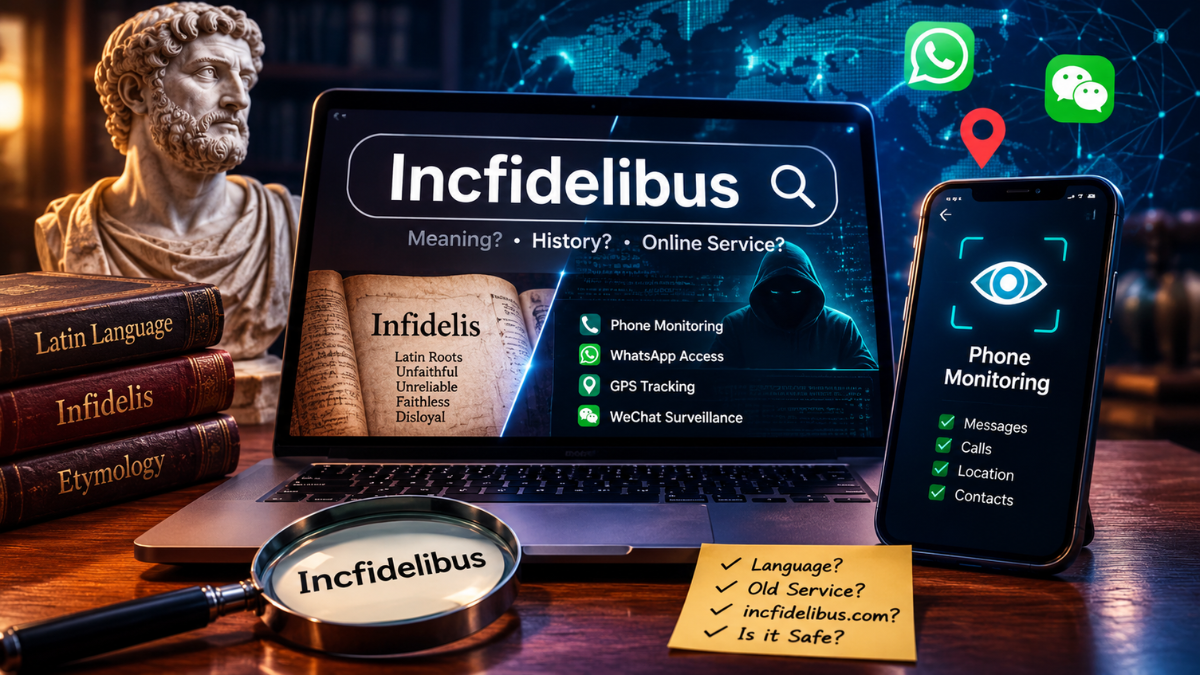
Incfidelibus is an ambiguous online term rather than a clearly established ancient Latin concept. It resembles the documented Latin form infidelibus, but the IncFidelibus name also has a historical online footprint connected with phone monitoring and hacking-related services.
The distinction matters because someone searching for incfidelibus may be trying to understand a strange word, investigate an old service, check whether incfidelibus.com is trustworthy, or work out what to do after sending money or personal information. Those are different problems, and treating them as one story can produce misleading conclusions.
The most useful approach is to separate four things: the linguistic question, the historical IncFidelibus identity, the complaints associated with that historical service, and the current incfidelibus.com website.
What Is Incfidelibus in Simple Terms?
Incfidelibus does not have one universally established meaning.
In a language context, it looks similar to infidelibus, an inflected form connected to the Latin adjective infidelis. Traditional Latin lexical sources associate infidelis with meanings such as unfaithful, unreliable, faithless, or disloyal.
The spelling incfidelibus, however, contains an additional “c.” That small difference matters. The available linguistic evidence does not justify confidently presenting Incfidelibus as a standard classical Latin word with a documented philosophical tradition.
Online, the spelling developed another identity. Historical web pages under the IncFidelibus name promoted mobile-phone monitoring, WhatsApp access, WeChat surveillance, GPS tracking, and other hacking-related services.
The domain incfidelibus.com is also active today, but its visible purpose in August 2026 is very different. It currently functions as a general informational website publishing articles on technology, education, websites, and other topics.
So the right first question is not simply “What does Incfidelibus mean?” It is “Which Incfidelibus am I looking at?”
Is Incfidelibus a Real Latin Word?
It is more accurate to say that Incfidelibus resembles established Latin vocabulary than to describe it confidently as a documented classical Latin term.
The stronger linguistic evidence surrounds infidelis and its grammatical forms, including infidelibus. The additional “c” in Incfidelibus is not something that should be ignored or explained away simply because the word looks Latin.
This is where several articles about the term become unreliable. They begin with a Latin-looking spelling and then build an elaborate narrative around loyalty, trust, identity, religion, medieval philosophy, the Renaissance, or the Enlightenment.
Those themes may be interesting in their own right, but resemblance is not historical evidence.
There is currently not enough reliable documentation to establish Incfidelibus as a major ancient philosophical concept that moved through those periods. If primary manuscripts, historical dictionaries, dated citations, or specialist linguistic research eventually establish such a history, the conclusion could change. Until then, caution is more accurate than certainty.
Incfidelibus vs. Infidelibus: What Is the Difference?
The main difference is evidence as well as spelling.
Infidelis is documented Latin vocabulary. Infidelibus is a grammatical form derived from it. Incfidelibus, with the additional “c,” is the spelling that later appears prominently as an online name.
That makes the following distinction useful:
When a historical or linguistic article discusses infidelibus, the reader is dealing with Latin vocabulary.
When an old website, hacking advertisement, email, forum post, or service refers to IncFidelibus, the reader may instead be dealing with the online identity.
It is possible that Incfidelibus originated as deliberate branding, a spelling alteration, a transcription mistake, or something else. Available evidence does not establish one explanation strongly enough to present it as fact.
That uncertainty is not a weakness. It prevents a modern online identifier from being mistaken for a verified ancient concept.
Where Did the Incfidelibus Name Appear Online?
The online history is much easier to document than the supposed ancient history.
Historical WordPress pages published under the IncFidelibus identity promoted services involving mobile phones and messaging platforms. The content included claims about obtaining access to WhatsApp communications, monitoring smartphones, tracking location data, and viewing activity associated with a target device.
Some historical pages also linked visitors toward incfidelibus.com.
This establishes an important fact: IncFidelibus was used publicly as an online identity associated with hacking and surveillance-related services.
It does not establish that every capability advertised actually worked.
A service’s own promotional material is evidence of what the service claimed to provide, not independent evidence that the claims were technically accurate or successfully delivered to customers.
That distinction is particularly important with extraordinary claims involving private communications, remote phone access, deleted data, encrypted messaging platforms, or secret surveillance.
What Is Incfidelibus.com Today?
As of August 2026, incfidelibus.com visibly operates as a general informational publishing website.
Its current site structure contains ordinary content categories such as technology and education, along with articles discussing websites, digital topics, and other informational searches. The visible site does not resemble the historical IncFidelibus hacking-service material.
This creates one of the most important issues surrounding the keyword.
The same domain name has a historical association with IncFidelibus hacking material, but its current visible purpose is different.
That does not automatically mean the same people operate both versions.
Domains can expire, be sold, change ownership, be repurposed, or be relaunched under entirely new editorial strategies. Without reliable ownership records connecting the historical operator and the current publisher, it would be irresponsible to state that today’s website is necessarily the same business.
The correct conclusion is narrower: historical IncFidelibus pages associated the name and domain with hacking and monitoring services, while today’s domain presents itself as a general content website. Public evidence reviewed does not establish continuity of ownership between those periods.
What Services Was the Historical IncFidelibus Identity Associated With?
Historical IncFidelibus pages were associated with claims involving phone and communications surveillance.
The advertised capabilities included monitoring mobile phones, accessing WhatsApp information, viewing messaging activity, obtaining location information, and accessing data related to target devices.
Those claims introduce two separate questions.
The first is technical: could the advertised service genuinely deliver what it promised?
The second is legal and ethical: did the person requesting the service have authorization to access the target account, phone, or communications?
Both questions matter.
A provider calling itself an “ethical hacker” does not create permission that did not otherwise exist. Ethical security testing normally depends on authorization from the owner of the system being tested. Secret access to another person’s communications can create serious privacy and legal issues depending on the jurisdiction and circumstances.
For readers evaluating such services, the practical question should therefore be broader than “Can they do it?”
It should be: Can the provider prove the capability, is the activity authorized, and is the transaction sufficiently protected to justify the risk?
Is Incfidelibus Legit or a Scam?
There are serious historical complaints associated with Incfidelibus, but the available evidence does not justify turning those complaints into a universal legal conclusion.
Trustpilot currently displays only two reviews for the Incfidelibus profile. Both are one-star reviews from the 2019–2020 period.
One reviewer alleged paying more than $2,000 for a service and later being asked for an additional payment for storage. The reviewer described receiving what they considered a static or non-functioning dashboard and claimed that the expected data was never delivered.
Another reviewer alleged making an initial payment of more than €1,600, followed by a much larger payment for what was described as a secure server and another smaller charge for a VPN. That reviewer also claimed that the promised information was not received and that communication eventually became unsuccessful.
The details are relevant because the two reports describe a similar sequence:
An initial payment is made. A technical interface or service stage is presented. Another payment is requested for infrastructure such as a server, storage, hosting, or VPN. The user pays again. The promised final result is allegedly still unavailable.
That pattern resembles an escalating advance-fee structure.
However, “resembles” is the important word.
Two user reviews do not constitute a criminal conviction, court judgment, regulatory finding, or independently audited record of the company’s transactions. They are evidence of reported customer experiences.
The strongest defensible conclusion is therefore that historical Incfidelibus complaints contain significant warning signs and justify caution, not that two Trustpilot reviews alone prove every transaction was fraudulent.
Why Technical-Sounding Additional Fees Deserve Scrutiny
A common mistake is assuming that a technical explanation must be legitimate because it sounds complicated.
Terms such as “secure server,” “VPN activation,” “hosting,” “storage,” “encryption,” or “data unlocking” can describe real technology. But using a legitimate technical term does not prove that a particular charge is necessary.
Suppose someone has already paid a large fee and is then told that their results are ready but cannot be released until another server payment is made. The important question is not whether servers exist. Of course they do.
The real questions are why the requirement was not disclosed earlier, what exactly the new payment buys, whether the fee is documented in the original agreement, whether the provider can prove the underlying result already exists, and what happens if the customer refuses to pay.
A professional-looking dashboard also proves less than many buyers assume. A dashboard can display names, percentages, status indicators, progress bars, or data placeholders without demonstrating that the promised private information has actually been obtained.
Interface quality is not the same thing as service verification.
That practical distinction is especially important when large additional payments are requested.
Warning Signs Before Paying a Hacking or Phone-Monitoring Service
The biggest warning sign is not necessarily one particular fee. It is the combination of high financial risk, extraordinary technical promises, weak identity verification, and pressure to continue paying.
Before sending money, a buyer should be able to establish who operates the service, what legal entity receives the payment, exactly what service is being purchased, whether the requested activity is authorized, which charges are included from the beginning, what refund conditions apply, and what evidence exists that the service can deliver what it claims.
Unexpected additional fees deserve particular scrutiny when the customer is told that everything has already been completed except for one final payment.
Payment method also matters. Card payments and some regulated payment services may offer dispute procedures. Cryptocurrency transfers are usually much more difficult to reverse once completed.
A claim should receive more scrutiny when the provider requests a payment method that gives the buyer little or no practical recourse.
How to Check Whether a Website Like Incfidelibus Is Trustworthy
Do not begin with the site’s appearance. Begin with identity and evidence.
A polished design, HTTPS connection, impressive technical vocabulary, live chat, testimonials, and a professional dashboard can all exist without proving that a business will deliver.
Independent verification is more useful.
Check whether the operator identifies a legal business name and verifiable contact information. Compare promises on the website with independent sources. Examine the age and quality of reviews rather than looking only at the average score. Read refund terms before paying rather than after a dispute develops.
Domain history can also matter, but it needs careful interpretation.
An old negative reputation does not automatically prove that a current domain owner is responsible for the earlier activity. Conversely, a newly redesigned website does not automatically erase meaningful historical questions.
The correct approach is to establish continuity before transferring reputation from one operator to another.
For Incfidelibus specifically, that means treating the historical hacking identity and today’s general-content website as separate entities unless stronger ownership evidence connects them.
Privacy and Legal Risks of Phone Monitoring Services
There is another issue that can be overlooked when someone is focused on whether a service is legitimate: the requested service itself may create legal or privacy risk.
Phone-monitoring software can sometimes be used legitimately, such as on devices a person owns or manages under appropriate rules. But secretly monitoring another person’s communications or device activity without authorization can be very different.
The Federal Trade Commission describes stalkerware as software capable of secretly monitoring activity on a phone, including potentially sensitive information.
Whether a particular type of monitoring is lawful varies by country, state, device ownership, consent, employment relationship, parental responsibility, and other circumstances.
That is why generic online claims such as “100% ethical” or “completely legal” should not substitute for jurisdiction-specific advice.
The practical principle is simple: authorization matters more than the marketing label attached to the service.
What Should You Do If You Already Paid Incfidelibus or a Similar Service?
If you believe something may be wrong, the highest-priority action is to avoid sending additional money until the transaction has been independently evaluated.
Preserve the evidence you already have. Keep emails, chats, invoices, receipts, screenshots, payment confirmations, wallet addresses, transaction IDs, refund promises, and copies of any dashboard or service portal you were given.
Then contact the relevant payment provider promptly.
The FTC advises consumers who believe they have been scammed to contact their bank, credit-card company, wire-transfer provider, payment application, or other payment service and ask whether the transaction can be disputed or reversed.
If you shared passwords, change them immediately and do not reuse the replacement password across other accounts. Enable multi-factor authentication where available.
If you provided remote access to a computer or phone, consider getting the device checked by a reputable security professional. If abuse, stalking, or domestic safety concerns are involved, preserve evidence before wiping or replacing the device because removing software immediately can sometimes destroy information that may later be useful.
Reporting procedures vary by country. U.S. readers can use relevant FTC and law-enforcement reporting channels, while readers elsewhere should use their national consumer-protection, cybercrime, banking, or police resources.
Beware of Recovery Scams After Losing Money
Losing money once can make a person particularly vulnerable to losing money again.
Refund and recovery scams often target people who have already been affected by fraud. Someone may claim to be an investigator, hacker, lawyer, cryptocurrency specialist, regulator, or asset-recovery professional who can retrieve the money.
The catch is another payment.
The FTC specifically warns consumers about refund and recovery scams that promise to recover previously lost money in exchange for fees or personal information.
This creates a useful rule: do not assume that someone who correctly describes your previous loss must be legitimate.
Information about victims can circulate. A second scammer may know the service used, the approximate amount lost, or even details about the transaction.
If recovery is genuinely possible, ask what identifiable legal, banking, blockchain, insurance, or regulatory mechanism will be used. “We will hack them and return your money” is not, by itself, a verifiable recovery process.
Common Misconceptions About Incfidelibus
One misconception is that Incfidelibus is definitely an ancient philosophical term centered on trust and loyalty.
The stronger evidence supports the Latin vocabulary infidelis and infidelibus. The specific spelling “incfidelibus” requires more caution.
Another misconception is that every appearance of Incfidelibus online must represent the same organization.
The historical identity advertised hacking-related services, while the current incfidelibus.com website visibly operates as a general informational publisher. Without ownership evidence, the two periods should not automatically be treated as one operator.
The opposite mistake is dismissing negative reviews because there are only two.
A small sample cannot establish universal customer experience, but two detailed reports describing similar escalating-payment sequences still provide useful risk information.
It is also unsafe to assume that paying one more server, storage, VPN, activation, or processing fee will finally produce the promised result. Before paying again, the customer should independently establish why the new charge exists and whether the promised output can actually be demonstrated.
Incfidelibus in 2026: What Searchers Should Understand
The most accurate way to understand Incfidelibus in 2026 is to separate four evidence categories.
The linguistic evidence supports a connection in appearance to infidelibus and infidelis, but not a confident claim that Incfidelibus itself is a famous classical Latin philosophical term.
The historical web evidence shows that IncFidelibus was used as an online identity promoting phone, WhatsApp, and related monitoring or hacking services.
The customer-experience evidence consists mainly of two historical Trustpilot reviews alleging large payments, additional technical fees, and non-delivery. Those reports contain meaningful warning signs but remain allegations rather than independent legal findings.
The current website evidence shows that incfidelibus.com now presents itself as a general informational publication. Available public evidence reviewed does not establish that its present publisher is the same operator responsible for the historical service.
Keeping these evidence categories separate produces a much clearer answer than forcing everything into either “ancient Latin concept” or “confirmed scam.”
FAQs
What does Incfidelibus mean?
There is no single established historical definition for the spelling Incfidelibus. It closely resembles infidelibus, a Latin form associated with infidelis, meaning unfaithful, faithless, unreliable, or disloyal depending on context. Incfidelibus has also been used as an online name.
Is Incfidelibus a real Latin word?
Available standard linguistic evidence is considerably stronger for infidelis and infidelibus. The spelling Incfidelibus, with an additional “c,” should not automatically be described as a standard classical Latin term without stronger historical documentation.
Is Incfidelibus the same as infidelibus?
No. They are different spellings. Infidelibus has an established grammatical relationship to the Latin infidelis. Incfidelibus is the spelling prominently associated with the online identity and domain discussed here.
Why is Incfidelibus associated with hacking?
Historical web pages under the IncFidelibus identity promoted services involving phones, WhatsApp, location monitoring, messaging data, and other hacking or surveillance-related claims.
Is Incfidelibus a scam?
Historical complaints provide reasons for caution, including two Trustpilot reviewers who alleged substantial payments followed by additional server, storage, or VPN fees and claimed that the expected data was not delivered. Those reviews are relevant evidence of reported customer experiences, but they are not equivalent to a court ruling or regulatory finding.
What is incfidelibus.com today?
As of August 2026, the visible website operates as a general informational publication covering subjects such as technology, education, websites, and digital topics.
Is today’s incfidelibus.com the same as the old hacking service?
Public evidence reviewed does not establish that relationship conclusively. The historical IncFidelibus pages and the current website share a name and domain history, but continuity of ownership should not be assumed without supporting records.
Should I pay someone who promises to hack a phone or account?
Do not base the decision on promises alone. Verify the provider’s identity, authorization requirements, complete pricing, refund terms, payment protection, and independent evidence of the claimed service. Also determine whether the requested access would be legal in your jurisdiction.
What should I do if I already sent money?
Stop additional payments while investigating, preserve all transaction evidence, contact your payment provider promptly, secure any credentials you shared, and use the appropriate consumer-protection or cybercrime reporting channel in your country.
What is a recovery scam?
A recovery scam occurs when someone promises to recover money already lost to fraud but demands another payment, personal information, or access first. People who have already been scammed are common targets.
Bottom Line: What to Know About Incfidelibus
Incfidelibus is best understood as an ambiguous online identifier rather than a clearly documented ancient philosophical concept. Its spelling resembles the established Latin form infidelibus, while the IncFidelibus name also has a documented web history connected with phone and messaging-account monitoring claims.
Historical Trustpilot reviews contain serious allegations about escalating payments for servers, storage, or VPN access followed by alleged non-delivery. Those reports justify caution, but they should remain clearly labeled as user allegations rather than presented as proven criminal findings.
The current incfidelibus.com website presents a different picture: in August 2026 it operates as a general informational publication. Without reliable evidence establishing continuity of ownership, today’s publisher should not automatically be identified as the operator of the historical hacking service.
For most readers, the practical decision is straightforward. If you are researching the word, separate Incfidelibus from the documented Latin infidelibus. If you are evaluating an online service, demand independently verifiable evidence before sending money. If additional technical fees appear after a large initial payment, stop and investigate before paying again. And if you believe you have already lost money, contact your payment provider and secure your accounts before engaging anyone promising to recover the funds.
You May Also Like Cricfooty

Wyvernity Team is a content writing team with 3 years of experience in creating clear, engaging, and SEO-friendly content for Wyvernity.com.