
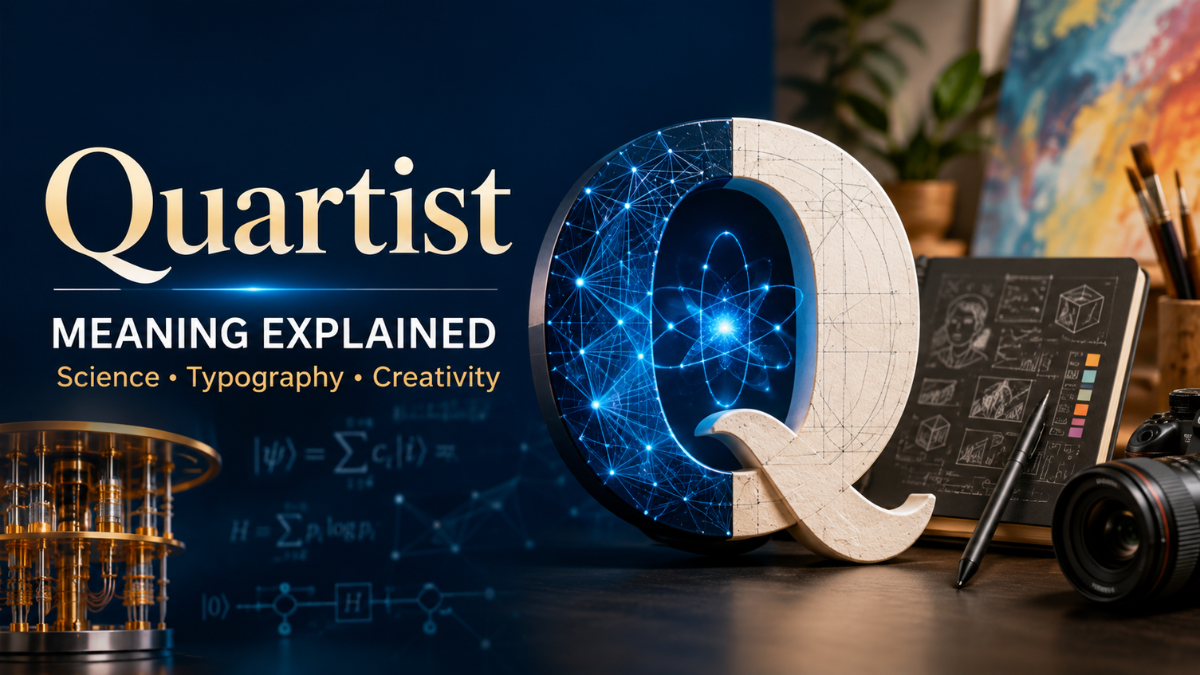
Quartist does not have one universally accepted meaning. Depending on the context, QuArtist can refer to a quantum artificial intelligence research center associated with Shanghai University, Quartist can refer to a serif typeface, or quartist may be used informally to describe a multidisciplinary creator working across art, technology, design, and other fields.
That distinction matters because someone searching for quartist meaning can encounter very different definitions. The scientific and typography uses can be tied to identifiable organizations or products, while the creative meaning is newer and less standardized. Understanding the context is therefore more useful than trying to force every use of the word into a single definition.
What Is Quartist in Simple Terms?
The simplest answer is that Quartist is a context-dependent term.
If you see QuArtist in a discussion about quantum physics, quantum computing, or Shanghai University, it most likely refers to the International Center of Quantum Artificial Intelligence for Science and Technology. If you find Quartist while searching for typography, logos, branding, or fonts, it may refer to the Quartist serif typeface. In newer creative discussions, the word can also function as an informal label for someone whose work combines several disciplines.
A quick comparison makes the difference clearer:
| Context | Meaning |
| Quantum science | QuArtist, a quantum artificial intelligence research center |
| Typography | Quartist, a serif typeface |
| Digital creativity | An emerging or informal multidisciplinary creative label |
The most important practical rule is simple: do not assume that every mention of Quartist describes an artist.
What Does the Word Quartist Mean?
There is no single definition that accurately covers every current use of the word.
The strongest institutional use is QuArtist, the name used by the International Center of Quantum Artificial Intelligence for Science and Technology. Shanghai University’s official QuArtist website describes the center as developing interdisciplinary research in quantum technologies.
A completely separate use exists in typography. GraphicSauce presents Quartist as a serif font designed for uses including display text, body text, brand identities, and logos.
The creative interpretation is less settled. One recent article from Tesseract Academy describes a quartist as someone working across multiple fields, usually four disciplines, but the same article also recognizes several interpretations, including a general multidisciplinary professional and a quantum-inspired creator.
That inconsistency is important. It suggests that “quartist” as a creative profession should currently be treated as developing terminology rather than a formally standardized occupational title.
Why Does the Capitalization Change?
Capitalization can provide a clue.
QuArtist, with the capital A, is the spelling used by the Shanghai University research center. Quartist appears as the name of the typeface. Lowercase quartist may also appear when writers use the term as a general creative label.
Capitalization alone cannot tell you the intended meaning, however. The surrounding words remain the strongest clue.
If a page mentions quantum sensing and simulation, think science. If it discusses typography and logo design, think font. If it talks about portfolios, storytelling, animation, or multidisciplinary art, the creative interpretation is more likely.
What Is QuArtist in Quantum Artificial Intelligence?
In a scientific context, QuArtist refers to the International Center of Quantum Artificial Intelligence for Science and Technology.
The center is associated with Shanghai University and focuses on interdisciplinary quantum research. Its published descriptions include quantum computing, quantum simulation, quantum communication, quantum sensing, and quantum artificial intelligence. Quantiki’s profile of the center also discusses bio-inspired and neuromorphic quantum information ideas.
This use of QuArtist is therefore very different from an artistic job title.
The center brings together areas of physics, computation, artificial intelligence, engineering, and quantum information. Its stated approach also emphasizes connecting scientific and technological ideas with broader interdisciplinary thinking.
What Is Quantum Computing?
Quantum computing uses principles of quantum mechanics to process information differently from conventional computers.
Traditional computers represent information using bits with values such as 0 and 1. Quantum computers use qubits, which can occupy richer quantum states and can make use of effects such as superposition and interference. These properties allow quantum algorithms to approach certain types of computational problems differently from classical algorithms.
That does not mean quantum computers are simply faster versions of normal computers.
For many everyday tasks, classical computing remains the practical choice. Quantum systems are being investigated for particular classes of problems where quantum methods may eventually provide useful computational advantages. IBM’s current overview similarly notes that quantum computing is not ideal for every problem and that practical workflows may combine quantum and classical resources.
How Does Artificial Intelligence Connect With Quantum Research?
Quantum artificial intelligence broadly explores relationships between quantum technologies and methods associated with AI, machine learning, optimization, or intelligent control.
This can involve several directions. Machine-learning techniques may help researchers control or analyze quantum systems, while researchers can also investigate whether quantum computational methods can contribute to certain learning or optimization problems.
The important distinction for general readers is that quantum AI is a research field, not simply ordinary generative AI running on a quantum computer.
When QuArtist appears in this context, it points toward this scientific intersection rather than toward digital illustration or creative software.
What Is the Quartist Font?
Quartist is also the name of a serif typeface.
GraphicSauce describes Quartist as an alternative to the New York font and positions it as a multipurpose serif suitable for display text, body copy, branding, and logos. Its description emphasizes a restrained, premium visual character rather than an extremely decorative appearance.
That makes the font potentially relevant to projects such as editorial layouts, premium brand identities, packaging, web headers, fashion-oriented graphics, beauty branding, and other designs where typography is expected to feel refined.
This does not mean it is automatically the right choice for every project.
A designer should still evaluate readability, text size, character coverage, brand personality, accessibility, and the devices on which the typeface will appear. A font that works beautifully as a large heading may perform very differently in a long mobile paragraph or an interface with small text.
The practical choice should therefore be based on the actual design environment rather than on the font’s luxury appearance alone.
Is the Quartist Font Free for Commercial Use?
Commercial use requires particular care.
GraphicSauce currently offers Quartist through several commercial license levels. Its licensing information distinguishes permissions for logos, self-hosted webfonts, social media, merchandise, publications, apps, software, games, film, and television. The scope changes depending on the license selected.
For example, the current Standard License permits specified logo, webfont, promotional, publication, social-media, and merchandise uses but excludes apps, software, games, film, and television. Higher license levels expand some of those permissions. The listed licenses currently have worldwide and perpetual scopes, subject to their individual restrictions.
The key lesson is more important than any individual license detail:
Access to a font file does not automatically mean unlimited commercial rights.
Before using Quartist in client work, merchandise, a website, software, a game, packaging, film, or another commercial setting, check the current license from the rights holder or seller.
Licensing can change over time, so an old blog post or download page should not replace the current license agreement.
Is Quartist Also a Modern Creative Identity?
In some recent online creative discussions, quartist is used as an informal label for multidisciplinary creators.
This is the meaning most likely to interest artists, designers, storytellers, filmmakers, animators, and creative technologists. It describes the idea that one person can build a creative identity across several connected disciplines rather than working exclusively within one medium.
The problem is that the exact definition is not standardized.
Tesseract Academy, for example, describes one interpretation as a person combining four disciplines, but it also identifies broader multidisciplinary and quantum-inspired interpretations. It further states that the term is not found in conventional dictionaries.
Available evidence therefore supports careful language such as:
A creative quartist can be understood as an informal or emerging label for a multidisciplinary creator who combines several artistic, technical, analytical, or storytelling skills into connected work.
It would be less accurate to say that every quartist must follow one officially recognized four-skill framework.
Is Quartist a Real Profession?
At present, it is more useful to treat Quartist as a possible creative identity than as a standardized profession.
Established professional descriptions already cover much of the same territory. Terms such as multidisciplinary artist, multimedia artist, digital artist, interdisciplinary creator, multidisciplinary designer, and creative technologist communicate recognizable kinds of work without requiring the audience to learn a new term first.
This does not make Quartist meaningless.
Artists and creative communities regularly develop new terminology to describe practices that cross traditional boundaries. A person may find Quartist useful because it captures a personal philosophy or a particular combination of disciplines.
The limitation is communication.
If a prospective client, employer, collaborator, or audience member does not understand the word, simply writing “Quartist” on a portfolio may create another question instead of explaining what the person does.
A practical approach is to combine the emerging label with a clearer professional description. For example, someone could describe themselves as a multidisciplinary digital artist and creative technologist and then explain that Quartist is the personal identity they use for work that crosses multiple disciplines.
What Skills Would a Creative Quartist Need?
There is no verified list of mandatory Quartist skills because the creative definition itself is not standardized.
A more useful approach is to think in terms of a core skill plus complementary capabilities.
Someone whose strongest discipline is illustration might add motion design and storytelling. A brand designer might add photography, animation, or 3D visualization. A filmmaker might combine editing, sound, visual effects, and interactive media. A technically minded creator might combine coding, data visualization, interface design, and visual storytelling.
The important part is integration.
Knowing ten unrelated software programs is not automatically multidisciplinary expertise. A stronger creative portfolio shows how different abilities work together to solve a problem, communicate an idea, or create a coherent experience.
This is where the theoretical image of a person who “does everything” meets practical reality.
Time and attention are limited. Every additional discipline has a learning curve. Trying to master illustration, animation, programming, photography, film, 3D modeling, AI tools, sound design, marketing, and writing simultaneously can leave a beginner with many surface-level skills but no strong foundation.
For most people interested in the creative Quartist concept, developing one strong primary discipline before adding complementary skills is the more practical path.
What Tools Can a Creative Quartist Use?
Tools should follow the project rather than define the identity.
A creative quartist might work with drawing software, cameras, editing programs, animation tools, 3D applications, coding environments, generative AI systems, augmented reality, virtual reality, or physical materials. Another creator may need only a drawing tablet, traditional materials, and video-editing software.
Neither approach is automatically more legitimate.
The important question is:
What does this tool allow the creator to communicate or build?
For example, 3D software may help an illustrator turn a flat concept into an environment. Motion tools can give a brand identity movement and timing. Coding can transform static information into an interactive experience. AI-assisted tools may support ideation or production when they fit the creator’s workflow.
Technology becomes meaningful when it serves the concept.
Collecting tools simply to appear technologically advanced creates complexity without necessarily improving the work.
How Can Someone Build a Quartist-Style Creative Career?
If the creative meaning of Quartist appeals to you, start with your work rather than your title.
First establish the area in which you want to be genuinely good. That might be illustration, design, writing, filmmaking, photography, animation, music, 3D art, interaction design, or another field.
Then add disciplines that strengthen that foundation.
A useful portfolio should show relationships between skills. Imagine a fictional product launch. Instead of creating only a logo, you might develop the visual identity, packaging concept, short animation, product imagery, and a digital campaign. One project then demonstrates several capabilities working toward the same objective.
That is more convincing than presenting unrelated exercises simply to prove that you know different software.
The next challenge is career positioning.
Because Quartist is not yet a widely standardized occupational label, searching only for jobs titled “Quartist” could unnecessarily narrow your opportunities. Search using familiar role descriptions that match your actual abilities, such as digital artist, multimedia designer, creative technologist, motion designer, visual designer, experience designer, or interdisciplinary artist.
You can still use Quartist as a personal concept if it accurately expresses how you think about your work.
Where Could Quartist Skills Be Used?
The multidisciplinary skills associated with the creative interpretation can be useful wherever projects require several forms of communication to work together.
In branding, a creator might connect identity design, typography, photography, illustration, and motion. In film and animation, the combination may include visual development, editing, sound, effects, and narrative thinking.
In games and interactive media, visual art can intersect with interface design, world building, narrative, animation, and technology. Cultural and educational projects may combine information design, physical exhibits, digital screens, interactive installations, or immersive experiences.
Social platforms can also give multidisciplinary creators room to combine still images, short video, sound, animation, and written storytelling.
The relevant opportunity is not that employers necessarily demand “Quartists.” It is that many modern projects benefit from people who understand how several creative disciplines connect.
Quartist vs Digital Artist: What Is the Difference?
A digital artist is generally understood as someone who creates art using digital tools or processes.
The emerging creative use of Quartist is broader and less precise. It may describe someone combining digital art with design, narrative, technology, analysis, physical media, or other disciplines.
A digital artist can therefore be multidisciplinary without calling themselves a Quartist, and someone using the Quartist identity may work in areas beyond digital art.
The main difference is not a formal professional boundary.
It is emphasis.
“Digital artist” identifies a recognizable mode of artistic production. “Quartist,” in its creative interpretation, emphasizes crossing or integrating disciplines.
Quartist vs Traditional Artist: Is There Really a Clear Divide?
It is easy to create an exaggerated comparison in which a traditional artist works with one medium while a Quartist uses many. That comparison is historically and practically weak.
Artists have crossed disciplines for centuries.
A painter can also be a sculptor. A photographer can make films. A musician can write, perform, design, and produce visual work. Multidisciplinary creativity did not begin with digital technology or with the word Quartist.
The useful distinction is therefore not old artist versus new artist.
It is whether a creator deliberately makes the interaction between several disciplines central to their identity and practice.
In that sense, the creative Quartist concept may provide a new label for a long-established way of working rather than introducing an entirely new form of creativity.
Common Misconceptions About Quartist
One common misconception is that Quartist has a single accepted definition. Current evidence shows at least three very different contexts: quantum research, typography, and emerging creative terminology.
Another misconception is that a creative Quartist must master exactly four disciplines. That is one interpretation presented in recent online writing, not a demonstrated universal standard. The same source discussing four disciplines also acknowledges alternative meanings.
It is also incorrect to assume that QuArtist is primarily an art movement. In scientific material, the name refers to the quantum artificial intelligence center associated with Shanghai University.
Finally, designers should not assume that obtaining the Quartist font gives them unrestricted rights. GraphicSauce’s current commercial licensing separates different uses and license levels.
How to Know Which Meaning of Quartist Someone Means
Look at the words immediately surrounding the term.
References to Shanghai University, physics, quantum computing, quantum sensing, quantum simulation, quantum information, or artificial intelligence research strongly point toward the QuArtist research center.
References to serif typefaces, branding, logos, webfonts, typography, merchandise, or font licensing point toward the Quartist font.
References to multidisciplinary art, creative identity, storytelling, digital media, technology, portfolios, or cross-disciplinary skills may indicate the newer creative interpretation.
When the context does not resolve the meaning, asking for clarification is better than guessing.
This is particularly important in academic writing, professional biographies, commercial licensing, and other situations where choosing the wrong interpretation can create a factual or practical error.
Should You Call Yourself a Quartist?
You can use Quartist as a personal creative identity if the term genuinely represents your way of working.
The question is whether it helps your audience understand you.
If you are creating an experimental portfolio or personal art brand, an unusual label may become part of your identity. If you are applying for jobs, attracting clients, or trying to explain your services quickly, a familiar professional title will often communicate more information immediately.
A useful compromise is to place the clearer title first.
For example, “Multidisciplinary Artist and Creative Technologist” immediately tells people something about the work. Quartist can then appear as the creator’s personal framework, philosophy, project name, or secondary identity.
That approach preserves individuality without asking every new visitor to decode an unfamiliar word.
What Is the Future of the Term Quartist?
The creative meaning of Quartist remains uncertain.
It could become more widely recognized if creators consistently adopt it and if professional communities begin using it with a reasonably stable meaning. It could also remain a niche label while established terms such as multidisciplinary artist and creative technologist continue to do most of the professional work.
At present, competing definitions are still visible. Tesseract Academy alone documents several interpretations rather than one settled meaning.
The underlying creative practices are more important than the label.
Digital storytelling, multidisciplinary design, interactive experiences, animation, creative technology, and AI-assisted workflows can continue evolving regardless of whether “Quartist” ultimately becomes a mainstream professional term.
That is the more useful way to think about its future: watch the practice and the language separately.
FAQs
What is Quartist?
Quartist is a context-dependent term. QuArtist is used by the International Center of Quantum Artificial Intelligence for Science and Technology associated with Shanghai University. Quartist is also a serif typeface, while some recent online writing uses “quartist” as an informal label for multidisciplinary creators.
What does Quartist mean in simple words?
It depends on where you found it. In quantum science it can mean a research center, in graphic design it can mean a font, and in creative discussions it may describe someone who combines several artistic or technical disciplines.
Is Quartist a real word?
The term is demonstrably used as a proper name, font name, and emerging creative label. However, the creative interpretation does not currently have one universally standardized definition. One recent source explicitly notes that its creative use is not a conventional dictionary term.
Is Quartist a profession?
There is not enough evidence to treat Quartist as a standardized professional occupation. In creative contexts, it is better described as an emerging or informal identity. More established terms include multidisciplinary artist, digital artist, multimedia artist, and creative technologist.
Is every Quartist an artist?
No. A reference to QuArtist may instead concern the Shanghai University quantum artificial intelligence research center, while another reference may concern the Quartist font. Context determines the intended meaning.
What does QuArtist stand for in quantum science?
QuArtist refers to the International Center of Quantum Artificial Intelligence for Science and Technology, which is associated with Shanghai University and interdisciplinary quantum research.
What does the QuArtist center research?
Published descriptions identify areas including quantum computing, quantum simulation, quantum communication, quantum sensing, quantum artificial intelligence, and related quantum-information research.
Is Quartist a font?
Yes. GraphicSauce currently offers Quartist as a serif typeface for uses including display typography, body text, brands, and logos.
Can the Quartist font be used commercially?
Yes, subject to the applicable commercial license. GraphicSauce currently offers multiple licensing levels with different permissions for uses such as logos, webfonts, merchandise, apps, games, publications, film, and television. Check the current license before starting a commercial project.
Does a creative Quartist need four skills?
Not necessarily. The four-discipline definition is one interpretation found in recent online content, not an established universal requirement. The same source also describes multidisciplinary and quantum-inspired interpretations.
What skills should a creative Quartist develop?
A sensible path is to become strong in one core creative discipline and then add complementary skills that improve the work. Depending on the person, those might include storytelling, design, animation, photography, 3D, coding, video, sound, or interactive media.
Is Quartist the same as a digital artist?
Not exactly. Digital artist is a more established description of someone producing art through digital processes. The emerging Quartist concept places greater emphasis on combining several disciplines, and some of those disciplines may not be exclusively digital.
Quartist Meaning: The Most Useful Takeaway
The most accurate way to understand Quartist is not to search for one definition and ignore everything else. The meaning depends on context.
QuArtist has a clearly documented scientific use through the International Center of Quantum Artificial Intelligence for Science and Technology associated with Shanghai University. Quartist also has an established use as the name of a serif typeface sold with defined commercial licensing options.
The idea of a quartist as a multidisciplinary creator is more fluid. Current sources describe it in different ways, so it should be presented as an emerging or informal creative identity rather than a universally recognized profession.
For researchers, the sensible next step is to follow official institutional and scholarly sources. For designers, it is to confirm the current font license before commercial use. For creators, the practical question is not whether they satisfy an invented definition of a Quartist, but whether combining disciplines improves their work and whether the term helps their audience understand what they do.
That contextual approach provides the clearest and most defensible answer to what Quartist means today.
You May Also Like Coomer.su

Wyvernity Team is a content writing team with 3 years of experience in creating clear, engaging, and SEO-friendly content for Wyvernity.com.