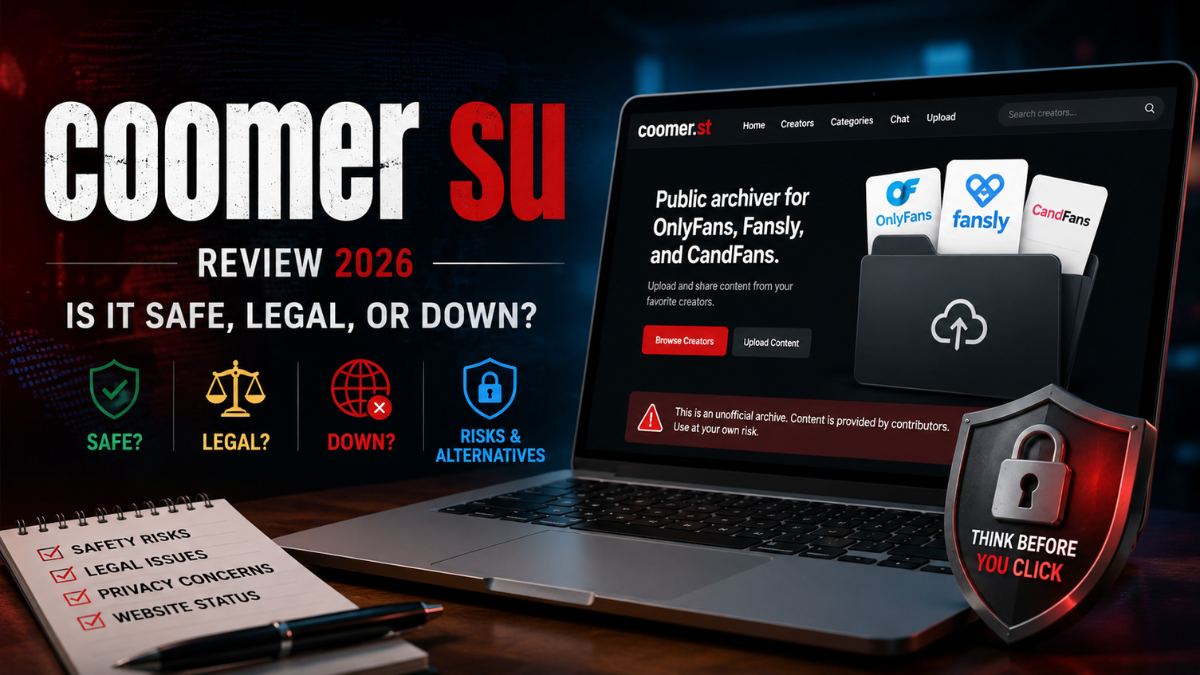
Coomer.su is no longer the normal active address for the Coomer adult-content archive. As of August 2026, the original .su domain remains registered but is listed as “REGISTERED, NOT DELEGATED,” while Coomer.st identifies itself as a public archiver for creator content from services including OnlyFans, Fansly, and CandFans.
The more important question is not simply whether Coomer still exists. Users searching for Coomer.su usually want to know whether the service is working, whether the new domain is legitimate, whether downloaded files are safe, and whether viewing or downloading archived subscription content creates copyright or privacy risks.
Those questions require different answers. A website being reachable does not make its files safe, and publicly accessible content is not automatically legally authorized for redistribution.
Updated: August 16, 2026
Coomer.su Quick Overview
| Detail | Current information |
| Original domain | Coomer.su |
| Current archive domain | Coomer.st |
| Website type | Public archive of adult creator content |
| Original domain registered | August 25, 2022 |
| Registration paid until | August 25, 2027 |
| Current .su WHOIS status | REGISTERED, NOT DELEGATED |
| Registrar | RUCENTER-SU |
| Public registrant | Private Person |
| Platforms named by current archive | OnlyFans, Fansly, CandFans |
| July 2025 migration evidence | Reported and incorporated into third-party software support |
| Malwarebytes classification of .su | Riskware |
| Main risks | Security, copyright, consent, privacy and unreliable availability |
| Is Coomer an official creator platform? | No evidence indicates that it is |
| Does public access prove permission? | No |
| Safest approach | Use authorized creator platforms and avoid untrusted downloads |
The original Coomer.su WHOIS record currently shows that the domain was created on August 25, 2022, is paid through August 25, 2027, uses RUCENTER-SU as registrar, and identifies its registrant only as “Private Person.” Most importantly, its status is REGISTERED, NOT DELEGATED.
What Was Coomer.su?
Coomer.su became known as a searchable archive for material associated with paid adult-creator platforms.
It was different from services such as OnlyFans or Fansly because it was not primarily a marketplace where creators created official storefronts, charged subscriptions, and received payments from users.
Instead, its purpose was to collect and organize material that originated elsewhere.
The current Coomer.st homepage describes the service as a public archiver for OnlyFans, Fansly and CandFans and says that contributors upload content to make it easier to search and organize.
That distinction matters.
A creator having a profile or material in an archive does not by itself prove that the creator:
- created the archive profile,
- uploaded the archived copy,
- approved its redistribution,
- receives money from archive visitors, or
- authorized public downloading.
Coomer is therefore better understood as an unofficial third-party content archive, rather than an alternative official subscription platform.
Is Coomer.su Still Working in 2026?
For practical purposes, users should not treat Coomer.su as the active Coomer website in 2026.
The domain has not expired. Its registration remains paid until August 25, 2027. However, WHOIS currently lists it as “REGISTERED, NOT DELEGATED.”
Registration and operation are separate things.
A registered domain can remain under someone’s control without functioning as a normal publicly reachable website.
What does “registered, not delegated” mean?
DNS delegation tells the wider internet which authoritative name servers are responsible for a domain.
When a domain is registered but not delegated, the important takeaway for an ordinary visitor is that ownership of the registration may continue even though the domain is not operating normally through public DNS.
It does not automatically prove that:
- the domain was seized,
- its owner abandoned it,
- law enforcement closed it,
- the registration expired,
- it is available for purchase, or
- one particular copyright complaint caused the change.
In Coomer.su’s case, the current WHOIS information explicitly shows that the registration remains active even though its status is not delegated.
Did Coomer.su Move to Coomer.st?
The available evidence strongly supports the conclusion that Coomer.st replaced Coomer.su as the primary address.
A July 27, 2025 issue in the widely used open-source gallery-dl project reported that Coomer.su had moved or redirected to Coomer.st. At the time, the change caused cookie and downloader compatibility problems because software still recognized the previous hostname.
More importantly, the current gallery-dl code now explicitly uses coomer.st as the root domain for its Coomer extractor. That provides stronger technical evidence than simply relying on old forum comments or unofficial mirror lists.
The current Coomer.st homepage also describes itself using the same archive concept associated with the old service.
The reasonable 2026 conclusion is therefore:
Coomer.st is the active successor address associated with the Coomer archive, while Coomer.su should be regarded as the former primary domain.
Why Did Coomer Change Domains?
There is not enough reliable public evidence to state one definitive reason.
It is tempting to say that copyright complaints, domain seizures, or legal pressure caused the migration; however, unless administrators or an authoritative legal record confirms that explanation, presenting it as fact would go beyond the evidence.
Domain changes for controversial archive services can potentially involve:
- infrastructure changes,
- hosting changes,
- DNS problems,
- registry issues,
- abuse complaints,
- copyright enforcement,
- security concerns,
- service restructuring,
- search or network blocking, or
- operational continuity during outages.
The evidence verifies that a domain change occurred. It does not establish a single documented cause.
That difference is important when evaluating claims from articles that state Coomer moved domains specifically “to evade legal action.” Such a motive may be possible, but it should not be reported as established fact without supporting evidence.
Is Coomer.st Working Right Now?
As of this review, the Coomer.st homepage is reachable and identifies the website as a public archiver.
That does not mean every creator profile, API request, image, or video will work reliably.
Third-party software projects have repeatedly documented connection and compatibility issues involving Coomer infrastructure. For example, a gallery-dl issue opened in April 2026 reported that Coomer worked in the user’s browser while automated connections were refused. Earlier migration-related issues also documented 403 and API problems after the switch to the .st domain.
These reports should be interpreted carefully. They show that users and software clients have experienced technical problems, but they do not prove the entire site is continuously offline.
A more accurate description is:
Coomer.st is currently reachable, but availability of individual functions and third-party access has historically been inconsistent.
Why can a homepage load while media fails?
Modern websites often split their infrastructure across several systems.
A service can have separate components for:
- HTML pages,
- search,
- user profiles,
- API data,
- image delivery,
- video delivery,
- authentication,
- anti-bot protection, and
- content storage.
A working homepage therefore proves only that the front-end page responded.
It does not prove that every underlying API or media server is functioning.
This is why users may see a normal website interface while a profile, image, video, or software integration returns an error.
Is Coomer.su Safe?
There is enough evidence to recommend caution rather than describing Coomer.su as safe.
Malwarebytes currently states that it blocks Coomer.su because the domain is associated with riskware. It says the platform has been abused to share malicious files.
However, an important distinction is often missed in articles about the site:
“Riskware” does not mean Malwarebytes has proven that every page or every downloaded file is malware.
Malwarebytes defines riskware more broadly as software or resources that may not be inherently malicious but can create other risks.
So the responsible conclusion is not:
“Every Coomer download contains a Trojan.”
There is no evidence supporting such a blanket statement.
The evidence supports the narrower conclusion that the old Coomer.su domain has been considered risky enough for Malwarebytes to block it and that malicious files have been associated with abuse of the platform.
Security risks users should consider
Archive and file-sharing environments can expose visitors to more than one type of risk.
Potential concerns include:
- malicious or misleading downloads,
- fake download buttons,
- executable files disguised as media,
- advertising redirects,
- phishing pages,
- browser-notification abuse,
- cloned domains,
- credential theft,
- unwanted software,
- tracking, and
- fake “Coomer” mirrors taking advantage of the site’s name.
The domain migration itself creates another practical risk: when users search for an old website that has moved, numerous look-alike domains can appear.
Do not assume a domain is legitimate simply because it includes the word “Coomer.”
Are Coomer Downloads Safe?
No third-party archive download should be treated as automatically safe.
A media filename ending in .jpg, .mp4, or another familiar extension can appear reassuring, but a visitor still has to trust several parties:
- whoever originally obtained the material,
- whoever submitted it,
- the archive infrastructure,
- any external file host involved,
- advertising or redirect systems, and
- the user’s browser and device security.
Malwarebytes’ warning concerning the old domain gives users an additional reason not to disable security software merely to force a download through.
If browser protection, antivirus software, or an operating system flags a download, overriding the warning without understanding the file is generally a poor security decision.
The safest option is not to download files from untrusted archives at all.
For creator content, authorized creator platforms provide a clearer chain of responsibility than third-party reposting sites.
Does Coomer Host Adult Content?
Yes. Coomer is associated specifically with adult creator material.
The current archive identifies OnlyFans, Fansly, and CandFans among the services whose material contributors archive.
Material may therefore include sexually explicit adult content and is not appropriate for minors or environments where adult material is restricted.
People should also consider privacy when accessing adult websites. Browser history, DNS requests, network monitoring, account activity, and downloaded files can leave records depending on the device and network being used.
The more serious issue, however, is not simply that the website contains adult material. It is that some archived content may have originated behind a subscription or other restricted-access system.
Is Coomer Officially Connected to OnlyFans or Fansly?
There is no reliable evidence showing that Coomer is an official product, partner,r or authorized archive operated by OnlyFans, Fansly,y or CandFans.
The service itself describes a contributor-based archiving model rather than an official creator marketplace.
Users therefore should not interpret a creator’s presence on Coomer as proof that the creator chose to publish there.
Official creator platforms and third-party archives operate under fundamentally different relationships.
On an official platform, a creator may decide:
- what to publish,
- who may access it,
- how much access costs,
- whether content is free or paid, and
- how the creator earns from the audience.
An unofficial archive can remove some or all of those controls if copies are redistributed outside the original platform.
Do Creators Get Paid When Their Content Is Viewed on Coomer?
There is no evidence of a standard system through which the creators whose material appears in the archive receive subscription revenue from people browsing archived copies.
That matters because paying a creator through an official platform and viewing an unauthorized copy elsewhere are economically different actions.
Official subscriptions, paid posts, and other authorized purchases can directly support the relevant creator under that platform’s payment structure.
Viewing a third-party copy does not automatically do so.
For users whose goal is simply to view a creator’s work while supporting that creator, the official account remains the clearer option.
Is Coomer Legal?
There is no single yes-or-no legal answer that applies worldwide.
Copyright, privacy, platform terms, intimate-image laws, and intermediary liability rules differ between jurisdictions.
However, there is an important copyright principle users should understand.
Under U.S. copyright law, copyright owners generally hold exclusive rights that include reproducing a protected work and distributing copies of it.
The U.S. Copyright Office also explains that uploading or downloading copyrighted works without the authority of the copyright owner can infringe reproduction or distribution rights.
That does not mean every file appearing on an archive is necessarily infringing.
A particular work could potentially be:
- uploaded by its rights holder,
- licensed for redistribution,
- distributed with permission,
- available under terms allowing sharing,
- in the public domain, or
- covered by a legal exception.
The legal status depends on the individual work, the authorization involved, and the applicable jurisdiction.
But when content originates from a paid subscription account, users should not assume public republication is authorized merely because a copy can be found online.
Does paying for OnlyFans content give you copyright ownership?
Generally, buying access to a digital work is different from acquiring the copyright to that work.
The U.S. Copyright Office specifically distinguishes ownership of a copy from ownership of the copyright embodied in that copy.
In practical terms, purchasing access to content does not automatically give someone permission to:
- repost it publicly,
- create a public mirror,
- distribute copies,
- resell it,
- upload it to another archive, or
- give thousands of other people unrestricted access.
Copyright ownership or redistribution rights normally require a separate legal basis.
Is Everything on Coomer Copyright Infringement?
It would be inaccurate to say that every archived item is automatically illegal.
Authorization is a factual question.
The U.S. Copyright Office recognizes situations in which copyrighted works may legally be used through permission, licensing, or statutory exceptions.
For example, a creator might intentionally distribute promotional material publicly.
A rights holder might permit redistribution.
Some works may be used under an applicable copyright exception.
But those possibilities do not justify assuming that an entire archive of material originally associated with paid creator accounts was authorized.
The more defensible rule for users is:
Accessibility is not evidence of permission.
If the archive does not provide clear provenance or licensing information for a particular item, the visitor usually cannot determine from the page alone whether its redistribution was authorized.
What About Creator Consent and Privacy?
Copyright is only one part of the issue.
Adult material raises separate questions involving consent and privacy.
The person depicted in content and the person who owns the copyright are not always legally the same person. For example, a photographer, production company,y or creator could hold particular rights depending on the circumstances.
Likewise, permission to create an image does not automatically answer every question about permission to redistribute it through a different service.
Users therefore should not assume that the existence of an archived creator profile proves that the depicted person:
- approved the archive,
- approved public redistribution,
- approved downloads,
- knows that every copy exists, or
- receives compensation.
Depending on the jurisdiction and circumstances, unauthorized distribution of intimate material can raise legal issues beyond ordinary copyright law.
Anyone dealing with a specific legal dispute should seek advice based on the relevant country or state rather than relying on a general website review.
Who Owns Coomer.su?
Public registration data does not identify a named individual or conventional company.
The current WHOIS record lists:
- Registrant: Private Person
- Registrar: RUCENTER-SU
- Created: August 25, 2022
- Paid through: August 25, 2027
- Status: REGISTERED, NOT DELEGATED
The raw record also contains a contact email using a kemono.ru domain. That may suggest some relationship with the broader Kemono archive ecosystem, but an email-domain relationship alone is not enough evidence to identify a legal owner, corporate structure, or management team.
The public record does not clearly establish:
- a legal operating company,
- named directors,
- a physical business headquarters,
- a publicly accountable management team, or
- a straightforward jurisdiction for customer disputes.
That lack of transparency is relevant when evaluating trust.
If a normal paid service mishandles an account or transaction, users generally expect identifiable terms, support procedures,s and a business operator.
An anonymous or pseudonymous archive provides fewer accountability signals.
Why Are Traffic Numbers for Coomer.su Confusing?
Search visibility, domain traffic,c and website availability are three different measurements.
A third-party SEO platform may continue displaying historical or modeled traffic for a domain even after its infrastructure changes.
For example, current Semrush data still contains traffic estimates and keyword information associated with Coomer.su.
That does not override the domain’s current WHOIS state.
Likewise, the Ranktracker material referenced in competing coverage reportedly shows approximately 10,500 visits for a Whois.com URL concerning Coomer.su, rather than verified traffic to the Coomer archive itself.
This is an important SEO distinction.
If an analytics report uses:
Exact URL: Whois.com/whois/coomer.su
then the reported organic visits belong to that Whois.com page.
They should not be rewritten as:
“Coomer.su has 10,500 monthly visitors.”
Those are different webpages on different domains.
Search-volume figures also need similar care.
A keyword tool estimating high monthly searches for “coomer su” indicates search demand for the phrase. It does not prove:
- how many people successfully reach the archive,
- how many downloads work,
- how many visitors are unique,
- whether the old domain is functional, or
- whether the service is safe.
Traffic estimates should therefore be treated as SEO indicators, not technical-health or security evidence.
Why Does Coomer Keep Appearing in Search If the Old Domain Changed?
People frequently keep searching for an old brand-domain combination after a website moves.
This happens because:
- users remember the old address,
- backlinks still contain the old domain,
- historical discussions use the old name,
- search engines retain indexed references,
- browser bookmarks remain unchanged,
- social posts continue circulating, and
- the old query becomes part of the service’s brand identity.
“Coomer.su” can therefore remain a popular search term even when .su is no longer the archive’s normal active address.
That also explains why WHOIS pages, troubleshooting articles, VPN pages, and alternative-site guides can rank for the query.
Search results for a domain name are not necessarily results from the domain itself.
Should You Use a Coomer.su Alternative?
Searching for a replacement mirror may solve one problem—access—but introduce several new ones.
An unofficial “Coomer alternative” can have the same or greater risks involving:
- unclear copyright authorization,
- fake domains,
- malicious advertisements,
- unsafe downloads,
- tracking,
- stolen credentials,
- copied branding, and
- unclear ownership.
For users whose real goal is accessing a particular creator’s material, the safer and more accountable alternative is the creator’s authorized page or official distribution channel.
That may include the creator’s official:
- OnlyFans profile,
- Fansly profile,
- website,
- social-media links,
- membership service, or
- other verified storefront.
This approach may require payment, but it also provides a clearer relationship between the viewer, platform, and creator.
A free mirror is not automatically a better alternative when security, authorization,n and creator consent are part of the decision.
How to Judge Sites Like Coomer More Safely
Instead of relying on claims such as “100% safe” or “official mirror,” evaluate an archive using several independent signals.
1. Check whether the operator is identifiable
Look for a real business entity, meaningful contact details, transparent policies, and clear responsibility for the service.
2. Separate domain registration from website availability
A registered domain can still be inactive.
DNS status and the current service address matter.
3. Treat security warnings seriously
A warning from established security software deserves investigation rather than automatic dismissal.
4. Do not assume browser access means files are safe
A webpage loading successfully says nothing about the safety of every file offered through it.
5. Look for authorization information
Ask whether the archive explains how it obtains permission to republish creator content.
6. Avoid confusing popularity with trust
Traffic, backlinks and keyword rankings measure visibility—not safety, legality or ethical practices.
7. Consider the original source
When the same content is available directly from its creator, the official source generally offers clearer ownership, payment and accountability.
Common Myths About Coomer.su
“Coomer.su expired.”
Not according to the current WHOIS record. It remains registered through August 25, 2027, although it is currently marked REGISTERED, NOT DELEGATED.
“Coomer disappeared completely.”
The old .su address is no longer the normal active domain, but Coomer.st currently presents itself as the Coomer public archiver.
“The domain moved because it was definitely seized.”
The migration is supported by evidence, but we did not find authoritative evidence proving a seizure was the specific cause.
“Malwarebytes says every Coomer file is malware.”
No. Malwarebytes classifies the old domain as riskware and says the platform has been abused for malicious file sharing. That is a serious warning, but it is not the same as saying every file is infected.
“If I paid for a post, I own it.”
Buying access to a copy or digital work does not automatically transfer copyright ownership.
“If something is publicly downloadable, sharing it must be legal.”
Public accessibility alone does not prove that reproduction or distribution was authorized. Copyright owners generally retain important reproduction and distribution rights.
FAQs
Is Coomer.su down in 2026?
The original Coomer.su domain should no longer be considered the normal active archive address. Its registration remains valid, but WHOIS currently labels it REGISTERED, NOT DELEGATED.
What happened to Coomer.su?
Evidence from July 2025 shows that the service transitioned from Coomer.su to Coomer.st, and current third-party software supporting Coomer now uses the .st domain.
Is Coomer.st the new Coomer.su?
Available evidence strongly supports that conclusion. The current .st homepage uses the Coomer identity and describes the same type of public creator-content archive.
Is Coomer.su safe?
It should not be described as demonstrably safe. Malwarebytes blocks the old domain because of its association with riskware and says the service has been abused to share malicious files.
Is Coomer.st safe?
The fact that Coomer.st is reachable does not independently establish the safety of every file, ad, redirect, or third-party resource associated with the service. Users should apply the same caution they would to any unofficial archive offering downloadable material.
Is Coomer legal to use?
That depends on jurisdiction and what the user does. Simply describing the entire website as either “legal” or “illegal” oversimplifies the issue. Copyright authorization, reproduction, downloading, redistribution,n and privacy laws can all matter. In the United States, copyright owners generally control reproduction and distribution of protected works.
Does Coomer contain OnlyFans content?
The current Coomr.st homepage identifies OnlyFans as one of the creator services whose material is archived, alongside Fansly and CandFans.
Is Coomer affiliated with OnlyFans?
We found no reliable evidence demonstrating that Coomer is an official OnlyFans service or authorized companion platform.
Can creators request content removal?
Removal procedures can change and should be verified directly against the service’s current published policies. A site’s availability of takedown procedures also does not by itself establish that every archived upload was originally authorized.
Does downloading content mean I own it?
No. Possession of a copy and ownership of copyright are legally distinct concepts.
Why does “coomer su” still receive searches?
Users remember the original domain name, while historical backlinks, discussions, bookmarks, and search-engine listings continue referring to it. Search demand can remain long after a website changes domains.
How This Review Was Verified
This review deliberately separates current evidence from speculation.
For the 2026 status of Coomer.su, the domain’s current WHOIS record was checked. It confirms the registration date, paid-through date, registrar, private registrant, and REGISTERED, NOT DELEGATED status.
For the current archive identity, the Coomer.st homepage was checked and currently identifies the service as a public archiver for OnlyFans, Fansly,y and CandFans content.
For the migration, public development records from gallery-dl were reviewed. The project documented the .su to .st change in July 2025, and its current code uses Coomer.st as the Coomer root domain.
For the security assessment, Malwarebytes’ current threat entry was used rather than relying solely on blogs repeating the warning. Malwarebytes states that it blocks Coomer.su because it is associated with riskware and has been abused for malicious file sharing.
For copyright principles, information from the U.S. Copyright Office was used. Its guidance distinguishes owning a copy from owning copyright and explains the copyright owner’s reproduction and distribution rights.
We did not download adult files, attempt to bypass security controls, test leaked media, or assume that individual archived items were uploaded without permission. Those conclusions would require evidence about the specific files involved.
Final Verdict
Coomer.su is effectively no longer the primary working address for the archive in 2026. The domain remains registered through August 25, 2027, but its current WHOIS status is REGISTERED, NOT DELEGATED. Coomer.st now presents itself as the active public archiver associated with the service.
On security, users should be cautious. Malwarebytes continues to classify the old .su domain as riskware and states that the platform has been abused to distribute malicious files. That warning does not prove every file is malicious, but it provides a legitimate reason not to treat downloads from the ecosystem as inherently trustworthy.
On legality, the answer depends on the content, authorization, use activity, ty and jurisdiction. Public availability does not automatically grant redistribution rights. Copyright owners generally retain control over reproduction and distribution, while possession of a purchased or downloaded copy does not itself transfer copyright ownership.
You May Also Like Mansutfer

Wyvernity Team is a content writing team with 3 years of experience in creating clear, engaging, and SEO-friendly content for Wyvernity.com.