
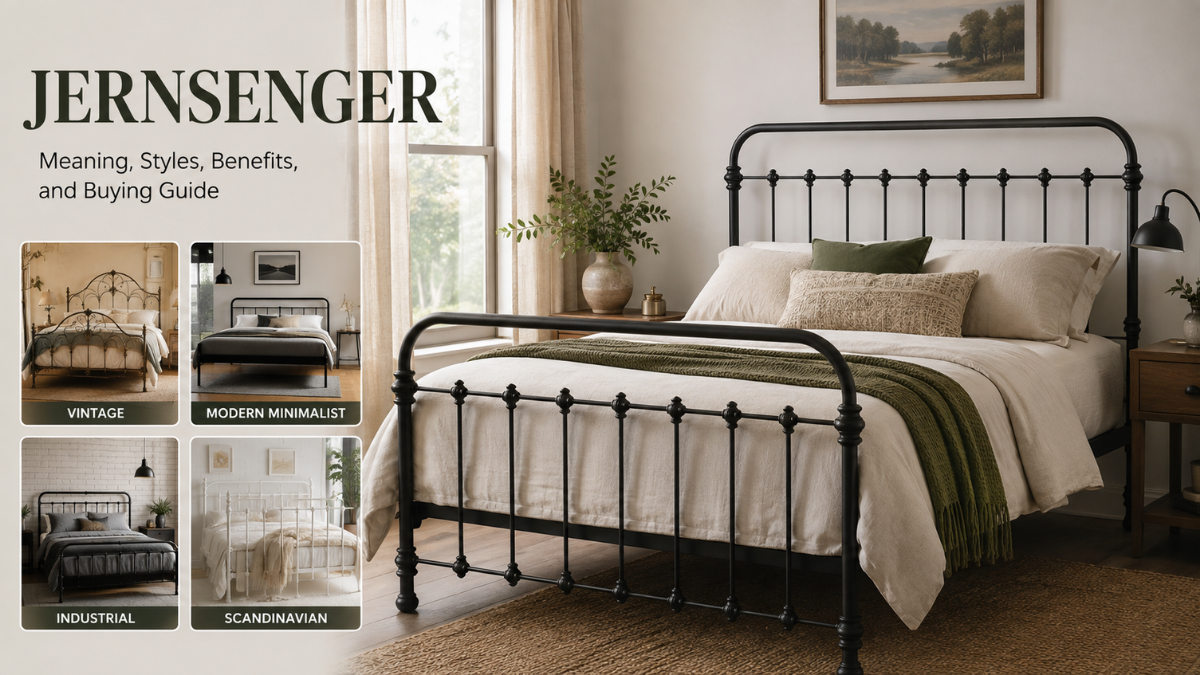
Jernsenger means iron beds in Norwegian. The singular word jernseng refers to a bed made from iron, while jernsenger is used for multiple iron beds. The term is increasingly appearing in English-language interior design searches, where it usually describes traditional or Scandinavian-inspired metal bed frames.
One linguistic detail is worth correcting at the outset: although jernseng exists in both Norwegian and Danish, jernsenger is specifically the Norwegian plural form. The Danish plural is jernsenge. The Norwegian Academy Dictionary defines jernseng simply as a “bed of iron,” while the Danish dictionary defines it as a bed with an iron frame.
Today, jernsenger can refer to everything from ornate vintage iron bedsteads to clean-lined steel frames inspired by Scandinavian and industrial interiors. Their appeal comes from a combination of durability, relatively simple maintenance, open visual design, and the ability to work with many decorating styles.
What Does Jernsenger Mean?
The easiest definition is:
Jernsenger are iron or metal-framed beds. Jern means iron, while seng means bed. Jernseng is singular, and jernsenger is plural in Norwegian.
This distinction matters because some recent online explanations describe “jernsenger” broadly as both a Norwegian and Danish plural. That is not quite accurate.
The Danish dictionary lists jernseng with the inflection -en, -e, -ene. In other words:
| Language | Singular | Indefinite plural | Meaning |
| Norwegian | jernseng | jernsenger | iron bed/iron beds |
| Danish | jernseng | jernsenge | iron bed/iron beds |
The Danish definition specifically describes a jernseng as a bed with an iron frame.
So, if you encounter jernsenger in an English furniture article or search result, the safest interpretation is Norwegian for iron beds, with the broader design concept extending naturally to Nordic metal-bed styles.
Where Do Jernsenger Come From?
Iron has been incorporated into beds for centuries, but metal bedsteads became especially visible as manufactured household furniture during the nineteenth century.
Historical evidence provides a more reliable picture than treating every modern “Scandinavian iron bed” as part of one continuous design tradition. The Metropolitan Museum of Art, for example, holds an illustrated catalogue of English-made brass and iron bedsteads dating from approximately 1880–1900, demonstrating that iron beds were an established manufactured furniture category by the late nineteenth century.
Industrial manufacturing made it increasingly practical to produce standardized metal furniture components. Iron beds could range from simple institutional-looking frames to highly decorative bedsteads with elaborate cast details.
This history also explains why today’s jernsenger can look so different from one another. An ornate Victorian-style frame and a minimalist black steel bed may share the same basic material concept without belonging to the same historical design tradition.
That distinction is useful when shopping. “Jernseng” describes the type of bed more reliably than it describes one specific style.
What Does a Modern Jernseng Look Like?
There is no single design that every jernseng must follow.
Modern iron and steel beds typically use an open headboard and sometimes an open footboard constructed from vertical rods, tubes, curves, or geometric metal sections. The frame may be supported by metal rails, wooden slats, metal slats, or a platform-style base.
Four broad styles are particularly common.
Classic Wrought-Iron Style
These beds use curved lines, rounded posts, decorative finials, scrollwork, or other traditional details.
They work particularly well in cottage, vintage, farmhouse, romantic, and traditional bedrooms.
Many products marketed today as “wrought-iron style” are not necessarily constructed from traditionally hand-forged wrought iron, so check the manufacturer’s material specification rather than relying on the appearance or product name.
Modern Minimalist Jernsenger
Minimalist versions remove most decorative elements.
Expect straight lines, slim posts, restrained headboards, and finishes such as black, white, cream, or muted metallic tones.
This is the version most naturally associated with contemporary Scandinavian-inspired interiors because the frame provides structure without visually dominating the room.
Industrial Metal Beds
Industrial designs tend to emphasize the material rather than disguise it.
Common features include darker finishes, square tubing, exposed-looking joints, thicker rails, and simple geometric headboards.
These frames pair naturally with timber furniture, brick, concrete, leather, and neutral textiles.
Canopy and Four-Poster Iron Beds
A metal four-poster bed extends the frame upward from each corner, sometimes connecting the posts to form a canopy.
It can create a strong architectural focal point, but dimensions matter. A tall frame that looks balanced in a showroom can overwhelm a bedroom with a low ceiling or limited floor space.
Always check total height as well as mattress dimensions before buying one.
Jernsenger vs. Wooden Beds
Neither material is automatically better. The right choice depends on construction quality, room design, climate, budget, and how you intend to use the bed.
| Factor | Jernsenger / Metal Beds | Wooden Beds |
| Main material | Iron or, commonly today, steel | Solid or engineered wood |
| Visual profile | Often slim and open | Can be slim or visually substantial |
| Termite risk | Metal itself cannot be eaten by termites | Wood can be vulnerable |
| Moisture concern | Corrosion if finish is damaged | Swelling, warping, staining, or decay can occur |
| Weight | Varies considerably | Varies by wood and construction |
| Noise | Loose metal joints can squeak | Loose wooden joints can also creak |
| Style | Industrial, vintage, minimalist, traditional | Modern, rustic, traditional, luxury and more |
| Repair concerns | Coating, welds, bolts, bent components | Joints, cracks, veneer, slats and finishes |
Claims that all metal beds are stronger, lighter, cheaper, or longer-lasting than wooden beds are too broad.
A well-constructed hardwood bed may outperform a poorly made lightweight steel frame. Similarly, a properly coated and assembled metal frame can provide decades of service.
Construction quality matters more than material alone.
Benefits of Jernsenger
Strong Structural Potential
Iron and steel can provide excellent structural strength without requiring very bulky components.
That allows manufacturers to create relatively slender frames while maintaining substantial load-bearing capacity. Actual strength, however, depends on tubing thickness, welds, joints, center support, slats, and overall engineering.
Do not judge strength simply by how “heavy-duty” a bed looks.
Resistant to Wood-Destroying Pests
Termites and wood-boring insects cannot consume an iron or steel frame.
This can be a meaningful advantage in environments where wood pests are a concern. However, mattresses, wooden slats, flooring, and nearby furniture may still contain materials vulnerable to pests.
So “pest resistant” is more accurate than describing an entire bed setup as universally pest-proof.
Visually Light Design
One of the most practical advantages of many jernsenger is visual rather than structural.
An open metal headboard allows the wall to remain visible through the frame. Compared with a large upholstered or solid-panel headboard, this can make a small bedroom feel less crowded.
It does not physically create additional space, but it can reduce visual weight.
Relatively Simple Cleaning
Most powder-coated or painted metal frames can be maintained with routine dust removal and appropriate gentle cleaning.
There are fewer broad porous surfaces than on many upholstered beds, although decorative scrollwork and narrow joints can collect dust.
Broad Styling Flexibility
A simple black jernseng can move between several decorating styles without replacing the bed itself.
Change crisp white linen for patterned quilts and the room can become more traditional. Pair the same frame with neutral bedding, pale wood, and simple lighting, and it becomes more Scandinavian-inspired.
That flexibility can extend the useful design life of the furniture.
Disadvantages of Jernsenger
Iron beds also have limitations that should be considered before purchasing.
Rust and Corrosion
Iron is vulnerable to corrosion when exposed to moisture and oxygen without adequate protection. The Danish dictionary’s entry for jern also notes that iron rusts when it is not protected from moisture.
Modern powder coating, paint, plating, and other protective finishes substantially reduce this risk, but scratches and chips can expose the underlying metal.
Humidity therefore deserves extra consideration.
Squeaking Can Develop
A metal bed is not inherently noisy.
Squeaking commonly develops when joints loosen, components rub against one another, the frame is assembled incorrectly, or the floor beneath it is uneven.
A well-designed and correctly assembled frame should remain stable. Periodically checking fasteners can help prevent noise from developing.
Some Frames Are Heavy
Traditional cast-iron components can be extremely heavy. Modern tubular steel beds may be much lighter.
This is another reason not to assume that every product described as an “iron bed” has identical properties.
If you move frequently, check the assembled weight, number of components, and assembly method before purchasing.
Metal Can Feel Visually Cold
A room containing dark metal furniture, hard flooring, bare walls, and cool lighting can feel austere.
Fortunately, this is primarily a styling issue.
Wooden bedside tables, rugs, linen bedding, curtains, wool throws, plants, and warm lighting can soften the appearance without hiding the metal frame.
How to Choose a Jernseng Bed
The best jernseng is not necessarily the heaviest or most decorative one. It is the frame that properly supports your mattress, fits your room, remains stable, and suits your maintenance expectations.
Check the Exact Mattress Size
Start with the mattress rather than the appearance of the frame.
Confirm its:
- width
- length
- depth
- required support type
- permitted slat spacing
Mattress sizes can vary between countries and manufacturers. This becomes particularly important when purchasing an antique or imported bed.
Never assume an older “double” frame matches a modern standardized double mattress.
Examine the Support System
The headboard gets most of the visual attention, but the mattress-support system matters more for everyday performance.
Look for adequate slats, secure side rails, and appropriate center support on larger beds.
Check the mattress manufacturer’s requirements as well. Excessive slat gaps or an unsuitable base can affect support and may conflict with warranty conditions.
Inspect Joints and Connections
A bed can use strong metal and still perform poorly if its connections are weak.
For bolt-together frames, check whether components fit firmly without excessive movement.
For welded frames, inspect accessible welds for obvious gaps, cracking, or poor finishing.
Once assembled, the bed should not noticeably rock when moderate pressure is applied from different directions.
Check the Finish
Powder coating and quality painted finishes create a barrier between the metal and its environment.
Look carefully at corners, welds, bolt holes, and other areas where coatings can be damaged.
On second-hand frames, distinguish deliberate distressed finishing from active corrosion.
Verify Weight Capacity
Do not assume that “iron” automatically means unlimited strength.
Use the manufacturer’s stated load capacity where one is provided and remember that the bed must support the mattress as well as its occupants.
Measure the Entire Room
Mattress dimensions tell you only part of the story.
Measure the frame’s full exterior width and length, headboard height, footboard height, and under-bed clearance.
For a canopy jernseng, also measure the ceiling and check the position of fans and light fixtures.
How to Style Jernsenger Without Making a Bedroom Feel Cold
The most reliable styling approach is contrast.
Metal provides hard lines and a smooth structural surface. Pairing it with softer or warmer materials prevents the room from becoming visually severe.
For a Scandinavian-inspired bedroom, consider white or muted bedding, light timber furniture, linen or cotton textiles, a textured rug, restrained decoration, and warm ambient lighting.
A black iron bed against an off-white wall creates strong contrast while remaining simple.
For a more traditional bedroom, use quilts, patterned cushions, warmer timber, antique-inspired lighting, or brass details.
Industrial rooms can use darker metal alongside reclaimed-looking timber, brick, concrete, and textured fabrics.
The important principle is balance. You do not need every piece of furniture to match the bed.
How to Maintain an Iron Bed
Maintenance is straightforward when the protective finish remains intact.
Dust the frame regularly with a soft cloth or suitable vacuum attachment. When deeper cleaning is necessary, follow the manufacturer’s instructions and avoid leaving moisture sitting on the metal.
Every few months, or whenever movement or noise develops, inspect the major fasteners.
Tighten loose connections according to the assembly instructions rather than overtightening them.
Pay particular attention to scratches or chipped coatings. Exposed iron can begin corroding in humid conditions, so damaged protective finishes should be addressed before rust spreads.
Floor protectors are also useful. Appropriate pads or glides can reduce scratching and may improve stability on hard floors.
Are Antique Jernsenger Worth Buying?
An antique iron bed can provide character that is difficult to reproduce with mass-produced furniture, but buying one requires more inspection than purchasing a new frame.
Start with dimensions.
Historical bed frames do not necessarily correspond to today’s mattress standards. Measure the internal mattress area, not merely the outside dimensions.
Next, inspect the structure for corrosion, missing hardware, bent rails, damaged cast components, questionable repairs, and unstable joints.
Surface rust can be very different from deep corrosion affecting structural integrity.
Also consider restoration costs before deciding whether an inexpensive vintage frame is actually a bargain.
A bed requiring specialist metal repair, replacement rails, refinishing, and a custom mattress can become substantially more expensive than its purchase price suggests.
Common Myths About Jernsenger
One misconception is that jernsenger are exclusively a Scandinavian furniture style.
The word is Norwegian, but iron bedsteads have a much broader history. Surviving nineteenth-century commercial material documents English-made brass and iron bedsteads, for example.
Another misconception is that metal beds never develop problems.
They can rust, loosen, squeak, bend, or suffer coating damage. Their durability depends heavily on construction and maintenance.
A third is that iron beds are always extremely heavy. Traditional cast-iron beds may be, while contemporary tubular-steel frames can be comparatively light.
Finally, jernseng should not be treated as a recognized technology, business methodology, or digital collaboration framework. Authoritative Norwegian and Danish dictionary evidence identifies jernseng as a bed made from or framed in iron.
Who Should Choose a Jernseng?
A jernseng is particularly worth considering if you want an open-looking bed frame, prefer metal over upholstered furniture, are concerned about wood-destroying pests, or want a design capable of moving between minimalist, vintage, industrial, cottage, and Scandinavian-inspired interiors.
It can also make sense in a smaller room where a thick upholstered headboard or large wooden structure feels visually overwhelming.
A metal bed may be less suitable if you strongly prefer the warmth of natural timber, live in a highly humid environment and do not want to monitor the finish, need an unusually lightweight frame for frequent moving, or dislike exposed metal as a design material.
There is no universally superior choice between iron and wood. Match the material to the environment and the way the bed will actually be used.
FAQs
What does jernsenger mean?
Jernsenger means “iron beds” in Norwegian. The singular form is jernseng, meaning a bed made from iron.
Is jernsenger a Danish word?
Jernseng is also a Danish word, but there is an important grammatical difference. The Danish dictionary gives its plural as jernsenge, whereas jernsenger is Norwegian.
Are jernsenger made from real iron?
Not always. Historical examples may use cast or wrought iron, while many contemporary “iron-style” beds use steel tubing or other metal construction. Check the product specifications if the exact material matters to you.
Are iron beds stronger than wooden beds?
Not automatically. Both materials can produce extremely durable beds. Frame engineering, material thickness, joints, slats, center supports, manufacturing quality, and maintenance are more useful indicators than material alone.
Do jernsenger squeak?
They can, particularly when bolts loosen or components begin rubbing together, but squeaking is not an unavoidable feature of metal beds. Proper assembly, stable flooring, suitable hardware, and periodic tightening can reduce noise.
Can jernsenger rust?
Yes. Unprotected iron can rust when exposed to moisture. Protective paint, powder coating, plating, and prompt treatment of damaged areas help reduce corrosion.
Are jernsenger suitable for small bedrooms?
Often, yes. Open headboards and slim metal profiles can reduce visual bulk compared with large solid or upholstered beds. Measure the actual external dimensions, however, because visual lightness does not necessarily mean a smaller footprint.
Can an old iron bed use a modern mattress?
Sometimes, but never assume it will. Antique and imported frames may use dimensions that differ from current mattress standards. Measure the internal sleeping area before purchasing either the bed or mattress.
Final Thoughts on Jernsenger
Jernsenger are, at their core, iron beds, not a mysterious new furniture category. The Norwegian term describes a practical type of bed that can take many forms, from decorative traditional bedsteads to streamlined modern steel frames.
Their strongest advantages are structural potential, resistance to wood-destroying pests, relatively straightforward maintenance, and an open design that can work across several interior styles. Their weaknesses are equally important: poorly protected metal can corrode, loose joints may become noisy, some frames are difficult to move, and older beds may not fit modern mattresses.
The best buying decision therefore comes down to more than choosing iron over wood. Check the frame construction, mattress support, dimensions, joints, protective finish, stated load capacity, and availability of replacement hardware.
Choose well, maintain the finish, and balance the hard metal structure with comfortable textiles and warmer materials. A good jernseng can then serve as both a practical bed and a long-lasting visual feature rather than simply another furniture trend.
You May Also Like Antarvwsna

Wyvernity Team is a content writing team with 3 years of experience in creating clear, engaging, and SEO-friendly content for Wyvernity.com.