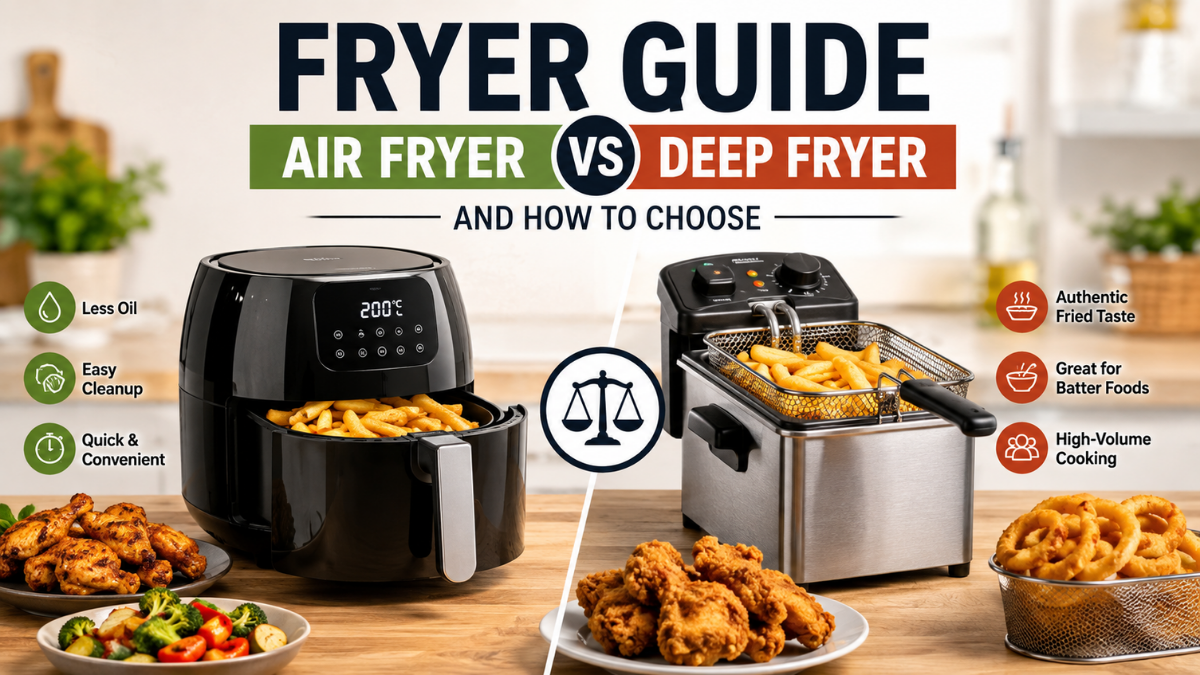
A fryer is a cooking appliance or utensil designed to cook food using hot oil, heated air, or another high-temperature frying method. For most home buyers today, the real decision comes down to an air fryer or deep fryer.
An air fryer is usually the better choice if you want quick everyday cooking, less oil, easier cleanup, and crispy foods without fully submerging them in fat. A deep fryer makes more sense when traditional fried texture, wet batter, high-volume frying, or maximum crunch matters more than oil consumption and cleanup.
Neither type is automatically “better.” The right fryer depends on what you cook, how many people you feed, how much counter space you have, and what kind of results you expect.
What Is a Fryer?
A fryer is equipment designed primarily for frying food. Traditional fryers heat cooking oil so food can be partially or completely surrounded by hot fat. Newer appliances, particularly air fryers, achieve browning and crispness by rapidly circulating heated air around the food.
This distinction matters because air frying and deep frying are not simply two versions of exactly the same process.
In a deep fryer, food is submerged in hot oil. The oil transfers heat quickly over the food’s surface, helping create the distinctive crust associated with fried chicken, French fries, doughnuts, battered fish, samosas, pakoras, onion rings, and similar foods.
An air fryer works more like a compact, high-powered convection oven. A heating element warms the air while a fan circulates that hot air rapidly through a relatively small cooking chamber. The resulting airflow promotes browning and surface crisping without requiring the food to sit in a large volume of oil.
The word “fryer” can also describe commercial and industrial equipment, including pan fryers, pressure fryers, continuous fryers, vacuum fryers, stir fryers, and automated frying systems. For a typical household, however, air fryers and electric deep fryers are the two most relevant categories.
Air Fryer vs Deep Fryer: What Is the Difference?
The biggest difference is the cooking medium.
A deep fryer transfers heat primarily through hot oil. An air fryer transfers heat primarily through rapidly moving hot air.
That changes not only how much oil is required but also texture, cooking behaviour, cleanup, safety considerations, and the foods each appliance handles best.
| Factor | Air Fryer | Deep Fryer |
|---|---|---|
| Main cooking method | Rapid hot-air circulation | Food submerged in hot oil |
| Oil required | Little or sometimes none | Large quantity |
| Texture | Crisp and browned | Traditionally fried and very crisp |
| Best for | Fries, chicken pieces, vegetables, reheating, roasting | Battered foods, doughnuts, fried chicken, fries, onion rings |
| Wet batter | Usually unsuitable | Excellent |
| Cleanup | Generally easier | More involved |
| Cooking smell | Usually lower | Usually stronger |
| Countertop mess | Relatively limited | Oil splatter and handling required |
| Oil storage/disposal | Minimal | Required |
| Small everyday meals | Very convenient | Less convenient |
| Traditional deep-fried result | Similar for some foods, not identical | Best match |
| Safety concern | Hot surfaces and electrical overheating | Very hot oil, burns and grease fires |
The practical takeaway is simple: choose an air fryer primarily for convenience and low-oil cooking. Choose a deep fryer primarily for authentic deep-fried texture and batter performance.
How Does an Air Fryer Work?
An air fryer contains an electric heating element and a powerful fan. Once the heating element reaches the selected temperature, the fan circulates hot air rapidly around food placed inside a basket or cooking chamber.
The compact chamber is important. Because there is much less interior space to heat than in a full-sized oven, an air fryer can often reach cooking temperature quickly.
Hot airflow removes moisture from the food’s surface while heat promotes browning. A light coating of oil can improve browning and crispness, but food does not need to be submerged.
This makes air fryers particularly effective for foods with relatively dry surfaces, including potatoes, breaded chicken, frozen snacks, vegetables, chicken wings, fish fillets, and foods being reheated.
An air fryer should therefore be understood as a small convection cooking appliance, rather than a literal replacement for deep frying in every situation.
How Does a Deep Fryer Work?
A deep fryer heats a reservoir of oil, commonly to temperatures in the region used for deep-fat frying, and holds the oil near the selected temperature while food cooks.
When food enters the hot oil, heat moves rapidly from the oil into its surface. Moisture near the surface turns into steam while browning develops on the exterior.
The United States Department of Agriculture describes deep-fat frying as cooking food by submerging it in extremely hot oil until it reaches a safe internal temperature. It also warns that oil used for deep frying can exceed 400°F and can cause serious burns or fires if handled incorrectly.
Temperature stability is one of the most important characteristics of a good deep fryer. When cold or frozen food is added, the oil temperature falls. A fryer with adequate heating power can recover relatively quickly, helping prevent greasy or uneven results.
Capacity matters for the same reason. Overloading a deep fryer can reduce oil temperature, promote uneven cooking, and potentially cause oil to overflow. USDA guidance specifically advises against overcrowding a frying basket.
Which Fryer Produces Crispier Food?
For traditional fried food, a deep fryer generally produces the more authentic result.
Foods such as battered fish, doughnuts, tempura-style dishes, pakoras, fried chicken with wet coatings, and onion rings benefit from direct contact with hot oil. Air circulation cannot perfectly reproduce the way a liquid cooking medium transfers heat around an irregularly shaped batter.
Air fryers can nevertheless produce excellent crispness with breaded foods, potatoes, chicken wings, roasted vegetables, frozen snacks, and reheated fried foods.
The key is to have realistic expectations.
An air-fried potato can become highly crisp. Air-fried breaded chicken can develop a convincing crunchy coating. Reheated pizza or fried food may also become far crispier than it would in a microwave.
A dripping wet batter, however, can fall through an air-fryer basket before it sets. That is a cooking-method limitation, not evidence that the appliance is defective.
If your definition of a good fryer is “makes everyday foods browned and crispy with little oil,” an air fryer is probably the stronger fit.
If your definition is “reproduces restaurant-style deep-fried food,” a deep fryer has the advantage.
Is an Air Fryer Healthier Than a Deep Fryer?
An air fryer can reduce the amount of added cooking oil because food does not need to be immersed in fat. That can make it easier to prepare certain foods with less added fat than conventional deep frying.
But the appliance alone does not determine whether a meal is healthy.
Air-frying vegetables, potatoes, fish, or minimally processed ingredients is very different nutritionally from repeatedly cooking highly processed frozen snacks simply because the package says they are suitable for an air fryer.
The better question is therefore not simply “Is an air fryer healthy?”
It is: Will buying an air fryer help you cook the foods you want using less added oil and a cooking method you will actually use regularly?
For many households, the answer is yes.
There is also frequent discussion about PFAS and non-stick air-fryer coatings. This subject needs careful wording. The U.S. Food and Drug Administration explains that some PFAS are authorized in the manufacture of non-stick cookware coatings. According to the FDA, these coatings are polymerized and tightly bound during manufacture, and available studies show a negligible amount of PFAS capable of migrating from these coatings into food.
Buyers who still prefer to avoid conventional non-stick food-contact surfaces can look for stainless steel, glass, ceramic-coated, or explicitly PFAS-free cooking components. Regardless of material, follow the manufacturer’s care instructions and replace damaged components when necessary.
Does an Air Fryer Use Less Electricity Than an Oven?
It often can for small meals, but not in every situation.
A useful 2026 comparison from Which? tested an air fryer against a built-in electric oven when cooking several foods. For a roughly 1.3 to 1.4 kg roast chicken, the tested air fryer used 0.54 kWh while the built-in oven used 1.157 kWh. For 320 g of frozen chips, the air fryer used 0.287 kWh compared with 0.863 kWh for the oven.
Those results illustrate why air fryers can be efficient: you are heating a smaller cooking cavity for a relatively short period.
But capacity changes the equation.
If dinner requires three consecutive air-fryer batches while an oven could cook everything simultaneously, the air fryer’s apparent efficiency advantage may shrink or disappear. Which? reached a similar conclusion, noting that energy savings decline when several batches are required.
So the practical rule is:
Small meal + small cooking chamber = air fryer often makes sense.
Large family meal + multiple dishes = a full oven may make more sense.
This is more useful than comparing appliance wattages alone. A higher-wattage appliance that finishes quickly can sometimes consume less total electricity than a lower-powered appliance running much longer.
What Can You Cook in an Air Fryer?
Air fryers are more versatile than their name suggests. In addition to “frying,” many models can roast, bake, reheat, grill, toast, or dehydrate depending on their design.
They are particularly useful for French fries, potato wedges, chicken wings, breaded chicken, fish, kebabs, roasted vegetables, sausages, frozen snacks, reheated pizza, small baked items, and other foods where surface browning is desirable.
The limitation is airflow.
Food cooks best when hot air can circulate around much of its surface. Packing a basket tightly can produce pale, soft, or uneven areas. Shaking, turning, or rearranging food during cooking often improves consistency.
Foods containing loose liquid or very wet batter require extra care. Rice and pasta normally need water-based cooking methods before they can be finished or reheated in an air fryer. Lightweight leafy ingredients may also move around in powerful airflow.
The best air-fryer recipes are therefore not simply recipes that “fit” inside the basket. They are recipes suited to dry, high-temperature circulating heat.
What Can You Cook in a Deep Fryer?
Deep fryers excel where hot oil is part of the desired result rather than merely a source of heat.
That includes battered fish, fried chicken, French fries, onion rings, doughnuts, tempura-style foods, spring rolls, samosas, pakoras, breaded seafood, potato products, and many other traditionally fried foods.
The liquid oil surrounds complicated shapes very effectively. This is especially valuable when cooking coated foods because the coating can set rapidly after contacting the oil.
For frequent entertaining, restaurant-style cooking, or recipes based around batter, an electric deep fryer can also be more predictable than frying in an open saucepan because temperature controls help regulate the oil.
The trade-off is the entire oil-management process: filling the fryer, heating it, avoiding contamination, filtering reusable oil where appropriate, storing or discarding oil, and cleaning the appliance afterward.
What Size Fryer Do You Need?
Capacity is one of the most important buying decisions, and advertised litre capacity does not tell the whole story.
A large quoted volume does not automatically mean a large usable cooking surface. Air-fryer performance depends heavily on how food is distributed. A wide basket can sometimes be more useful than a deeper basket of similar volume because more food can sit in a relatively open layer.
For one or two people, a compact basket fryer may provide enough space while using less counter area.
For a family, a larger single basket, dual-basket design, or air-fryer oven may be more practical. Dual-zone models are particularly useful when cooking two foods that require different times or temperatures.
For a deep fryer, examine both the oil capacity and recommended food capacity. A large oil tank does not mean the basket should be filled completely with food.
Before buying, think about the actual meals you cook rather than choosing the largest number printed on the box.
How to Choose the Best Fryer for Your Kitchen
Use these eight factors as your buying framework:
- Start with the food you actually cook. Choose an air fryer for fries, wings, vegetables, reheating, roasting, and low-oil convenience. Choose a deep fryer if wet batter, doughnuts, pakoras, fried chicken, or restaurant-style frying are priorities.
- Match capacity to portion size. A small fryer may be efficient for one or two people but frustrating for a large family if every meal requires multiple batches.
- Check usable basket dimensions. Width and cooking area can matter more than headline litre capacity.
- Consider cleaning before extra features. Removable dishwasher-safe baskets, accessible heating areas, oil filtration systems, and easy-to-clean surfaces often provide more everyday value than a long menu of presets.
- Check temperature control. Adjustable temperature is especially useful when you cook different foods rather than relying entirely on automatic programs.
- Consider counter and storage space. Measure the location before buying, including clearance needed around air vents.
- Review safety information and recalls. Buy through a reputable seller, register the appliance if the manufacturer offers product registration, and check relevant product-safety databases when appropriate.
- Compare total ownership effort, not just price. A cheap deep fryer may consume significant cooking oil over time, while an expensive oversized air fryer may provide poor value if you use it only occasionally.
This framework prevents a common purchasing mistake: paying for the fryer with the longest feature list instead of the one that best matches normal cooking habits.
Single-Basket vs Dual-Basket Air Fryer
A single-basket fryer is usually simpler, smaller, and often less expensive. It works well when most meals involve one primary food or several ingredients that cook at similar temperatures.
A dual-basket fryer separates the cooking space into two zones. This can be useful when one food needs 180°C while another needs 200°C, or when one item requires considerably more cooking time than another.
Some models offer synchronization functions designed to make both zones finish together.
The trade-off is size. Dual-basket machines can occupy substantial counter space, and two separate baskets may each be narrower than the basket of a similarly sized single-zone appliance.
For buyers deciding between them, the useful question is not “Is dual-zone better?”
It is: How often do I genuinely need to cook two different foods independently at the same time?
Basket Air Fryer vs Air Fryer Oven
Basket air fryers emphasize concentrated airflow, simplicity, and quick everyday cooking.
Air-fryer ovens use a larger, oven-style cavity and may include shelves, racks, trays, rotisserie accessories, or other cooking functions. They can offer more flexibility but may require more space and more cleaning.
A basket model is usually the practical choice when fries, chicken, frozen foods, vegetables, and reheating are your main uses.
An air-fryer oven becomes more attractive when you want one countertop appliance to perform several small-oven functions.
However, increasing the cooking chamber also reduces one of the air fryer’s fundamental advantages: its compact size. Bigger is therefore not automatically better.
Important Fryer Features That Are Actually Worth Considering
Preset buttons are convenient, but they should not dominate your buying decision.
Temperature accuracy and consistency matter more. So do basket design, cooking-area dimensions, ease of cleaning, handle quality, visibility of controls, build quality, replacement-part availability, and appropriate safety certification for your market.
A viewing window can be useful because it lets you check browning without repeatedly opening the chamber, although it is not essential.
Dual-zone synchronization can provide real value to families cooking different foods simultaneously.
For deep fryers, useful features include thermostatic temperature control, a secure lid where appropriate, cool-touch exterior components, an oil-drainage system, removable oil containers, and filtration features that simplify oil reuse.
Smartphone connectivity is much less important unless you have a clear reason to use it.
Fryer Safety: What Users Should Know
Any appliance producing high heat requires sensible handling.
With an air fryer, keep ventilation areas unobstructed, place the appliance on a suitable heat-resistant surface, avoid damaged power cables, clean accumulated grease, and use the appliance according to its manual. Product recalls have occurred in the air-fryer category because of overheating, fire, burn, and related hazards, which is another reason to check the model and manufacturer rather than treating every fryer as interchangeable.
Deep fryers require additional precautions because of the quantity of hot oil involved.
USDA guidance warns never to allow water into hot frying oil because water can turn rapidly into steam and cause dangerous splattering. It also advises never using water on a grease fire. Hot frying oil should not be left unattended.
Food safety matters too. A browned exterior does not necessarily prove that meat or poultry has reached a safe internal temperature. Use a food thermometer when appropriate rather than relying only on appearance.
How to Clean and Maintain a Fryer
Good maintenance affects performance as well as hygiene.
For an air fryer, allow the appliance to cool before cleaning. Remove crumbs, grease, and food residue from the basket and cooking chamber regularly. Residue left near heating components can produce smoke and unwanted odours during later use.
Avoid abrasive tools if the cooking surface has a coating that can be damaged. Follow the manufacturer’s instructions for dishwasher use because not every component is dishwasher-safe.
For a deep fryer, let the oil and appliance cool fully before attempting to drain or clean them.
If oil is being reused, it should be filtered and stored appropriately. USDA guidance recommends discarding frying oil when it becomes cloudy, foams, or develops an undesirable smell or taste. It also advises against pouring used cooking oil down a sink because it can contribute to drainage problems.
Cleaning effort is an underestimated buying criterion. An appliance that performs brilliantly but is unpleasant to clean may eventually remain unused in a cupboard.
Air Fryer, Deep Fryer, or Oven: Which Should You Buy?
Choose an air fryer if you normally prepare small or medium portions, want crisp food with less added oil, value quick preheating and cleanup, regularly reheat foods, or do not need true deep-fried batter results.
Choose a deep fryer if traditional fried texture is the priority, you regularly prepare battered food, you are comfortable handling and storing cooking oil, and you accept the additional cleaning and safety requirements.
Keep using your conventional oven if you normally cook large meals, fill several trays simultaneously, bake large dishes, or would need to operate a small air fryer through several consecutive batches.
Some households benefit from having both an oven and air fryer because they serve different purposes rather than competing directly.
The same can be true of air and deep fryers. Someone who normally air-fries everyday meals may still prefer a deep fryer for occasional battered fish, fried chicken, doughnuts, or traditional snacks.
Is a Fryer Worth Buying?
A fryer is worth buying when it solves a recurring cooking problem.
For an air fryer, that problem might be heating a full oven for one portion, wanting crisp leftovers without using a microwave, reducing the amount of oil used for everyday cooking, or preparing quick meals without extensive preheating.
For a deep fryer, the problem might be inconsistent oil temperature when frying in a saucepan, difficulty producing properly fried batter, or needing predictable results across repeated batches.
A fryer is less worthwhile when it duplicates an appliance you already use effectively.
For example, someone with a modern convection oven who normally cooks large family meals may gain less from an air fryer than someone cooking one or two portions every day.
The best buying decision therefore starts with frequency of use, not popularity.
Common Fryer Buying Mistakes
One common mistake is buying based almost entirely on litre capacity. Usable cooking area matters just as much.
Another is assuming an air fryer will reproduce every deep-fried dish. It will not.
The opposite mistake is dismissing an air fryer because it does not perfectly copy deep frying. Its real strengths are fast convection cooking, browning, reheating, roasting, and reducing the need for large quantities of oil.
Buyers also frequently overvalue presets. A machine with 15 cooking programs is not necessarily better than one with accurate temperature control, a well-designed basket, and simple controls.
Price can also mislead. The cheapest fryer may be expensive to own if it is inefficient, difficult to clean, poorly built, or requires replacement after limited use. The most expensive fryer can be equally poor value when most of its capabilities remain unused.
FAQs
What does fryer mean?
A fryer is an appliance or cooking utensil designed for frying food. Common household versions include air fryers and deep fryers.
Is an air fryer really a fryer?
Yes, although technically it cooks by circulating heated air rather than submerging food in oil. Its cooking mechanism is closer to a compact convection oven than a conventional deep fryer.
Which is better, an air fryer or deep fryer?
An air fryer is generally better for convenient everyday cooking with little added oil. A deep fryer is better when you want authentic deep-fried texture, especially with wet batter.
Can you put oil in an air fryer?
A small amount of oil can be applied directly to many foods when desired, but an air fryer basket should not be filled with oil like a deep fryer. Always follow the instructions supplied with your particular model.
Can an air fryer replace an oven?
It can replace an oven for many small meals, snacks, reheating tasks, and some baking or roasting. It is less practical for very large dishes, multiple full-size trays, or meals that exceed its cooking capacity.
Does an air fryer save electricity?
It can when cooking relatively small quantities. 2026 Which? testing found substantially lower energy consumption for its air fryer than its built-in electric oven in several small-meal comparisons, but the researchers also cautioned that savings decline when multiple air-fryer batches are required.
Is air-fried food the same as deep-fried food?
No. The two methods can both produce browned and crispy surfaces, but deep frying surrounds food with hot oil while air frying uses circulating hot air. Texture and batter performance can therefore differ significantly.
What fryer is best for a large family?
A larger single-basket or dual-zone air fryer can work well when the foods you prepare suit air frying. Families that frequently prepare substantial quantities of traditionally fried foods may find a large electric deep fryer more appropriate. If several trays of food need cooking simultaneously, a conventional oven may still be the more practical option.
Do I need to preheat an air fryer?
It depends on the appliance and recipe. Some models and foods benefit from preheating while others do not require it. Follow the manufacturer’s guidance rather than assuming that every air fryer should be operated the same way.
How long should a fryer last?
There is no meaningful universal lifespan because durability depends on build quality, frequency of use, maintenance, component design, and availability of replacement parts. Warranty length, repairability, manufacturer support, and owner feedback can therefore be more useful buying signals than unsupported lifespan claims.
Final Verdict: Which Fryer Is Right for You?
The best fryer is not necessarily the model with the largest capacity, the highest wattage, or the longest list of cooking programs. It is the appliance that matches the food, portion sizes, cooking frequency, space, and results you actually need.
For most households looking for convenient everyday cooking, an air fryer is the more versatile starting point. It can prepare crisp foods with little added oil, heats a relatively small cooking chamber, handles many reheating and roasting tasks, and can use substantially less electricity than a full-sized electric oven when cooking smaller portions.
A deep fryer remains the stronger tool when maximum crunch, wet batter, traditional fried texture, and authentic deep-frying performance are the priorities. Its disadvantages are equally real: more oil, additional cleanup, oil storage or disposal, and greater burn and fire hazards from handling very hot fat.
Before purchasing either type, ask one practical question: What will I cook in this fryer every week?
If you can answer that clearly, choosing the right capacity, design, and features becomes much easier. If you cannot, buying another kitchen appliance simply because it is popular may not deliver much value.
The smartest fryer purchase is the one that becomes part of your normal cooking routine rather than another appliance occupying counter or cupboard space.
You May Also Like InstaPV

Wyvernity Team is a content writing team with 3 years of experience in creating clear, engaging, and SEO-friendly content for Wyvernity.com.