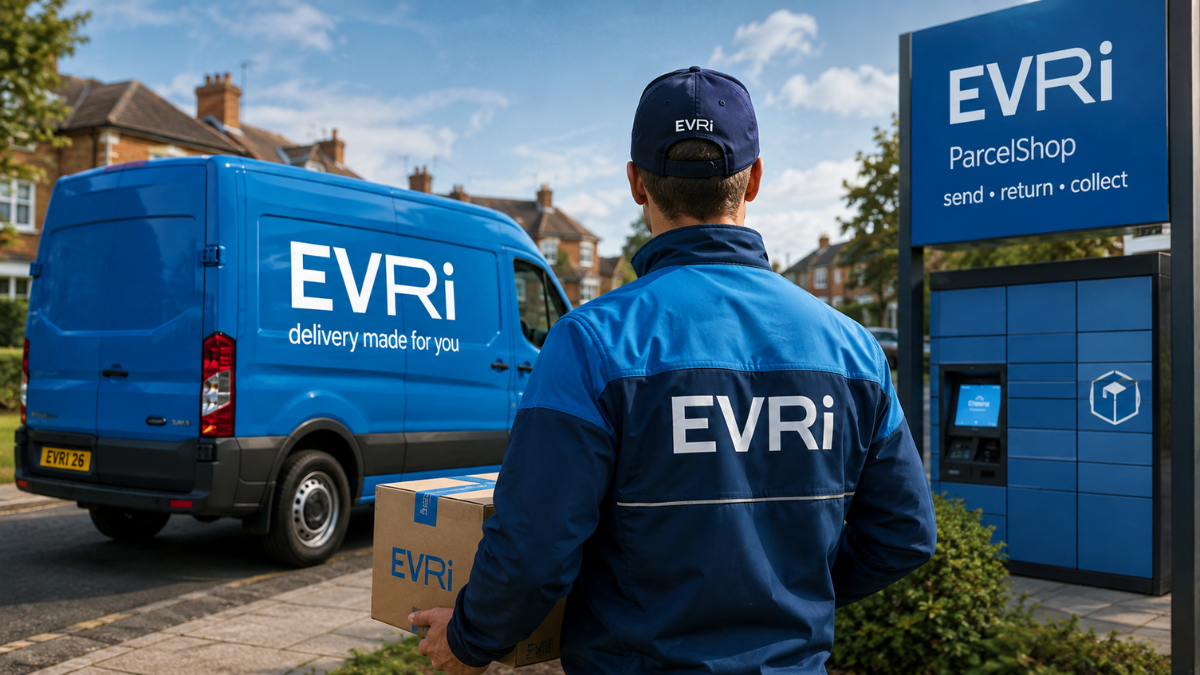
Evri is one of the UK’s largest parcel delivery companies, providing domestic and international shipping, parcel tracking, returns, courier collection and out-of-home delivery through ParcelShops and lockers. Formerly known as Hermes UK, Evri has changed substantially since its 2022 rebrand, particularly following its acquisition by Apollo-managed funds and its combination with DHL eCommerce UK.
For customers, the important question is not simply whether Evri is “good” or “bad.” Its network offers low-cost and convenient delivery options, but independent Ofcom research has also highlighted comparatively weak satisfaction among customers who needed to contact or complain to the company. Courier pay and working conditions have separately attracted parliamentary scrutiny and a BBC Panorama investigation, with Evri disputing important allegations made about its business practices.
Understanding those different issues separately gives a much clearer picture of how the company works in 2026 and whether its services are suitable for a particular parcel.
What Is Evri?
Evri is a UK courier and logistics company focused heavily on parcel delivery. Its services cover sending, receiving, tracking and returning parcels, with customers able to use courier collection, ParcelShops and lockers depending on the service selected.
The company’s roots go back much further than the Evri name. It operated under several names over its history, including Parcelnet and Hermes Parcelnet, before Hermes UK officially rebranded as Evri in 2022.
This means a consumer asking whether Hermes and Evri are the same company is broadly correct in practical terms: Evri is the successor brand to Hermes UK’s parcel operation rather than an unrelated delivery business created in 2022.
How Large Is the Evri Delivery Network?
The scale depends on whether someone is discussing the core Evri operation or the newer Evri Group.
When the enlarged Evri Group was announced in October 2025, the company said the combined organisation would bring together more than 30,000 couriers and van drivers, around 12,000 employees and approximately 8,000 vehicles. It said the group would have capacity to deliver more than one billion parcels and one billion business letters annually.
The same announcement described a network of more than 10,000 ParcelShops and lockers and more than 500 hubs and depots.
These figures matter because older articles may still describe Evri using statistics from before the DHL eCommerce UK transaction. When comparing network size or parcel volumes, check whether the figure refers specifically to the traditional Evri courier network or the entire Evri Group.
Who Owns Evri in 2026?
Apollo-managed funds agreed to acquire Evri from Advent International in July 2024, and Apollo documentation records that the transaction subsequently closed in August 2024.
The ownership structure changed again as part of the DHL eCommerce UK transaction. In September 2025, the Competition and Markets Authority cleared Evri’s acquisition of DHL eCommerce UK alongside DHL Group’s acquisition of a minority stake in Evri.
This distinction prevents a common misunderstanding. It is inaccurate to simplify the transaction as “DHL bought Evri.” DHL became a minority shareholder while DHL eCommerce UK’s UK operation was combined with Evri.
For customers, the ownership structure matters less than what the enlarged business does with its additional network capacity, technology, international reach and service portfolio.
Evri and DHL eCommerce UK: What Changed?
The combination with DHL eCommerce UK officially completed on 1 October 2025, creating the enlarged Evri Group.
The transaction broadened the business beyond Evri’s traditional low-weight consumer parcel model. The group now combines Evri’s core courier network with a premium van operation, B2B parcel services, international logistics capabilities, fulfilment services and UK Mail’s business-letter operation.
That means the company increasingly competes across several parts of the UK logistics market rather than only inexpensive doorstep parcel delivery.
What Is Evri Premium?
DHL eCommerce UK’s UK network was positioned to become Evri Premium – a network of DHL in 2026.
Evri describes the premium operation as a separate network focused on faster, time-sensitive and more secure delivery, including services intended for high-value and larger items.
This makes Evri Premium different from simply paying extra for a standard Evri parcel. It represents a distinct service proposition within the wider group.
For an e-commerce business shipping inexpensive clothing, the core courier network may be sufficient. A company sending expensive electronics, larger goods or commercially sensitive B2B consignments may place greater value on the premium network’s service characteristics.
How Does Evri Parcel Delivery Work?
A typical parcel enters the network through a ParcelShop, locker or courier collection. Tracking begins as the shipment moves through Evri’s operational network before being allocated to a local courier for last-mile delivery.
“Last-mile delivery” simply means the final stage of the journey from a local delivery facility to the customer’s address or chosen collection point.
Evri also allows eligible recipients to divert parcels to options such as a neighbour, safe place, ParcelShop or locker, although available diversion choices depend on the service purchased by the sender.
For customers, this flexibility is one of the practical advantages of an extensive out-of-home network. A locker can be more convenient than waiting at home for a delivery, while ParcelShops allow people to send and collect parcels through local participating businesses.
The benefit is highly location-dependent. A nearby locker that fits someone’s normal routine can be useful; an inconvenient collection point several miles away may provide little practical advantage.
Evri Standard and Next Day Delivery
Evri currently offers Standard and Next Day options for UK consumer parcels. Its Standard service aims for delivery within two to three working days after collection or drop-off, although this is a service aim rather than an unconditional guarantee that every parcel will arrive within that period.
Current prices vary according to parcel weight, dimensions, delivery destination, collection method and optional extras. Evri also states that most eligible shipments include £20 of parcel cover, with upgrades available for greater values.
Because shipping prices can change, anyone comparing Evri with Royal Mail, DPD, DHL, UPS or another courier should compare current quotes for the actual parcel rather than relying on an old article or generic statement that one carrier is always cheaper.
How Are Evri Couriers Paid?
Evri relies heavily on self-employed couriers, and its payment model has traditionally been based on parcels delivered rather than a conventional fixed hourly salary.
During evidence to the House of Commons Business and Trade Committee in January 2025, Evri’s Hugo Martin confirmed that couriers are paid per parcel. He said rates are modelled partly around geography and the number of parcels a courier is expected to be able to deliver within an hour.
This creates an important reality that headline hourly figures can hide.
A courier delivering many parcels within a compact urban area may complete more deliveries per hour than someone covering widely separated rural addresses. Parking, traffic, failed delivery attempts, parcel handling and the density of stops can all affect how efficiently a round can be completed.
What Is Evri Self-Employed Plus?
Evri also operates a Self-Employed Plus, or SE+, model associated with arrangements developed with the GMB union.
The structure is designed to provide additional protections and benefits while preserving elements of self-employed working. In parliamentary evidence, Evri referred to provisions including paid holiday, pension arrangements and other rights within its courier model.
This is why it is misleading to treat every person delivering an Evri parcel as having exactly the same contractual arrangement or employment protections.
How Much Do Evri Couriers Earn?
Evri told Parliament that courier parcel rates produced average earnings of £20.86 per hour. A March 2025 response from the company also discussed its parcel-rate methodology and how weights and dimensions affect what couriers are paid.
That figure should be described accurately as an Evri-reported average, not evidence that every courier earns £20.86 for every hour spent working.
The distinction is central to the controversy around courier pay.
The current UK National Living Wage for eligible workers aged 21 and over increased to £12.71 per hour from 1 April 2026, compared with £12.21 during the previous year.
However, comparing that benchmark directly with self-employed courier income is not straightforward. The argument also involves what working time is counted and how expenses such as fuel, insurance, vehicle maintenance, loading and sorting are treated.
Why Did “Small Packets” Become an Issue?
Evri introduced or developed a lower parcel category for small packets as the volume of lightweight parcels increased.
In correspondence with Parliament, the company said growth in small packets could increase delivery density and argued that changes to parcel classifications could increase future income potential on a typical round. It also explained that parcel rates are influenced by weight and dimensions supplied by clients and corrected through automated equipment or courier reports where necessary.
Couriers and whistleblowers presented a different view to the Business and Trade Committee. Their allegations included incorrect parcel banding, reduced rates, unpaid or insufficiently recognised working time and costs that they said affected effective earnings.
Evri rejected important parts of those claims. Hugo Martin told MPs that he did not recognise the evidence presented and said the company’s model was designed to ensure earnings above minimum-wage levels.
The defensible conclusion is therefore not that Parliament proved systematic underpayment. It established that serious allegations existed, questioned Evri about them and recorded the company’s response.
Why Has Evri Faced Customer-Service Criticism?
Complaints about delayed, missing or incorrectly delivered parcels are not unique to one UK courier.
Ofcom’s 2025 research found that common parcel problems across the sector included delivery delays, parcels being left in inappropriate locations, drivers not knocking loudly enough and recipients not being given enough time to answer the door.
Where Evri performed particularly poorly was among customers who had reason to contact or complain about a delivery problem.
Ofcom reported a 31% satisfaction score for Evri in this group, compared with 57% for Amazon and FedEx and 55% for UPS and DHL. Evri also recorded 41% dissatisfaction. The research was based on surveys of 4,058 UK adults carried out in January and July 2025.
That finding needs careful interpretation.
It does not mean only 31% of Evri parcels are successfully delivered. It measures satisfaction among people who had reason to contact or complain to a parcel company.
This distinction matters because customer-review scores, overall delivery success rates and complaint-handling satisfaction measure different things. Combining them into one supposed “Evri reliability score” would be misleading.
How Reliable Is Evri in 2026?
There is no evidence-based yes-or-no answer that applies to every parcel.
Evri operates at enormous scale and provides a broad tracking, collection, delivery and out-of-home network. At the same time, Ofcom’s complaint-handling findings show a genuine weakness in the experience reported by customers who needed help after a delivery problem.
Local variation also matters. Last-mile delivery depends partly on the individual route, depot and courier. Two customers using the same national delivery company can therefore have very different experiences.
For an inexpensive and easily replaceable parcel, price and convenient drop-off may be the deciding factors. For expensive, fragile, irreplaceable or time-critical goods, the consequences of failure are larger.
That leads to a better decision framework than simply asking, “Is Evri reliable?”
Ask whether the service level, parcel protection, proof of delivery, local convenience and support process are appropriate for the value and urgency of the item being sent.
What Did BBC Panorama Report About Evri?
BBC Panorama broadcast Evri: Where’s My Parcel? in December 2025. The programme examined courier working conditions, customer complaints and claims that some couriers were under financial pressure within the delivery model.
Evri disputes the programme’s central allegations, including suggestions that it used exploitative practices or misled Parliament about courier pay.
The disagreement has since become a legal matter.
In July 2026, reports confirmed that Evri was suing the BBC for approximately £1.2 million over the Panorama broadcast. Court documents cited in reporting said Evri was seeking damages and an injunction, while the company stated that the case was ongoing.
The correct position as of August 2026 is therefore that a libel claim is ongoing.
The filing of that claim does not establish that Panorama’s allegations were false. Equally, publication of the programme does not itself establish that every allegation was proven.
Until the legal dispute is resolved, those claims should continue to be presented alongside Evri’s denials rather than as settled findings.
Does Courier Pressure Cause Poor Deliveries?
A pay-per-parcel system can logically create an incentive to complete more deliveries, but that alone does not prove that it causes missing or badly handled parcels across Evri’s entire network.
Parliament heard allegations about workloads, rates, parcel classifications and the way courier time and expenses were calculated. Evri responded that its rates are modelled to produce sustainable earnings and disputed the description given by some whistleblowers.
This is an area where correlation should not be presented as proven causation.
Courier pressure may be relevant when examining service quality, but poor deliveries can also arise from address problems, depot errors, routing issues, customer instructions, theft, failed delivery attempts or individual mistakes.
A balanced evaluation therefore considers both system-level incentives and the fact that individual delivery failures can have different causes.
What Should You Do If an Evri Parcel Is Missing?
Start with Evri tracking and review the latest scan or proof-of-delivery information. Check the delivery photograph where available, then look at any nominated safe place and ask household members or neighbours who may have accepted the parcel.
Evri’s current tracking guidance states that if a parcel has been with the company for more than seven days and still has not arrived, the recipient should notify the sender so the sender can contact Evri.
For direct support, Evri says its chat service is currently the quickest contact method. Customers may need a tracking number, ParcelShop receipt number or calling-card number before the company can investigate a parcel query.
If you bought the missing item from a UK business, contacting the retailer can be more important than trying to solve everything with the courier yourself.
Citizens Advice states that where a business seller selected the courier, the seller is responsible for making sure the order reaches the customer and should pursue the courier if necessary. There are exceptions, including situations where the consumer specifically agreed to delivery to a particular alternative location.
Keep copies of tracking records, delivery photographs, order confirmation, receipts and correspondence until the case is resolved.
Evri vs Royal Mail, DHL, DPD and Other Couriers
There is no meaningful universal “best UK courier” because customers are buying different services for different purposes.
Evri’s core strengths are its extensive consumer parcel network, low-cost positioning and large number of drop-off and collection options. Royal Mail has a different network model and universal service role, while companies such as DHL, UPS, FedEx and DPD have different strengths across premium, international and business logistics.
Ofcom’s common research methodology provides one useful comparison for customer support. In its 2025 study, Evri scored below Amazon, FedEx, UPS and DHL among consumers who had needed to contact or complain about a delivery issue.
That should influence a decision, but it should not be the only metric.
Compare the actual cost for your parcel, expected delivery speed, tracking, compensation limits, signature or proof-of-delivery options, local drop-off convenience and the consequences if something goes wrong.
For a £15 clothing return, low cost and convenience may matter most. For a £700 electronic device, service security and compensation terms may deserve much greater weight.
The Risks of Relying Only on Evri Reviews
Review platforms can be useful for understanding recurring customer experiences, but they are not a controlled measurement of every parcel delivered.
People who voluntarily leave reviews may differ from the overall customer population. Regulatory surveys, corporate performance statistics and online review scores also use different methodologies.
This explains why apparently contradictory claims can coexist. A company can process hundreds of millions of successful deliveries while still producing a large absolute number of dissatisfied customers. It can also have a high public review score while performing poorly on a narrower regulator measure such as complaint handling.
The useful approach is to ask what each statistic actually measures before using it to make a decision.
Evri Technology and AI-Powered Delivery Checks
Technology has become another part of Evri’s strategy as parcel volumes increase.
In its 2025/26 reporting, the company said parcel volumes had risen 17% year on year and that it invested more than £80 million in operations, service and people. The report also highlighted Veri-snap, an AI-powered system designed to review millions of delivery photographs.
This is a relevant operational use of artificial intelligence because proof-of-delivery photographs can become important when customers dispute where or whether a parcel was delivered.
However, the existence of an AI system is not proof that incorrect delivery photographs or disputes have been eliminated.
The meaningful measure will be whether technology such as Veri-snap produces demonstrable improvements in delivery evidence, successful resolution and customer satisfaction over time.
How Evri Is Expanding Beyond Everyday Parcels
Evri Group is increasingly broader than the consumer courier brand many UK shoppers know.
The combination with DHL eCommerce UK added B2B parcel services, a premium van network, international capability and UK Mail’s business-letter operation. The group also includes customs clearance and logistics specialist Coll-8.
This gives the group a stronger position across e-commerce, retail logistics, international shipping, fulfilment and business mail.
For online retailers and SMEs, that broader range could make it possible to use related Evri Group services for different shipping requirements rather than treating every order as the same type of parcel.
The challenge is execution. Expanding the network only creates customer value when increased scale is matched by reliable delivery, clear proof of delivery and effective support when problems occur.
FAQs
Is Evri the Same as Hermes?
Yes. Hermes UK rebranded as Evri in 2022. The parcel operation itself has roots stretching back decades before the current brand name.
Who Owns Evri Now?
Apollo-managed funds acquired Evri in 2024. As part of the later DHL eCommerce UK transaction, DHL Group acquired a minority stake in Evri.
Did DHL Buy Evri?
Not outright. Evri acquired DHL eCommerce UK while DHL Group received a minority stake in Evri as part of the wider transaction.
What Is Evri Premium?
Evri Premium is the premium delivery operation developed from DHL eCommerce UK’s network. It is intended for services including faster, more secure delivery of high-value, large and time-sensitive shipments.
Are Evri Couriers Self-Employed?
Self-employed couriers remain an important part of the Evri model. The company also has its Self-Employed Plus arrangement, which provides additional benefits and protections under that model.
How Much Do Evri Couriers Earn?
Evri reported average parcel-rate earnings of £20.86 per hour in evidence supplied to Parliament. This is a company-reported average and should not be interpreted as a guaranteed hourly income for every courier.
Is Evri Reliable?
Evri successfully operates one of the UK’s largest parcel networks, but Ofcom’s 2025 research found relatively low satisfaction among customers who needed to contact or complain to the company. Reliability can also vary by location, service type and local delivery operation.
What If Evri Says My Parcel Was Delivered but I Cannot Find It?
Check tracking, the delivery photograph, safe places and neighbours first. If the item was purchased from a retailer and was not delivered to an agreed location, contact the retailer because the seller is generally responsible for ensuring the order reaches you.
How Can I Contact Evri Customer Service?
Evri currently recommends chat as its quickest support route. Customers should have their tracking number, ParcelShop receipt number or calling-card number ready where applicable.
Should I Use Evri for an Expensive Parcel?
The carrier name alone should not determine the decision. Check the service level, compensation amount, exclusions, delivery evidence and consequences of loss before sending a high-value item. For some business and high-value shipments, the separate Evri Premium proposition may be more relevant than the standard courier network.
Conclusion
Evri has changed from the rebranded Hermes UK courier into the core of a much broader logistics group. Apollo’s acquisition, the DHL eCommerce UK transaction, Evri Premium, UK Mail and continued technology investment have increased its scale and widened the range of services available to consumers and businesses.
That growth does not remove the service concerns surrounding the company. Ofcom has documented relatively weak satisfaction among customers who needed help with delivery issues, while Parliament has examined allegations involving courier pay and working conditions. Evri disputes significant parts of those allegations, and its separate legal dispute with the BBC remained ongoing as of August 2026.
For consumers, the most useful question is therefore not whether Evri is universally good or bad. Consider what you are sending.
For ordinary, replaceable parcels where price and convenient ParcelShop or locker access matter, the service can be a practical option. For expensive, fragile or urgent shipments, examine compensation, delivery security, proof-of-delivery requirements and alternative services more carefully before booking.
If you are waiting for an online purchase that has gone missing, keep your tracking evidence and involve the retailer where appropriate rather than assuming the courier dispute is yours alone to resolve.
The strongest way to judge Evri in 2026 is therefore by service suitability, risk and evidence, not by a single review score or headline.
You May Also Like Pravi Celer

Wyvernity Team is a content writing team with 3 years of experience in creating clear, engaging, and SEO-friendly content for Wyvernity.com.