
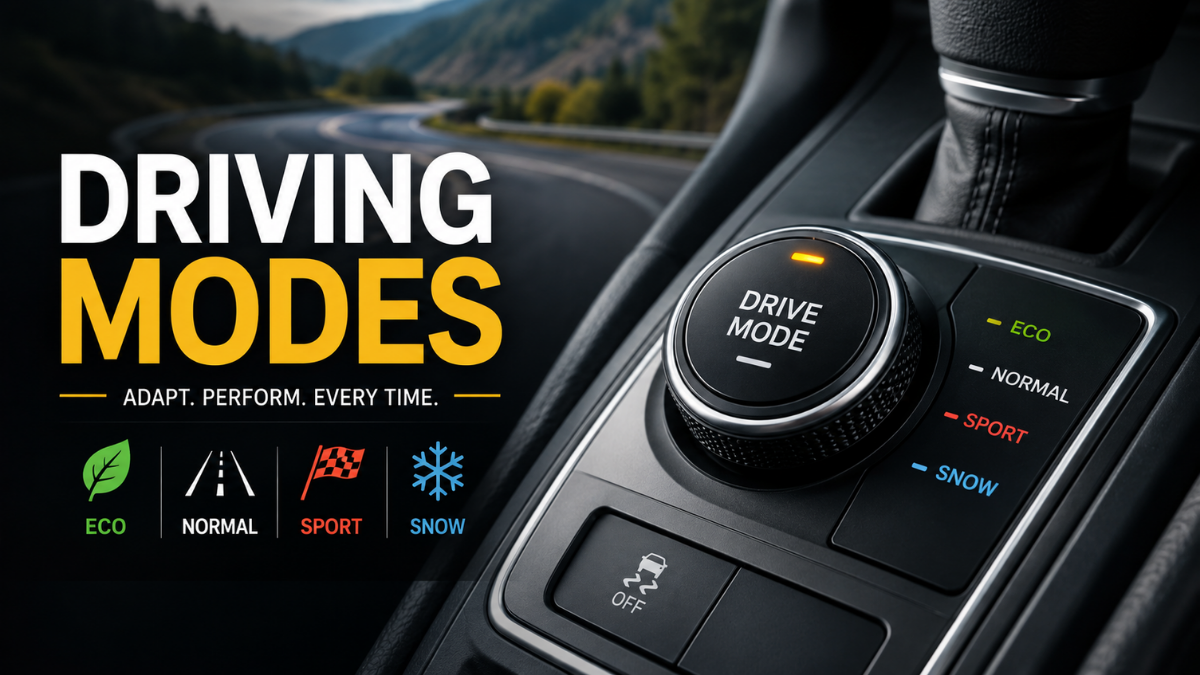
Driving modes are electronic settings that change how a car responds to the driver or road conditions. Depending on the vehicle, selecting a different mode can alter throttle response, transmission behavior, steering assistance, suspension damping, traction control, AWD operation, regenerative braking, climate control and other electronically managed systems.
The most important point is that driving modes do not mean exactly the same thing in every car. Sport mode in one vehicle may change only throttle and transmission mapping, while another car with adaptive suspension, an active differential and electronically controlled steering may change several systems at once.
A useful way to think about driving modes is simple: the software changes how the car uses the hardware it already has. It cannot add equipment, tire grip, towing capacity or engine output that the vehicle does not possess.
What Are Driving Modes in a Car?
A driving mode is a selectable vehicle calibration that changes how one or more electronically controlled systems behave.
Most modern cars use electronic control units to manage systems such as the engine or electric motor, automatic transmission, steering, brakes, stability control and climate system. When a driver selects Eco, Sport, Snow or another mode, those controllers can load a different set of instructions.
The vehicle therefore does not usually become mechanically different when the mode changes. Instead, the same hardware is told to respond differently.
For example, a manufacturer may configure Normal mode for balanced everyday driving, Eco mode for efficiency, Sport mode for stronger response and Snow mode for more controlled power delivery on slippery surfaces.
Honda’s documentation for the 2026 Pilot illustrates how extensive this coordination can become. Depending on the selected mode, the vehicle can alter characteristics involving the throttle, transmission, steering, brakes and AWD system. Honda Info Center
Not every car has the same modes, and even identical names can represent different calibrations between manufacturers.
How Do Driving Modes Work?
Changing a driving mode typically causes several control modules to apply different software settings.
The process can be understood as:
Driver selects a mode → vehicle controllers change their calibration → one or more systems respond differently → the driver experiences different acceleration, handling, comfort, traction or efficiency characteristics.
A drive-by-wire accelerator can become more or less sensitive. An automatic transmission can change its shift strategy. Electric power steering can alter assistance. An AWD system may change torque distribution, while stability and traction control can change how quickly they intervene.
Electric and hybrid vehicles can add another layer because their driving modes may also influence motor output, regenerative braking and energy consumption.
Hyundai’s electric-vehicle documentation, for example, shows that driving modes can affect regenerative-braking behavior and climate settings in addition to acceleration characteristics.
Can you change driving modes while driving?
Many cars allow ordinary modes such as Normal, Eco and Sport to be changed while the vehicle is moving.
That should not be treated as a universal rule. Certain terrain, performance or drivetrain settings may have speed, gear-selection or other operating requirements.
The owner’s manual for the specific vehicle is the correct source for activation restrictions.
What Does Changing the Driving Mode Actually Change?
The exact systems affected depend on the vehicle’s equipment and manufacturer calibration.
Throttle and accelerator response
Modern accelerator pedals commonly use electronic signals rather than a direct mechanical connection to the throttle.
This allows manufacturers to alter accelerator mapping.
In Eco mode, the first part of the pedal’s travel may request less torque, producing a gentler response. Sport mode can make the same amount of pedal movement produce a stronger response.
This can make a car feel significantly more powerful even when maximum engine or motor output has not changed.
That distinction is important:
Sharper throttle response does not automatically mean more horsepower.
Automatic transmission behavior
Automatic transmissions can change shift points according to the selected driving mode.
Eco mode may favor earlier upshifts where appropriate so the engine operates at lower speeds. Sport mode typically keeps lower gears available for longer and may downshift more readily.
This is why engine RPM often stays higher in Sport mode.
Honda describes Sport mode in the 2026 Pilot as increasing throttle responsiveness while allowing the transmission to hold lower gears for stronger acceleration.
Steering assistance
Electric power steering allows manufacturers to change the amount or character of steering assistance electronically.
Comfort-oriented settings may feel lighter and easier to turn. Sport settings frequently feel heavier.
Heavier steering should not be confused with additional tire grip. The change primarily concerns steering assistance and calibration.
Suspension damping
Cars fitted with electronically adjustable dampers may alter suspension behavior when the driving mode changes.
Comfort mode can select a softer damping strategy, while Sport mode may use firmer damping to reduce body movement.
However, this is a hardware-dependent feature.
If a vehicle has conventional fixed dampers, selecting Sport mode cannot electronically make those dampers stiffer.
This principle applies throughout the vehicle:
Driving-mode software can control available hardware, but it cannot create hardware that was never installed.
Traction control and stability control
Driving modes can influence how stability and traction-control systems respond to wheel slip.
A low-traction road mode may intervene early to reduce unwanted wheelspin. Certain off-road modes may intentionally allow more wheel slip because some loose surfaces require momentum.
Ford, for example, explains that its Mud/Ruts mode can permit some wheel slip to help clear mud from the tire tread, while its Slippery mode applies torque more gradually and uses a different traction-control strategy.
This is why saying that off-road modes simply provide “more traction control” is incomplete.
AWD and torque distribution
In vehicles with electronically controlled AWD, a terrain or traction mode may change how torque is distributed between the front and rear axles or individual wheels.
Again, the hardware distinction matters.
A driving mode may change how an AWD system operates. It cannot convert a two-wheel-drive vehicle into an AWD vehicle.
Climate control and energy consumption
Efficiency-oriented modes can sometimes reduce climate-control energy use.
That may include limiting compressor output, adjusting heating or cooling behavior or prioritizing efficiency over maximum cabin-conditioning performance.
The effect can be especially relevant in electric vehicles because energy used for cabin heating or cooling comes from the same battery that powers the vehicle.
Regenerative braking
Some electric and hybrid vehicles link regenerative braking behavior to their drive modes.
Regenerative braking slows the vehicle by using the electric motor as a generator and returning some energy to the battery.
Depending on the vehicle, Eco, Normal, Sport or Snow settings may allow different levels of regeneration or change how regeneration interacts with traction requirements.
Exhaust, sound and other systems
Performance cars may also connect driving modes to active exhaust valves, synthesized engine sound, differential control, seat bolsters, active aerodynamics or ride height.
These are not universal characteristics of Sport mode. They depend entirely on the vehicle’s equipment.
What Are the Most Common Driving Modes?
Although manufacturers use different names, most driving modes fall into several recognizable groups.
Normal Mode
Normal is typically the balanced everyday setting.
Throttle response, steering, transmission behavior and comfort are configured to work reasonably well across normal commuting and highway conditions.
For most drivers, this is the logical default.
Comfort Mode
Comfort mode prioritizes refinement.
Vehicles equipped with adaptive suspension may use softer damping, while electric steering may provide additional assistance.
The goal is usually smoother, easier everyday driving rather than maximum responsiveness.
Eco Mode
Eco mode prioritizes fuel or energy efficiency.
It can soften accelerator response, encourage earlier transmission shifts and reduce energy consumption from systems such as climate control.
Eco mode does not force the vehicle to be efficient. Driver behavior still matters.
Sport or Dynamic Mode
Sport mode prioritizes responsiveness.
Typical changes can include sharper throttle response, later transmission upshifts, earlier downshifts, heavier steering and firmer adaptive suspension.
Some manufacturers call a similar calibration Dynamic rather than Sport.
The name itself is not a technical standard.
Individual or Custom Mode
Individual or Custom modes allow the driver to combine settings.
A driver might prefer Sport throttle response with Comfort suspension, for example.
The number of adjustable parameters depends on the vehicle.
Smart or Adaptive Mode
Some vehicles use modes that change automatically according to driver behavior or conditions rather than remaining fixed.
Kia’s Smart Mode documentation, for example, describes a system that interprets accelerator, braking and steering behavior and adapts vehicle characteristics accordingly.
What Is Eco Mode and When Should You Use It?
Eco mode is intended to help the vehicle operate more efficiently.
It commonly reduces initial accelerator sensitivity and may alter automatic transmission behavior so higher gears are selected earlier when conditions permit.
Some vehicles also reduce climate-control energy demand.
Ford describes Eco mode in Ranger and Everest applications as reducing throttle sensitivity, encouraging earlier shifts and using a more economical cruise-control strategy.
Does Eco mode actually save fuel?
Eco mode can support fuel-efficient driving, but it does not guarantee a specific reduction in fuel consumption.
Actual economy depends on factors such as speed, traffic, temperature, terrain, load and driver inputs.
Aggressive acceleration can overwhelm much of the intended benefit.
The more accurate conclusion is:
Eco mode can make efficient driving easier, but driving behavior often has a greater influence than the mode itself.
When should you use Eco mode?
Eco mode makes sense when fuel economy or electric range is more important than immediate throttle response.
Typical situations include routine commuting, steady-speed driving and journeys where maximum responsiveness is unnecessary.
If the softened response becomes inconvenient, Normal mode may be a better compromise.
What Is Sport Mode and What Does It Do?
Sport mode changes vehicle calibration to provide quicker responses.
A typical Sport setting makes the accelerator more sensitive and changes automatic-transmission logic so lower gears remain available.
Vehicles with compatible hardware may also change steering, adaptive suspension, differential behavior or exhaust settings.
Does Sport mode increase horsepower?
Not necessarily.
This is one of the most important misconceptions surrounding driving modes.
If Sport mode changes throttle mapping, 30% accelerator travel might request more torque than the same pedal position in Normal mode. The vehicle therefore feels faster and more eager.
Maximum engine output may remain exactly the same.
Some high-performance cars and electric vehicles genuinely unlock additional output or temporary boost functions in certain modes. That is vehicle-specific and should be confirmed from manufacturer specifications rather than assumed.
Does Sport mode use more fuel?
It can.
Holding lower gears means the engine may operate at higher RPM. Faster throttle response can also encourage harder acceleration.
Both can increase fuel or energy consumption.
Is Sport mode bad for the car?
A manufacturer-provided Sport mode is designed to operate within the vehicle’s programmed limits when used as instructed.
Higher RPM or more frequent transmission activity does not by itself mean the engine or gearbox is being damaged.
Normal mode is still usually more appropriate when the extra responsiveness is unnecessary.
Normal vs Comfort vs Eco vs Sport Mode: What’s the Difference?
The exact changes vary by vehicle, but the following table shows typical priorities.
| System or priority | Normal | Comfort | Eco | Sport |
| Throttle response | Balanced | Smooth | Softer | Sharper |
| Automatic transmission | Balanced | Smoothness focused | Often shifts earlier | Often holds lower gears |
| Steering feel | Balanced | Often lighter | Vehicle dependent | Often heavier |
| Adaptive suspension | Balanced | May become softer | Vehicle dependent | May become firmer |
| Climate control | Normal | Normal | May reduce energy use | Usually normal |
| Fuel or energy efficiency | Balanced | Moderate | Highest priority | Lower priority |
| Ride comfort | Balanced | Highest priority | Moderate | Lower priority |
| Best general use | Everyday driving | Comfort-focused trips | Efficiency | Responsive driving |
The words may, often and typically matter. Manufacturers decide which systems each mode controls.
For most drivers, Normal is the sensible baseline. Eco is useful when efficiency matters, Comfort when ride quality matters and Sport when responsiveness matters.
What Are Snow, Wet and Bad-Weather Driving Modes?
Snow, Wet and Slippery modes are designed to make torque delivery easier to manage when grip is limited.
They may soften accelerator response, change transmission logic and alter traction or stability-control behavior.
Honda’s 2026 Pilot Snow mode uses dampened throttle response and second-gear starts to help improve control on slippery surfaces.
Ford’s Slippery mode similarly uses more gradual torque application, earlier gear changes and a traction-control strategy intended to limit wheelspin.
Snow mode vs AWD
Snow mode and AWD solve different problems.
Snow mode is a control strategy. AWD is a drivetrain configuration.
AWD determines which wheels can receive power. Snow mode influences how available systems respond when grip is poor.
Having AWD does not make Snow mode unnecessary, and having Snow mode does not give a two-wheel-drive vehicle AWD capability.
More importantly, neither system can overcome inadequate tires or severely limited road grip.
Appropriate tires, safe speed and smooth driver inputs remain fundamental.
How Do Off-Road and Terrain Driving Modes Work?
Off-road driving creates requirements that are very different from ordinary paved roads.
Terrain modes can alter throttle response, transmission strategy, AWD torque distribution, braking and traction-control behavior to suit a particular surface.
Trail and Off-Road modes
Trail-oriented modes generally prioritize controlled low-speed progress and traction over smooth road behavior.
Honda’s Trail mode on the 2026 Pilot changes throttle and transmission mapping while coordinating AWD and braking functions for low-speed terrain. Honda Info Center
Mud and Ruts mode
Mud may require some wheelspin.
Ford describes its Mud/Ruts calibration as allowing controlled wheel slip partly so tire tread can clear accumulated mud.
This demonstrates why maximum electronic intervention is not always desirable off road.
Sand mode
Sand usually requires maintaining momentum.
A Sand mode may change throttle, transmission, AWD and stability-control strategies to avoid unnecessary power reduction.
Rock or Crawl modes
Vehicles designed for more demanding off-road use may include Rock or Crawl settings that prioritize very low-speed control and precise torque delivery.
Their operation varies significantly by vehicle and drivetrain, so manufacturer instructions matter particularly here.
What Is Tow/Haul Mode and When Should You Use It?
Tow/Haul mode is designed to improve powertrain behavior when a vehicle is carrying or pulling a significant load.
It commonly changes automatic-transmission logic.
The transmission may hold lower gears longer when climbing, downshift sooner when necessary and provide more engine braking on descents.
Ford describes Tow/Haul mode as modifying shift timing to maintain useful power delivery and engine braking in hilly conditions.
Honda likewise documents a Tow mode on the Pilot that changes transmission and steering behavior.
Does Tow/Haul mode increase towing capacity?
No.
Tow/Haul mode changes how the powertrain behaves. It does not increase the manufacturer’s rated towing capacity.
Maximum towing capacity depends on factors such as vehicle design, cooling capability, brakes, drivetrain, chassis, hitch equipment and manufacturer specifications.
A Tow button is therefore not evidence that a heavier trailer is safe to pull.
What Are EV, Hybrid and Electric-Car Driving Modes?
Driving modes in electric and hybrid vehicles can behave differently because there may be no conventional automatic gearbox or normal engine RPM to manage.
Instead, modes can influence motor response, energy consumption, regenerative braking and climate-control demand.
Hyundai documentation provides examples of drive modes affecting regenerative-braking ranges and climate behavior in electric vehicles.
EV Mode vs Eco Mode
These terms are not interchangeable.
In a hybrid or plug-in hybrid, EV Mode generally refers to operating on electric propulsion without the combustion engine when battery charge, temperature, power demand and other system conditions permit.
Eco Mode is an efficiency-oriented calibration.
A hybrid can therefore be in an Eco-oriented configuration without necessarily operating exclusively on electricity.
What does Sport mode do in an electric car?
Sport mode in an EV can sharpen accelerator response and, depending on the vehicle, change motor output, regenerative braking, steering or chassis behavior.
Some performance EVs also provide temporary higher-output functions, but this cannot be generalized across all electric cars.
What Are Sport+, Track and Drift Modes?
Performance cars may offer more aggressive modes beyond ordinary Sport.
Sport+ can increase powertrain and chassis responsiveness further. Track modes may prioritize sustained performance and reduce certain electronic interventions. Drift modes on vehicles engineered for that purpose may alter torque distribution and stability-control behavior to allow deliberate oversteer.
These should not be treated as simply superior versions of Normal mode.
Reduced stability intervention can be useful on a closed course while reducing the safety margin appropriate for normal road driving.
Track, Drift and similarly specialized modes should therefore be used only according to manufacturer instructions and in suitable environments.
Do Driving Modes Really Make a Difference?
Yes, but the size of the difference depends heavily on the vehicle.
A performance car equipped with adaptive dampers, electric steering, active differential control, adjustable exhaust valves and sophisticated transmission software gives the driving-mode system many parameters to change.
A simpler car may alter only throttle and transmission mapping.
Both vehicles can legitimately have a Sport mode, but the driver will not experience the same transformation.
The mode-versus-hardware rule
The easiest way to judge any claim about driving modes is to separate software from hardware.
The driving mode supplies instructions. The vehicle’s equipment determines what those instructions can actually change.
Sport mode can tell adaptive dampers to use firmer settings. It cannot electronically stiffen fixed conventional dampers.
A terrain mode can alter AWD torque distribution. It cannot give a two-wheel-drive car an additional driven axle.
Snow mode can reduce wheelspin. It cannot create more tire grip than the road and tires provide.
Tow/Haul mode can improve shift behavior under load. It cannot increase certified towing capacity.
Sport mode can sharpen accelerator response. It does not automatically increase rated horsepower.
This distinction resolves many of the apparent contradictions surrounding driving modes.
Which Driving Mode Should You Use?
For everyday driving, start with Normal and move to another mode when it solves a specific problem or better matches your priorities.
| Driving situation | Sensible starting mode | Main reason |
| Everyday city driving | Normal | Balanced behavior |
| Routine highway driving | Normal or Comfort | Predictable response and comfort |
| Efficiency-focused driving | Eco | Favors lower energy consumption |
| More responsive driving | Sport | Sharper powertrain response |
| Snow or slippery roads | Snow or Slippery | More controlled torque delivery |
| Loose trails | Trail or Off-Road | Terrain-focused system calibration |
| Mud | Mud/Ruts | Helps maintain useful momentum |
| Sand | Sand | Calibrated for loose surfaces |
| Heavy towing | Tow/Haul | Better transmission behavior under load |
| Personal preferences | Individual or Custom | Allows mixed settings |
The manufacturer’s manual takes priority over a generic recommendation because mode behavior and restrictions vary.
Common Mistakes About Driving Modes
One mistake is assuming that mode names are standardized. They are not. Two manufacturers can use the word Sport while changing different systems.
Another is confusing response with power. A sharper accelerator and lower gear can make a car feel much faster without changing maximum output.
Snow mode is also sometimes mistaken for additional physical traction. It can manage available grip more effectively, but the tires remain the vehicle’s contact with the road.
Likewise, terrain modes cannot compensate for unsuitable tires, insufficient ground clearance or poor driving technique.
Eco mode is sometimes treated as an automatic fuel-saving solution. It can help, but aggressive acceleration, high speed and other driving conditions can outweigh the calibration.
Finally, Tow/Haul mode should never be confused with a towing-capacity upgrade.
FAQs
Is Normal or Eco mode better for everyday driving?
Normal is usually the best all-purpose choice because it balances response, comfort and efficiency. Eco is useful when reducing fuel or energy consumption is the priority and its softer response suits the situation.
Is it OK to drive in Eco mode all the time?
If the manufacturer allows normal use of Eco mode, it can generally be used regularly. Whether it is beneficial all the time depends on the driver and conditions. Normal may be more convenient when quicker response is required.
Is it OK to drive in Sport mode all the time?
Sport mode is designed for use within the vehicle’s programmed limits, but it may increase engine speed, energy consumption or suspension firmness. Normal is usually more appropriate when those characteristics provide no useful benefit.
Can you switch from Eco to Sport mode while driving?
Many vehicles allow ordinary drive-mode changes while moving. Specific restrictions vary, especially for terrain, performance and drivetrain modes, so check the owner’s manual.
Does Sport mode make a car faster?
It often makes the vehicle respond faster. That does not necessarily mean maximum horsepower or measured acceleration improves. Some vehicles genuinely change available output, but that is model-specific.
Does Sport mode damage the engine or transmission?
A manufacturer-provided Sport mode is intended to operate within the vehicle’s designed control limits when used correctly. Higher RPM or more frequent shifting does not by itself indicate damage.
Does Eco mode make a car slower?
Eco mode can make acceleration feel slower because throttle response may be softened and transmission behavior may favor efficiency. Whether maximum performance is restricted depends on the vehicle.
Which driving mode saves the most fuel?
Eco mode is normally the setting intended to prioritize efficiency. Actual consumption still depends heavily on speed, traffic, terrain, temperature, load and driver behavior.
Which driving mode is best for rain?
If a vehicle offers Wet or Slippery mode and the manufacturer recommends it for those conditions, it may help manage power delivery and traction-control behavior. Tire condition, safe speed and smooth steering and braking remain more important.
Should you use Snow mode on ice?
Snow or Slippery mode may help manage torque on low-grip surfaces, but no electronic mode can overcome severely limited tire traction. Appropriate tires and cautious driving remain essential.
Does Comfort mode use more fuel?
Not necessarily. Comfort mode primarily targets ride quality and ease of driving. Its effect on consumption depends on which systems the manufacturer changes.
Do driving modes work in manual-transmission cars?
Yes. Even without automatic shift programming, a drive mode can still change throttle response, steering assistance, suspension settings, stability control, AWD behavior or other electronic systems.
Do electric cars have driving modes?
Yes. Electric-car driving modes can change motor response, regenerative braking, climate-energy use, steering and chassis behavior.
Why does Sport mode keep the RPM high?
Sport transmission programming commonly holds lower gears longer so stronger acceleration is immediately available. Higher RPM is therefore often intentional.
Why does Eco mode make the accelerator feel less responsive?
Eco mode can remap accelerator input so the first portion of pedal movement requests less torque. This makes smooth, efficient acceleration easier.
Why does my driving mode reset after restarting the car?
Mode persistence varies by manufacturer and model. Some vehicles remember selected modes while others return to a predefined default when restarted. Check the owner’s manual for the specific vehicle.
How to Choose the Right Driving Mode
The best driving mode is not simply the most economical, comfortable or aggressive option. It is the mode whose calibration best matches the current task and conditions.
For normal commuting, Normal mode is usually the sensible baseline. Use Eco when efficiency is the priority, Comfort when refinement matters, Sport when you want stronger response and specialized Snow, Tow or terrain modes when the road, surface or load calls for them.
The most important practical insight is that driving modes tell the vehicle how to use systems it already has. They do not create additional tire grip, suspension hardware, driven wheels, towing capacity or engine output unless the vehicle was already engineered to provide those capabilities.
When in doubt, identify what the selected driving mode actually changes on your specific model and follow the owner’s manual for activation requirements and limitations. That approach is more reliable than choosing a mode based on its name alone.
You May Also Like Mike Wolfe Passion Project

Wyvernity Team is a content writing team with 3 years of experience in creating clear, engaging, and SEO-friendly content for Wyvernity.com.