
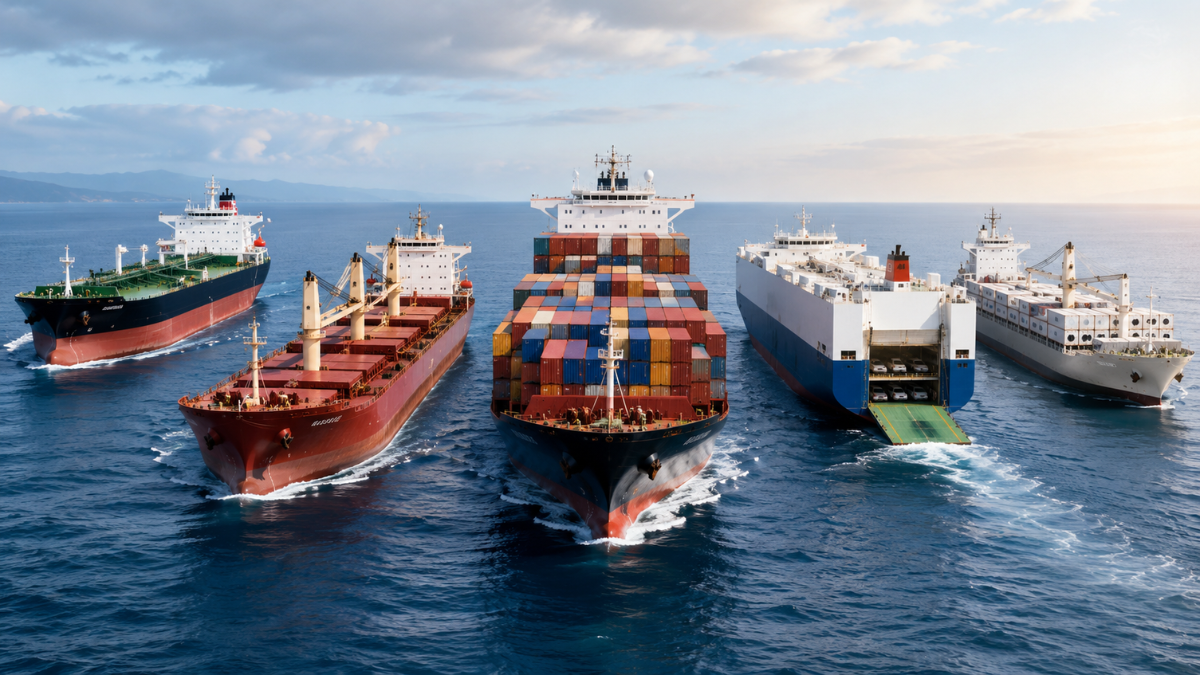
Cargo ships are commercial vessels designed to transport goods, raw materials, and commodities between ports through ocean routes. Cargo ships are responsible for moving everything from consumer products and industrial equipment to oil, grain, vehicles, and refrigerated goods, making them one of the most important parts of global trade and maritime logistics.
More than 80% of global merchandise trade by volume is transported by sea, according to the United Nations Conference on Trade and Development (UNCTAD), because ocean shipping can move extremely large quantities of cargo at a lower cost compared with most other transportation methods.
A cargo ship is not a single type of vessel. It is a broad category that includes container ships, bulk carriers, tankers, Ro-Ro ships, reefer vessels, and multipurpose ships. Each design exists because different goods require different storage methods, handling systems, safety measures, and operating conditions.
What Are Cargo Ships? Definition and Basic Explanation
A cargo ship, also known as a freight ship, freighter, or cargo vessel, is a merchant vessel built specifically to transport commercial goods from one port to another. Unlike passenger ships, which are designed around human accommodation, cargo ships are designed around efficient freight movement.
The main purpose of a cargo vessel is to safely carry goods while maintaining stability, protecting cargo quality, and completing long-distance transportation efficiently.
Cargo ships are engineered with specialized features such as:
- Cargo holds or container spaces
- Loading and unloading equipment
- Navigation systems
- Safety and communication technology
- Specialized storage areas
The design of each vessel depends on the type of cargo it carries. A container ship carrying thousands of retail products requires a completely different structure from a tanker transporting crude oil or a bulk carrier transporting iron ore.
How Are Cargo Ships Different From Other Merchant Ships?
The maritime industry includes many types of commercial vessels, but their functions are different.
Cargo Ships vs Passenger Ships
Passenger ships are designed to transport people and provide accommodation facilities. Cruise ships, ferries, and passenger liners include cabins, restaurants, entertainment areas, and passenger services.
Cargo ships prioritize:
- Maximum freight capacity
- Efficient loading systems
- Cargo safety
- Fuel efficiency
Their internal layout is dominated by cargo areas rather than passenger facilities.
Cargo Ships vs Naval Vessels
Naval vessels are military ships used for defense, surveillance, and strategic operations. Cargo ships are commercial vessels operated by shipping companies to support trade and logistics.
Cargo Ships vs Specialized Transport Vessels
Some cargo ships are highly specialized for specific industries.
Examples include:
- Tankers for oil and chemicals
- LNG carriers for liquefied natural gas
- Ro-Ro ships for vehicles
- Reefer ships for temperature-sensitive products
Specialization allows companies to transport goods more safely and efficiently.
What Do Cargo Ships Transport?
Cargo ships transport almost every category of goods used in modern economies.
Containerized Goods and Manufactured Products
Container ships carry standardized containers filled with:
- Electronics
- Clothing
- Furniture
- Consumer products
- Industrial components
- Machinery parts
The container system transformed global logistics because the same container can move between ships, trains, and trucks without unloading individual products.
Raw Materials and Commodities
Bulk carriers transport large quantities of unpackaged materials, including:
- Iron ore
- Coal
- Grain
- Cement
- Fertilizers
- Minerals
These ships support industries such as construction, agriculture, and energy production.
Liquids and Gases
Tankers are designed for liquid cargo, including:
- Crude oil
- Petroleum products
- Chemicals
- Liquefied natural gas (LNG)
- Liquefied petroleum gas (LPG)
Because many liquid cargos can be hazardous, tanker ships require advanced containment and safety systems.
Vehicles and Heavy Equipment
Ro-Ro ships transport wheeled cargo such as:
- Cars
- Trucks
- Buses
- Construction machinery
- Agricultural equipment
Refrigerated and Perishable Goods
Reefer vessels and refrigerated containers transport goods that require controlled temperatures:
- Fruits
- Vegetables
- Seafood
- Meat
- Dairy products
Maintaining the cold chain prevents product damage during long-distance transportation.
Why Are Cargo Ships Important for Global Trade?
Cargo ships form the backbone of international commerce because they connect producers, manufacturers, suppliers, and consumers across continents.
A product sold in one country may involve several maritime journeys before reaching the customer. Raw materials may travel from one region, manufacturing may happen elsewhere, and finished products may be transported through container shipping networks.
How Cargo Ships Support International Supply Chains
A typical ocean freight process looks like this:
Manufacturer → Export Port → Cargo Ship → Import Port → Rail/Truck Network → Final Customer
Cargo ships support:
- International trade
- Import and export operations
- Manufacturing supply chains
- Energy distribution
- Agricultural markets
Major shipping routes connect regions such as Asia, Europe, North America, and the Middle East through important maritime corridors.
How Much Cargo Can Ships Carry?
Cargo capacity depends on vessel type.
Container ships use TEU (Twenty-foot Equivalent Unit) as their main measurement. One TEU represents the capacity of a standard 20-foot shipping container.
The largest container ships can carry more than 20,000 TEU, although actual capacity depends on vessel design, route restrictions, and operational requirements.
Bulk carriers are measured using Deadweight Tonnage (DWT), which represents the maximum weight a ship can safely carry, including cargo, fuel, water, and supplies.
Main Types of Cargo Ships and Their Uses
Different cargo requirements have created specialized vessel categories.
Container Ships: Transporting Goods in Standard Containers
Container ships are among the most important vessels in modern international shipping. They carry standardized containers stacked both below deck and above deck.
What Do Container Ships Carry?
Common containerized cargo includes:
- Retail products
- Electronics
- Clothing
- Automotive parts
- Machinery
- Industrial goods
Special container types allow additional cargo options:
- Reefer containers for refrigerated products
- Tank containers for liquids
- Flat racks for oversized cargo
- Open-top containers for unusual dimensions
Container Ship Sizes and Classifications
Container ships are often classified according to size and route capability.
Feeder vessels
Smaller ships that connect smaller ports with major container hubs.
Panamax ships
Designed to fit through the original Panama Canal locks.
Neo-Panamax ships
Built for the expanded Panama Canal.
Ultra Large Container Vessels (ULCV)
The largest container ships used on major international routes.
Companies such as Maersk and Mediterranean Shipping Company operate some of the world’s largest container fleets.
Bulk Carriers: Moving Raw Materials in Large Quantities
Bulk carriers transport dry, unpackaged materials stored directly inside large cargo holds.
What Are Bulk Carriers Used For?
They commonly transport:
- Iron ore
- Coal
- Grain
- Cement
- Fertilizers
Bulk shipping is especially important for mining, agriculture, and industrial production.
Bulk Carrier Size Categories
Common classifications include:
- Handysize
- Handymax
- Supramax
- Panamax
- Capesize
Large Capesize vessels are mainly used for long-distance transportation of heavy commodities because their size limits the ports and routes they can access.
Tankers: Ships Designed for Liquid Cargo
Tankers transport liquids in specially designed storage compartments.
Types of Tankers
Crude oil tankers
Carry unprocessed petroleum.
Product tankers
Transport refined fuels such as gasoline and diesel.
Chemical tankers
Move industrial chemicals.
LNG carriers
Transport liquefied natural gas.
LPG carriers
Transport liquefied petroleum gas.
Why Do Tankers Require Specialized Safety Systems?
Liquid cargo creates unique operational challenges. Tankers use:
- Reinforced cargo tanks
- Leak prevention systems
- Fire protection equipment
- Monitoring technology
The International Maritime Organization (IMO) establishes international safety and environmental standards affecting tanker operations.
Roll-On/Roll-Off (Ro-Ro) Ships: Transporting Vehicles
Ro-Ro ships are designed so vehicles can be driven directly onto and off the vessel using built-in ramps.
How Do Ro-Ro Ships Work?
Unlike container ships that require cranes, Ro-Ro vessels use:
- Vehicle ramps
- Internal decks
- Specialized parking areas
This makes loading faster for vehicles and heavy machinery.
Common Ro-Ro Vessel Types
Pure Car Carrier (PCC)
Used mainly for automobiles.
Pure Car and Truck Carrier (PCTC)
Carries cars, trucks, and commercial vehicles.
ConRo Ships
Combine container and vehicle transport.
RoPax Ships
Carry vehicles and passengers.
Reefer Ships: Transporting Temperature-Controlled Cargo
Reefer ships are designed for products that require controlled temperatures.
They transport:
- Fresh produce
- Meat
- Seafood
- Dairy products
Today, refrigerated containers placed on standard container ships are increasingly common because they provide greater flexibility across shipping routes.
General Cargo and Multipurpose Ships
Multipurpose vessels are flexible ships capable of carrying different cargo types.
They may transport:
- Steel products
- Timber
- Heavy machinery
- Construction equipment
- Project cargo
These ships are useful when cargo demand changes frequently or when ports have limited infrastructure.
How Do Cargo Ships Work? Complete Shipping Process
Cargo transportation involves several coordinated steps.
Cargo Preparation and Booking
Before shipment, companies determine:
- Cargo type
- Weight
- Dimensions
- Required handling conditions
- Destination requirements
Shipping documentation and customs requirements must also be prepared.
Loading Cargo at the Port
Loading methods depend on vessel design.
Examples:
- Container cranes load container vessels
- Pumps transfer liquids into tankers
- Ramps load vehicles onto Ro-Ro ships
- Specialized equipment loads bulk materials
Cargo Arrangement and Ship Stability
Cargo placement is a critical safety factor.
Poor distribution can affect:
- Vessel balance
- Fuel efficiency
- Structural safety
- Cargo protection
Ships use detailed loading plans to maintain stability throughout the journey.
Navigation and Ocean Transportation
During transportation, crews monitor:
- Weather conditions
- Navigation systems
- Engine performance
- Fuel consumption
Modern ships rely on satellite navigation, digital communication, and automated monitoring systems.
Unloading and Final Distribution
After reaching the destination port:
- Cargo is unloaded
- Customs procedures are completed
- Goods continue through rail or road networks
This process connects maritime transportation with the wider logistics system.
Cargo Ship Sizes, Capacity, and Classifications
Cargo ships vary dramatically in size.
How Are Cargo Ships Measured?
TEU Capacity
Used mainly for container ships.
It measures how many standard containers a vessel can carry.
Deadweight Tonnage
Used mainly for bulk carriers and tankers.
It measures the total weight a ship can safely transport.
Other important measurements include:
- Length overall (LOA)
- Beam width
- Draft depth
- Gross tonnage
Major Cargo Ship Size Classes
| Ship Class | Main Limitation |
| Panamax | Original Panama Canal dimensions |
| Neo-Panamax | Expanded Panama Canal locks |
| Suezmax | Suez Canal restrictions |
| Malaccamax | Malacca Strait depth |
| Capesize | Too large for major canals |
These classifications matter because ship size determines which ports and routes are available.
Cargo Ships vs Other Shipping Methods
Cargo Ships vs Air Freight
| Factor | Cargo Ships | Air Freight |
| Cost | Lower | Higher |
| Speed | Slower | Faster |
| Capacity | Very high | Limited |
| Best For | Large shipments | Urgent deliveries |
Sea freight is usually the better option for businesses moving large quantities where cost efficiency matters more than speed.
Container Ships vs Bulk Carriers
| Feature | Container Ships | Bulk Carriers |
| Cargo Type | Packaged goods | Raw materials |
| Storage | Containers | Cargo holds |
| Industries | Retail, manufacturing | Mining, agriculture |
How to Choose the Right Cargo Ship
Choosing the correct vessel depends on practical shipping requirements.
Type of Cargo
Companies should consider:
- Dry goods
- Liquids
- Vehicles
- Perishable products
- Hazardous materials
Cargo Size and Weight
Large-volume shipments may require bulk carriers or large container vessels, while specialized products may require dedicated ships.
Port Infrastructure
The destination port must support:
- Vessel draft requirements
- Crane availability
- Terminal facilities
A large ship may be unsuitable if the port cannot handle its size.
Delivery Requirements
Businesses must balance:
- Cost
- Speed
- Reliability
- Route availability
The cheapest shipping option is not always the most efficient if delays or handling limitations create additional costs.
Common Cargo Shipping Challenges and Risks
Weather and Ocean Conditions
Storms, rough seas, and extreme weather can cause:
- Delays
- Route changes
- Additional fuel consumption
Port Congestion
Busy ports may create:
- Longer waiting times
- Container delays
- Supply chain disruptions
Cargo Damage Risks
Problems can result from:
- Incorrect packaging
- Poor securing methods
- Temperature failures
- Improper handling
Environmental Challenges
The shipping industry faces pressure to reduce:
- Carbon emissions
- Sulfur emissions
- Marine pollution
How Are Cargo Ships Becoming More Sustainable?
The maritime sector is investing in cleaner technologies to reduce environmental impact.
Alternative Fuels
Research and adoption are increasing around:
- Methanol
- Ammonia
- Hydrogen
- Biofuels
However, large-scale adoption depends on fuel availability, infrastructure, safety, and cost.
Automation and Smart Shipping Technology
Modern shipping is becoming more digital through:
- Automated ports
- Digital fleet management
- Satellite tracking
- Predictive maintenance
- AI-assisted route optimization
The goal is to improve efficiency while reducing fuel consumption and operational costs.
FAQs
What is the main purpose of a cargo ship?
A cargo ship transports commercial goods, raw materials, and commodities between ports through ocean routes.
How many containers can the largest cargo ships carry?
The largest container ships can carry more than 20,000 TEU depending on their design and operating conditions.
How long does a cargo ship last?
Many cargo vessels operate for several decades with proper maintenance, inspections, and upgrades.
What fuel do cargo ships use?
Traditional ships commonly use marine fuels such as heavy fuel oil and marine gas oil, while newer vessels are exploring lower-carbon alternatives.
How fast do cargo ships travel?
Most large cargo ships operate at approximately 15–25 knots depending on vessel type and conditions.
What is the difference between a cargo ship and a container ship?
A container ship is one specific type of cargo ship designed to transport standardized containers.
Are cargo ships environmentally friendly?
Shipping is efficient for moving large volumes, but the industry is working to reduce emissions through cleaner fuels, improved engines, and better operational practices.
The Future of Cargo Ships and Maritime Transportation
The future of cargo shipping will focus on balancing global trade demand with environmental responsibility.
Important developments include:
- Cleaner propulsion systems
- Autonomous vessel technology
- Smarter ports
- Digital supply chains
- More efficient navigation systems
Autonomous cargo ships are still developing, and widespread adoption depends on regulatory approval, safety testing, and technological maturity.
Conclusion
Cargo ships are essential to modern economies because they move the materials, products, and resources that support global industries. However, choosing the right vessel depends on more than size or cost.
Businesses must consider cargo type, volume, route, port capability, safety requirements, and delivery priorities before selecting a shipping solution.
A container ship may be ideal for electronics, a bulk carrier for raw materials, a tanker for liquids, and a Ro-Ro vessel for vehicles. Understanding these differences helps companies make better logistics decisions while preparing for a future where maritime transportation becomes more digital and sustainable.
You May Also Like Why More Students Are Struggling to Manage Work and Online Classes

Wyvernity Team is a content writing team with 3 years of experience in creating clear, engaging, and SEO-friendly content for Wyvernity.com.