
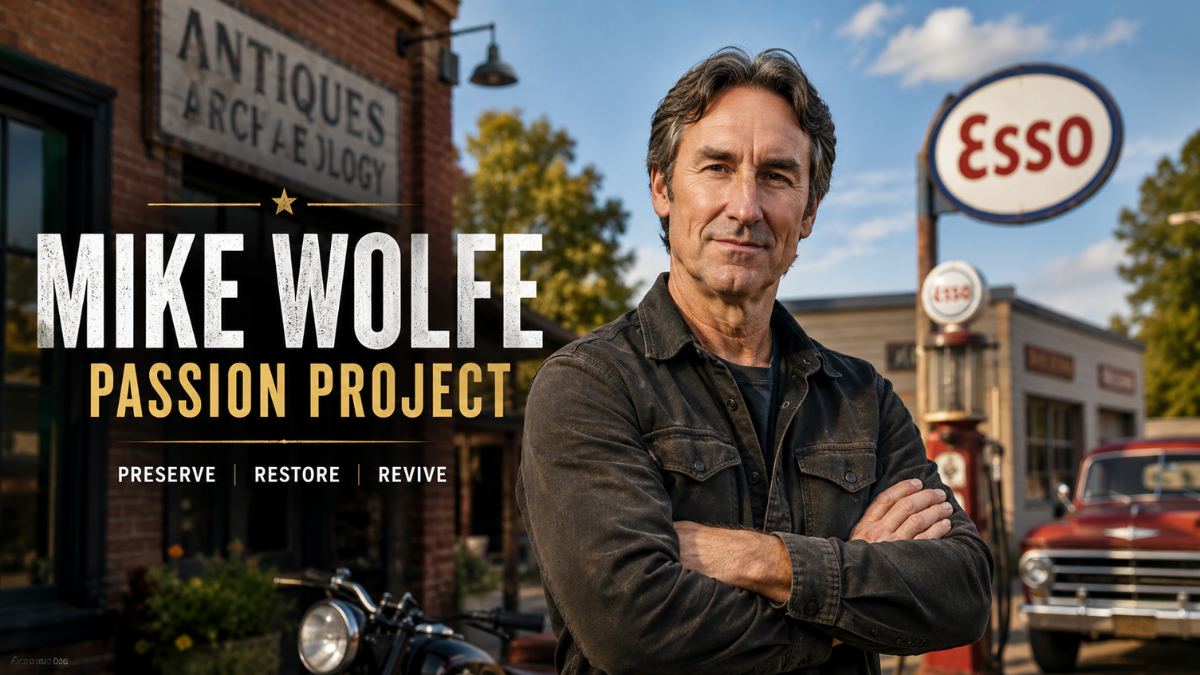
Mike Wolfe’s passion project is best understood as preserving historic places, objects, stories, and the character of small-town America, not as one single restoration or side project. The American Pickers creator has applied that passion to old commercial buildings, automotive landmarks, antiques, motorcycles, tourism, and community-focused redevelopment.
That interpretation comes from Wolfe’s official History profile, which describes preserving small-town America as his “full-time passion” and specifically connects it with finding older buildings in the Midwest and mid-South that can be reclaimed, restored, and reinvigorated.
The distinction matters because the phrase “Mike Wolfe passion project” has been used for several different things online. One recent example is his restoration of a former Esso station in Columbia, Tennessee. Other articles point to Columbia Motor Alley, Antique Archaeology, motorcycles, or Nashville’s Big Back Yard.
They are not competing answers. They are different expressions of the same preservation philosophy.
What Is Mike Wolfe’s Passion Project?
There does not appear to be one officially branded project called the “Mike Wolfe Passion Project.” Instead, Wolfe has a broader preservation mission that shows up repeatedly in his work.
At its simplest, that mission follows a recognizable pattern: find something historically meaningful that has been overlooked, understand the story behind it, preserve the character that makes it distinctive, and find a way for it to remain useful.
On American Pickers, that process happens with objects. Wolfe and the show’s other pickers search barns, garages, collections, and properties for items that reveal pieces of everyday American history. History describes Wolfe as being especially interested in objects with stories rather than value alone.
His building projects apply much the same idea at a larger scale.
A neglected motorcycle can document transportation history. An old gas pump can preserve part of roadside culture. A former Chevrolet dealership or service station can preserve the physical place where that history happened.
This is why reducing Wolfe’s passion project to motorcycle restoration or one Columbia property misses the larger picture.
Why Mike Wolfe’s Preservation Work Goes Beyond American Pickers
American Pickers made Wolfe’s fascination with forgotten objects visible to millions of viewers, but his preservation activity is not simply an extension of the television show.
One of the strongest pieces of evidence is his relationship with the National Trust for Historic Preservation. In 2016, the organization announced a formal partnership with Wolfe intended to promote the importance of saving historic places. The Trust described Wolfe as a “citizen preservationist” whose interest in protecting the things and places that tell America’s story aligned with its own mission.
That date is useful because it shows that Wolfe’s preservation focus did not suddenly emerge when entertainment outlets began calling individual projects “passion projects” years later.
There is also a logical progression in his work.
Picking saves objects.
Collecting preserves examples of material culture.
Storytelling documents who used them and why they mattered.
Building preservation protects the physical settings around those stories.
Heritage tourism gives people a reason to visit those places again.
Seen this way, Wolfe’s antiques, historic buildings, guesthouse, automotive properties, and small-town advocacy fit into one coherent framework rather than a collection of unrelated ventures.
How the Mike Wolfe Passion Project Works in Real Life
The simplest version of historic preservation is “save the old building.” Actual preservation is considerably more complicated.
Old structures may need structural repairs, new wiring and plumbing, fire-safety systems, accessibility improvements, weatherproofing, and changes necessary to satisfy contemporary building codes. A commercial property also needs a use capable of supporting continued maintenance.
That creates a real trade-off.
Preserving absolutely everything may leave a building impractical to use. Modernizing everything can erase the features that made it historically significant.
The more useful principle is preservation through continued use.
Wolfe’s documented building work reflects that approach. Rather than treating every historic structure as a museum, his projects often combine preservation with retail, hospitality, gatherings, or other practical uses.
This is closely related to adaptive reuse, the practice of giving an existing building a new or renewed function while retaining meaningful parts of its historic identity.
That distinction is important. A building filled with vintage decorations is not automatically a preservation project. What matters is whether the building’s actual historic fabric, architecture, context, and story are being retained.
Columbia, Tennessee Became a Center of Mike Wolfe’s Preservation Work
Columbia, Tennessee is one of the clearest places to see how Wolfe’s interests in architecture, transportation history, Americana, tourism, and Main Street life intersect.
Wolfe has spoken publicly about his affection for Columbia and its historic architecture. In 2025, while explaining his decision to close Antique Archaeology’s Nashville retail store, he described Columbia as his favorite place in Middle Tennessee and highlighted its history and architecture.
Several Wolfe-related projects are concentrated there, including Columbia Motor Alley, Two Lanes Guesthouse, and the restored Esso service station.
These projects are more useful for understanding his preservation philosophy than a generic list of properties because each shows a slightly different way an old place can remain relevant.
Columbia Motor Alley Brings Transportation History and Preservation Together
Columbia Motor Alley is perhaps the most direct physical expression of Wolfe’s two long-standing interests: transportation history and old buildings.
Wolfe’s official Antique Archaeology site describes Motor Alley as a 1947 Chevrolet dealership where his enthusiasm for transportation history and historic preservation come together. The site explicitly calls it a passion project and frames the property as an example of imagining new possibilities for abandoned dealerships, garages, and gas stations.
That makes Motor Alley especially important to the broader topic.
The cars, motorcycles, signs, gas pumps, and dealership memorabilia that collectors prize were originally part of physical environments like this one. Saving an old dealership therefore preserves context as well as individual artifacts.
Columbia’s tourism organization also currently maintains a listing for Columbia Motor Alley, reinforcing its continuing connection to the city rather than presenting it merely as a historical project that disappeared after completion.
The practical preservation lesson is straightforward: artifacts tell more of their story when the places associated with them survive too.
The Restored Columbia Esso Station Is a Passion Project, but Not the Entire Mission
The Columbia project most closely associated with recent searches for Mike Wolfe’s passion project is a former Esso station.
Wolfe publicly revealed the restored space in May 2025 after purchasing the downtown property and working to transform what he described as an ignored location into a community gathering place. The completed outdoor area included seating and a fire feature, while a food-and-cocktail concept called Revival was planned for the site.
This project provides a particularly clear example of adaptive reuse.
The goal was not to return the gas station to its original commercial purpose. Nor was the structure simply cleared away so the site could become something unrelated.
Instead, the historical identity of the service-station property became part of a new social and hospitality-oriented use.
That is a more revealing description of Wolfe’s approach than saying he “likes renovating old buildings.”
Renovation asks, “How can this property be improved?”
Preservation adds another question: “What should not be lost while improving it?”
Two Lanes Guesthouse Shows the Tourism Side of Preservation
Two Lanes Guesthouse demonstrates another way an older property can stay economically useful.
Visit Columbia currently lists the guesthouse at 11 Public Square in Columbia, describing it as a Main Street loft vacation rental containing objects Wolfe acquired through his picking career. It occupies the second floor of a brick building dating to 1857.
The project mixes several parts of Wolfe’s public identity: historic architecture, Americana, recovered objects, storytelling, and tourism.
That commercial component should not be treated as a contradiction.
Historic buildings require maintenance. Finding an economically viable use for one can be part of keeping it occupied and cared for rather than allowing it to deteriorate again.
At the same time, commercial use is not automatically good preservation. Owners still have to decide which features are historically important, how much alteration a new use requires, and whether modernization will compromise the original character.
That reality is often missing from celebrity-focused accounts of restoration.
Nashville’s Big Back Yard Extends the Idea From Buildings to Communities
Nashville’s Big Back Yard takes the discussion beyond individual properties.
The initiative’s current official site describes a region anchored by about 100 miles of the Natchez Trace Parkway and connecting 12 communities with populations under 5,000. Its stated mission is to connect those communities and create opportunity.
Wolfe has been closely associated with promoting the region and its small-town character, but calling Nashville’s Big Back Yard solely “Mike Wolfe’s project” would overstate his role.
Contemporary public-radio coverage identifies Aubrey Preston as the visionary behind the program while featuring Wolfe as a prominent advocate for Tennessee’s rural communities and the initiative’s broader goals.
That distinction is important because it prevents a collaborative regional effort from being inaccurately reduced to a celebrity venture.
The initiative still fits Wolfe’s wider preservation interests. Historic architecture, rural communities, local identity, scenic roads, tourism, and small-town economic opportunity are all closely related to his documented interest in preserving Main Street America.
Main Street Revitalization Is the Connecting Idea
The phrase “small-town revival” can sound vague until it is connected to actual places.
Traditional Main Streets contain more than attractive old storefronts. They preserve the physical record of how towns developed: former banks, groceries, garages, theaters, hotels, civic buildings, workshops, and locally owned businesses.
History’s biography of Wolfe specifically ties his preservation work to reclaiming older buildings and bringing new life to Main Streets.
That gives his projects a larger community context, but the impact should not be exaggerated.
Restoring one property can make an empty building productive again. Several restored properties can create visual momentum and attract visitors. A recognizable television personality can also direct attention toward places that might otherwise receive little national exposure.
None of that proves that one private investor “saved” a local economy.
Small towns can face employment problems, housing shortages, infrastructure needs, population changes, development pressure, and other challenges that building restoration alone cannot solve.
A more accurate conclusion is that preservation projects can contribute to revitalization, especially when they complement functioning local businesses, residents, tourism organizations, and community planning.
Antique Archaeology Connects Picking, Preservation, and Tourism
Antique Archaeology is Wolfe’s best-known business and the physical brand most closely tied to American Pickers.
Its role in the broader story is not merely retail. The business connects recovered objects with the stories and aesthetic world that made Wolfe famous.
There is, however, an important location update for readers in 2026.
Wolfe announced in April 2025 that the Nashville Antique Archaeology store would permanently close after nearly 15 years, with April 27, 2025 reported as its final day. He said he would continue picking, selling online, and operating from the original Iowa store.
Antique Archaeology’s current dedicated Visit Us page likewise focuses on the original location at 115 Davenport Street in LeClaire, Iowa, describing it as the home base of American Pickers and providing current visitor hours.
One source of confusion is that an older “Stores” page on the same website still contains Nashville location copy.
For travel planning, the dedicated current visitor page and Wolfe’s 2025 closure announcement are more useful than that legacy page.
Most importantly, there is no Antique Archaeology store in Columbia, Tennessee. Columbia contains other Wolfe-connected projects, but calling one of them “Antique Archaeology Columbia” would be inaccurate.
LeClaire, Iowa Remains Central to Wolfe’s Story
The renewed focus on Columbia should not obscure the importance of LeClaire, Iowa.
LeClaire remains the original Antique Archaeology base and is closely associated with Wolfe’s development as a picker. The current visitor page describes the Iowa property as both the store and the American Pickers home base, with pieces from Wolfe’s personal collection, including motorcycles and antiques, on display.
LeClaire also matters because Wolfe’s passion is specifically about small-town America rather than historic preservation in the abstract.
In 2025, while discussing the Nashville store closure, Wolfe said he wanted to spend more time around Iowa and work on deteriorated buildings in the area where he grew up.
For readers trying to understand where the passion project goes next, that statement is more significant than speculation about another television-related venture. It suggests that Midwestern building preservation remains part of his priorities.
Vintage Motorcycles Are Part of the Philosophy, Not a Separate Passion Project
Motorcycles appear frequently in stories about Wolfe because they are one of his strongest collecting interests.
They also illustrate an important preservation concept: restoration is not always the same thing as preservation.
Restoration can involve repairing or replacing material to return an object toward an earlier appearance or operating condition.
Preservation may prioritize keeping original surfaces, components, wear, or provenance intact even when that means the object does not look new.
For a historically significant motorcycle, heavy repainting and replacement of original parts can sometimes destroy evidence of its history. That is why collectors place value on terms such as originality, provenance, patina, and documentation.
The same principle applies, with important differences, to buildings.
A century-old commercial building does not become more historically authentic simply because someone fills it with reproduction signs and distressed furniture. The actual structure, materials, spatial layout, documented history, and surviving architectural features matter more.
Wolfe’s transportation collections therefore help explain his preservation mindset, but an article answering “What is Mike Wolfe’s passion project?” should not turn into a motorcycle-restoration tutorial.
What Wolfe’s Projects Can and Cannot Tell Us About Simple Living
Wolfe’s work can reasonably inspire ideas associated with simple or intentional living.
Repairing rather than immediately replacing, valuing craftsmanship, learning where objects came from, reusing existing buildings, and choosing meaningful possessions over disposable ones all fit naturally with that interpretation.
But there is an important factual boundary.
Available primary and authoritative sources consistently frame Wolfe’s passion in terms of preservation, American history, storytelling, small towns, Main Streets, antiques, transportation, and historic buildings.
They do not establish “simple living” or minimalism as the official definition of his passion project.
It is therefore reasonable for a writer or reader to draw simple-living lessons from Wolfe’s projects. It is less accurate to claim that Mike Wolfe himself created a formal simple-living initiative unless stronger evidence is available.
That distinction makes the article more useful because it separates documented intent from personal interpretation.
Common Misconceptions About the Mike Wolfe Passion Project
One frequent misconception is that the phrase refers only to the restored Columbia Esso station. That site was indeed described as a passion project, but Wolfe’s preservation activity is much older and broader.
Another is that antique motorcycles are the project. They are better understood as one part of Wolfe’s wider interest in transportation history and material culture.
A third is that Columbia has an Antique Archaeology store. It does not. Current visitor information centers the business in LeClaire, while the Nashville location closed in April 2025.
Another misconception is that Wolfe single-handedly created Nashville’s Big Back Yard. Reliable coverage instead describes a broader initiative in which he became an influential advocate.
Finally, claims that Wolfe’s private projects have “revived” entire towns should be treated cautiously. Preservation can support tourism, occupancy, local business activity, and civic pride, but community-wide economic effects require evidence beyond photographs of a successful renovation.
Can You Visit Mike Wolfe’s Preservation Projects?
Yes, some Wolfe-connected locations are public-facing, but not everything associated with him should be treated as a tourist attraction.
The most straightforward destination is Antique Archaeology in LeClaire, Iowa. The official visitor page currently provides opening hours, accessibility information, parking guidance, and details about displays from Wolfe’s collection.
In Columbia, Two Lanes Guesthouse is listed by the city’s tourism organization as a vacation rental, while Columbia Motor Alley also has a presence in the city’s tourism information and Wolfe’s current Antique Archaeology ecosystem.
Nashville’s Big Back Yard is different. It is a regional travel concept rather than one attraction. Visitors explore its participating communities and the surrounding Natchez Trace corridor.
Travelers should confirm hours, booking availability, event access, and operating status shortly before visiting. Historic properties can change tenants or uses, and a building mentioned in a news article is not necessarily open to the public.
Private homes should never be treated as fan destinations simply because ownership or renovation details have appeared online.
What Property Owners Can Learn From Wolfe’s Preservation Approach
The highest-impact lesson is to research the place before designing its future.
For a historically significant property, that can mean examining old photographs, maps, local archives, previous uses, building materials, architectural details, and neighborhood history before deciding what should change.
The next priority is identifying the features that give the structure its identity. Those may include a storefront, masonry, windows, signage, roofline, interior layout, industrial elements, or evidence of an earlier commercial use.
Only then does the question of modern use make sense.
A preservation-minded owner also needs practical expertise. Older structures can involve structural engineering, electrical and plumbing upgrades, accessibility requirements, fire codes, hazardous materials, local historic-district rules, and specialized repair skills.
Enthusiasm for vintage architecture is not a substitute for qualified contractors, architects, engineers, preservation professionals, or local authorities when those are required.
Wolfe’s projects are most useful as a philosophical model: understand what made the place matter before deciding what it should become next.
Is Mike Wolfe’s Passion Project Still Relevant in 2026?
Yes, although the individual projects and business locations continue to evolve.
Columbia Motor Alley remains featured within Wolfe’s current Antique Archaeology site, and the city continues to recognize the property as a local destination.
Two Lanes Guesthouse also remains listed through Columbia’s official tourism organization.
Antique Archaeology continues publicly from LeClaire, while the Nashville location has closed.
Meanwhile, Nashville’s Big Back Yard continues to maintain its regional tourism platform and 12-community network.
Taken together, the evidence suggests that historic preservation and small-town storytelling remain much more than an old promotional theme in Wolfe’s career.
The exact mix of projects changes. The underlying idea has been remarkably consistent.
FAQs
What exactly is Mike Wolfe’s passion project?
Mike Wolfe’s passion project is best understood as his broader mission to preserve historic buildings, objects, stories, and small-town America. History specifically describes preserving small-town America as his full-time passion.
Is Mike Wolfe’s passion project one specific building?
No. Individual properties such as Columbia Motor Alley and the restored Esso station have been described as passion projects, but Wolfe’s preservation work encompasses multiple buildings, antiques, transportation artifacts, and small-town initiatives.
What is Columbia Motor Alley?
Columbia Motor Alley is a historic 1947 Chevrolet dealership in Columbia, Tennessee that brings together Wolfe’s interests in transportation history and historic preservation. Wolfe’s official site explicitly describes it as a passion project.
What did Mike Wolfe do with the Esso station in Columbia?
Wolfe restored and repurposed an old downtown Columbia Esso station into a community-oriented gathering space. When revealing the project in May 2025, he described wanting the previously ignored location to become somewhere people could enjoy for years.
What is Nashville’s Big Back Yard?
Nashville’s Big Back Yard is a regional initiative connecting 12 small communities around approximately 100 miles of the Natchez Trace Parkway. Wolfe has been a prominent advocate for the region, but reliable reporting identifies Aubrey Preston as the initiative’s visionary rather than presenting it as Wolfe’s solo project.
Is Antique Archaeology in Columbia, Tennessee?
No. Wolfe has several projects in Columbia, but Antique Archaeology is not one of them. The current official visitor page directs visitors to the original store in LeClaire, Iowa.
Is Antique Archaeology still open in Nashville?
No. Wolfe announced the permanent closure of the Nashville location in April 2025, and its final day was reported as April 27, 2025. An older location page on the Antique Archaeology website still contains Nashville information, so travelers should use the current dedicated Visit Us page instead.
Can you stay at a Mike Wolfe property in Columbia?
Two Lanes Guesthouse is currently listed by Visit Columbia as a vacation rental at 11 Public Square. Its interior incorporates Americana and objects associated with Wolfe’s picking career.
Is Mike Wolfe involved in historic preservation outside American Pickers?
Yes. His 2016 partnership with the National Trust for Historic Preservation and his documented property projects establish a preservation role independent of the television program.
Does restoring old buildings automatically help small towns?
Not automatically. Reusing an empty historic property can contribute to tourism, business activity, and community identity, but broader revitalization depends on many factors, including residents, jobs, infrastructure, housing, local businesses, public policy, and continued investment.
The Bigger Meaning Behind Mike Wolfe’s Passion Project
The most useful way to understand the Mike Wolfe passion project is not as a single destination but as a preservation model.
Across American Pickers, Antique Archaeology, Columbia Motor Alley, the Esso station, Two Lanes Guesthouse, transportation collecting, and Wolfe’s support for rural communities, the same basic idea keeps resurfacing: something old does not become worthless simply because its original use has ended.
The distinctive part of that philosophy is what happens next.
Preservation cannot simply mean freezing everything in time. Buildings need to remain safe, maintainable, and useful. Small towns need functioning businesses and residents, not just nostalgic facades. Historic objects need context as well as collectors.
The strongest examples of Wolfe’s work sit at that intersection between history and continued use.
For fans, Columbia and LeClaire offer the clearest public-facing ways to explore that story, although current visitor information should always be checked before traveling. For homeowners, collectors, and small-town businesses, the more enduring lesson is simpler: before asking how to make something old look new, first determine what its age, craftsmanship, use, and history make worth keeping.
You May Also Like Jernsenger

Wyvernity Team is a content writing team with 3 years of experience in creating clear, engaging, and SEO-friendly content for Wyvernity.com.