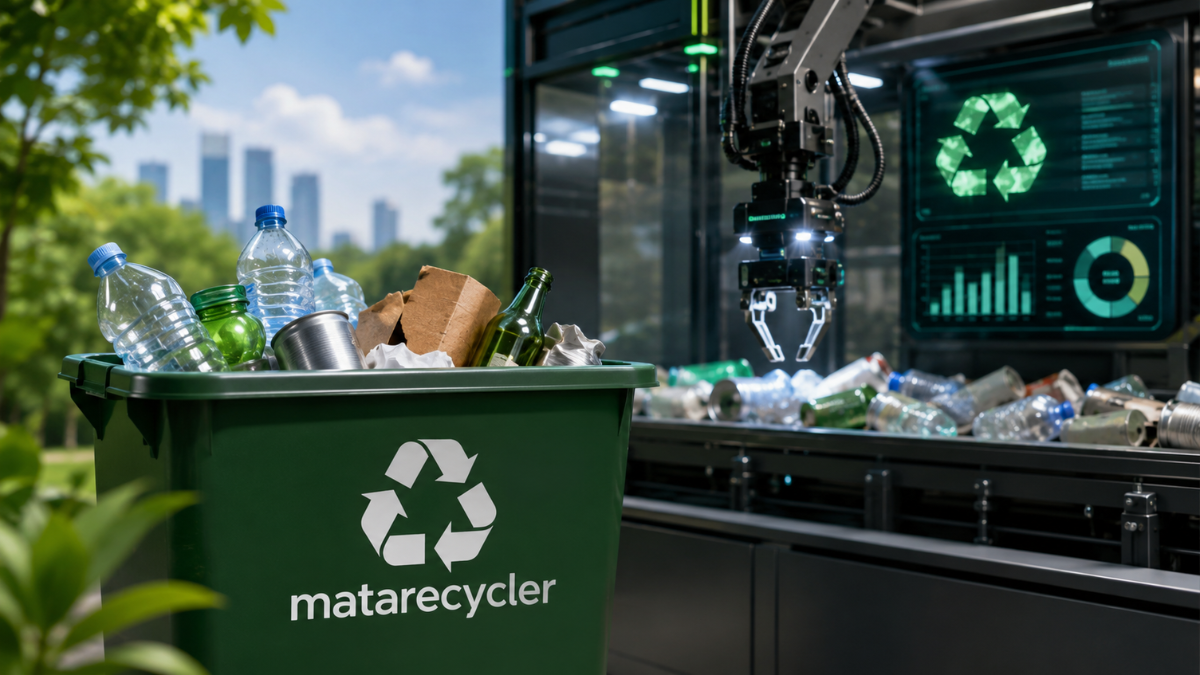
MataRecycler is best understood as a recycling and sustainability information platform, although some third-party articles describe the name more broadly as an AI-powered smart recycling system. Its official website focuses on recycling education, responsible waste management, sustainability, and environmental awareness rather than presenting detailed specifications for a commercial recycling machine.
That distinction is important. Technologies such as artificial intelligence, computer vision, robotic sorting, optical sensors, and waste analytics are genuinely changing modern recycling. However, capabilities demonstrated by companies such as AMP, TOMRA, or Greyparrot should not automatically be attributed to MataRecycler without direct supporting evidence.
Understanding that difference makes it easier to answer the real question behind searches for MataRecycler: what is it, how does smart recycling actually work, and which claims can currently be supported?
What Is MataRecycler?
MataRecycler describes itself as a platform designed to make recycling and sustainable living easier to understand. Its official About page focuses on practical recycling information, waste reduction, responsible disposal, environmental awareness, and guidance for individuals, organizations, and communities.
Elsewhere online, however, MataRecycler is sometimes presented as a more elaborate smart waste management technology involving artificial intelligence, automated sorting, smart sensors, mobile applications, connected bins, and data dashboards.
Those descriptions create an entity problem.
Based on the available primary information, it is safer to describe MataRecycler itself as an environmental and recycling information platform while treating AI sorting, robotics, smart bins, and advanced recycling analytics as technologies within the broader smart-recycling industry unless stronger MataRecycler-specific documentation becomes available.
This distinction does not weaken the subject. It actually makes the discussion more useful because the underlying technologies are real and increasingly important.
There is also an unrelated older use of the phrase “Mata Recycler” associated with scripts intended to remove certain USB or Recycler malware. That computing meaning is separate from the recycling and sustainability topic discussed here.
Why MataRecycler and Smart Recycling Matter in 2026
The amount of waste produced worldwide continues to place pressure on collection systems, recycling infrastructure, municipalities, and the environment.
The World Bank’s What a Waste 3.0 estimates that the world generated about 2.56 billion tonnes of municipal solid waste in 2022. Under a business-as-usual scenario, annual waste generation could rise to approximately 3.86 billion tonnes by 2050. The same research shows substantial differences between countries in waste collection, treatment, and disposal capacity.
Those differences matter because there is no universal recycling system. A material accepted in one city may not be recyclable through another city’s collection program. Local processing capacity, contamination rules, transportation costs, regulation, labor, and demand for recovered materials can all affect what happens after something enters a recycling bin.
The United States provides another useful example of why statistics need context. The U.S. Environmental Protection Agency’s latest comprehensive national dataset for all municipal solid waste materials covers 2018. That dataset reported 292.4 million U.S. tons of municipal solid waste generated, with approximately 32.1% recycled or composted. It should therefore be described as a 2018 national figure, not as a current 2026 recycling rate.
The challenge is not simply producing more recycling equipment. It is recovering useful material more effectively while reducing contamination, unnecessary waste, operational costs, and dependence on virgin resources.
How Smart Recycling Works
Smart recycling combines conventional waste-processing methods with technologies that can improve identification, sorting, monitoring, or decision-making.
Waste normally begins with collection and source separation. Materials then arrive at a materials recovery facility, commonly called an MRF, where mixed recyclables may pass through screens, conveyors, magnets, optical sorters, air systems, manual quality-control stations, and other separation equipment.
Artificial intelligence can add another layer to this process.
Computer vision uses cameras and machine-learning models to recognize objects according to characteristics such as shape, appearance, packaging type, or other visual patterns. Sensor-based systems can also examine physical or chemical characteristics that ordinary cameras cannot identify reliably.
Once an object has been classified, that information can be used in different ways. A robotic arm may remove the item from a conveyor. An automated sorter may redirect it using compressed air. A monitoring platform may simply record the object and use the information to show facility managers what is moving through the plant.
These applications are related, but they are not identical.
A system that recognizes a plastic bottle does not necessarily physically sort it. A system that sorts a bottle does not necessarily guarantee that the bottle will eventually become a new product.
AI Waste Sorting, Computer Vision, and Robotics
Artificial intelligence is genuinely useful in recycling because waste streams contain enormous numbers of objects moving quickly through industrial facilities.
TOMRA, one of the established companies in sensor-based sorting, combines sensors, image processing, and artificial intelligence in recycling applications. Its GAINnext technology uses deep learning to classify objects that can be difficult to distinguish through conventional sensor rules alone.
AMP applies computer vision and machine learning to robotic waste sorting. In a published case study involving RDS of Virginia, AMP reported sustained performance of 80 picks per minute per robot, approximately 98% identification and recovery accuracy for the documented application, and a 10% increase in recovery.
These figures demonstrate what a specific AI-assisted system achieved under specific conditions. They are not evidence that every recycling AI system achieves 98% accuracy, nor should they be presented as MataRecycler performance.
That distinction becomes particularly important when comparing technology providers.
“Accuracy” could mean successful object recognition, correct material classification, successful robotic picking, recovery of a targeted commodity, or purity of the final material output. Those measurements are related but not interchangeable.
Waste Analytics Can Matter as Much as Robotic Sorting
Some smart recycling systems focus on understanding waste rather than physically moving it.
Greyparrot uses computer-vision systems installed above recycling conveyors to analyze waste streams continuously. Its technology can provide information about material categories, product types, contamination, and facility performance.
This kind of waste analytics can help operators identify where valuable recyclables are being lost, determine whether sorting changes are working, and compare facility performance over time.
That illustrates a broader lesson for MataRecycler-style smart waste management: automation does not always mean replacing people with robots.
Better information may sometimes provide greater value than another sorting machine.
If a recycling facility does not understand the composition of its incoming material or where losses occur, collecting reliable data may be the logical first step.
What Materials Can Smart Recycling Identify?
Modern recycling facilities may handle plastics, aluminum, steel, paper, cardboard, glass, packaging, and various other materials depending on the plant.
The important phrase is depending on the plant.
A computer-vision model may successfully identify an object that the local recycling system cannot economically process. Likewise, a packaging label saying “recyclable” does not guarantee that every municipality accepts the item.
Electronic waste demonstrates this difference clearly. Computers, phones, batteries, and other electronics contain recoverable materials, but they often require dedicated collection and specialist processing rather than ordinary household recycling.
Composite packaging can create similar problems because one object may contain several tightly bonded materials.
This leads to one of the most important principles in smart recycling:
Recognizing an object is not the same as recycling it.
Successful material recovery depends on collection, contamination levels, sorting technology, processing capacity, commodity markets, product design, and the existence of downstream buyers for the recovered material.
What Are the Real Benefits of MataRecycler-Style Smart Recycling?
The potential value of smart recycling comes from solving specific operational problems rather than simply adding AI to an existing process.
Computer vision can monitor material continuously. Robotic systems can perform repetitive sorting tasks at high speed. Waste analytics can reveal contamination or material losses that would otherwise be difficult to measure. Automated systems may also help facilities maintain more consistent performance when labor is limited.
The environmental benefits depend on what happens afterward.
Recovering more useful material can reduce the amount sent to disposal and decrease demand for some virgin raw materials. Better material purity can also make recovered commodities more useful to manufacturers.
However, environmental claims should be connected to actual material recovery rather than assumed from the presence of technology.
Installing an AI camera does not automatically reduce carbon emissions. The environmental benefit occurs when the technology contributes to measurable improvements such as additional recovery, higher-quality recycled feedstock, reduced unnecessary transport, or avoided disposal.
MataRecycler-Style Systems vs Traditional Recycling
The choice between traditional recycling and AI-assisted recycling is not as simple as replacing one with the other.
Modern materials recovery facilities already rely on combinations of mechanical separation, magnets, screens, optical sorting, air separation, conveyors, and human quality control. AI can complement these systems by improving classification, adding continuous monitoring, or controlling robotic equipment.
Traditional systems may remain perfectly suitable for predictable waste streams or facilities where advanced automation would not generate enough additional value to justify its cost.
AI-assisted systems become more attractive when a facility faces high material volumes, difficult sorting decisions, labor constraints, significant contamination, valuable recoverable materials, or poor visibility into what is being lost.
The best technology is therefore not necessarily the most advanced one.
It is the system that solves the facility’s actual bottleneck at an acceptable cost.
What MataRecycler and AI Recycling Cannot Do
Smart recycling technology has practical limits that are easy to overlook.
Waste does not arrive on a conveyor as clean, perfectly separated objects. Packages may be crushed, torn, covered in food residue, partially hidden, nested inside one another, or mixed with visually similar materials.
Computer-vision models can become less reliable as scenes become more complex or objects overlap. Research into industrial waste recognition continues to examine these real-world challenges because laboratory-style accuracy does not always translate directly to messy operating environments.
Infrastructure creates another limitation.
Even perfect sorting would not create a recycling market for a material that no nearby processor wants. Transportation costs can make technically recyclable materials economically unattractive. Local rules may also exclude materials that another city accepts.
Automated equipment introduces its own requirements, including maintenance, cleaning, software updates, employee training, downtime planning, spare parts, and integration with existing machinery.
For smaller communities or facilities, those costs may outweigh the benefits.
Recycling Is Not the Same as Waste Prevention
A common assumption is that increasingly intelligent recycling will solve the waste problem.
That view is incomplete.
Recycling begins after a product or package has already become waste. In many situations, preventing unnecessary material use creates a larger benefit than improving how that material is sorted afterward.
The broader circular-economy approach therefore includes reducing unnecessary consumption, designing durable products, extending useful life, repairing goods, reusing materials, simplifying packaging, and recycling what cannot reasonably be prevented or reused.
AI-assisted recycling remains valuable because large quantities of waste will still require processing. But smarter sorting should complement waste prevention rather than become an excuse to produce unlimited disposable material.
How Communities and Businesses Should Approach Smart Recycling
Organizations considering a MataRecycler-style approach should begin with the waste stream rather than the technology.
The first practical question is what is currently going wrong.
A municipality may have a household contamination problem. A materials recovery facility may be losing valuable PET plastic in its residue stream. A commercial property may have poor source separation. A manufacturer may need better information about its discarded materials.
Each problem requires a different response.
If household behavior is the main issue, clearer instructions, better bin design, or education may outperform expensive industrial automation.
If valuable recyclable material is being lost on a high-volume sorting line, computer vision, optical sorting, or robotics may make more sense.
If managers cannot determine where losses occur, continuous waste analytics may be the better starting point.
Technology should follow diagnosis, not replace it.
How to Evaluate Smart Recycling Performance
Any organization considering advanced recycling technology should establish a baseline before installation.
Without baseline performance, it becomes difficult to determine whether the technology actually improved anything.
Recovery rate measures how much targeted recyclable material is successfully recovered. Material purity indicates how much unwanted material remains in a recovered stream. Contamination shows how much inappropriate material enters or remains within the recycling process.
Throughput measures how much material a facility can process during a given period, while uptime reveals how consistently equipment remains operational.
Financial evaluation should consider installation, integration, maintenance, energy, training, downtime, labor changes, and the value of additional recovered material.
The most useful question is not “How accurate is the AI?”
It is:
What measurable improvement does the technology produce under our operating conditions, and is that improvement worth the total cost?
Costs and ROI Need Facility-Specific Evidence
One weakness in many articles about MataRecycler and smart recycling is the absence of credible cost information.
There is no single meaningful price for “AI recycling.”
A camera-based analytics installation, a robotic sorting unit, a complete optical sorting line, and a citywide smart-bin project have very different capital and operating requirements.
Return on investment can also change depending on labor costs, waste volume, commodity prices, landfill or disposal charges, existing infrastructure, maintenance, and the amount of additional material recovered.
For that reason, claims such as a universal 40%, 50%, or 60% cost reduction should be treated cautiously unless the facility, methodology, period, and comparison baseline are clearly identified.
A documented pilot is generally more valuable to a decision-maker than a broad marketing percentage.
Local Recycling Rules Still Matter
MataRecycler and smart waste technology operate within local waste systems.
A household in one country may have kerbside separation for glass, paper, plastics, food waste, and metals, while another community may have limited collection infrastructure or rely heavily on informal recovery.
Even neighboring cities can accept different materials.
Businesses and residents should therefore use local collection guidance when deciding what belongs in a recycling bin rather than relying only on a universal recycling symbol or generic online advice.
For municipalities, technology selection should also reflect local labor costs, available processing facilities, transport distances, regulation, disposal prices, and end markets for recovered materials.
There is no single smart-recycling configuration that makes sense everywhere.
Is MataRecycler Worth Using ?
The answer depends on what someone means by MataRecycler.
If the term refers to the platform described on MataRecycler’s own website, its primary role is educational: helping people understand recycling, waste reduction, environmental responsibility, and sustainable practices.
If the term is being used more broadly to represent AI-enabled smart recycling, then the technology category is already well established. AMP demonstrates robotic sorting, TOMRA provides sensor-based and deep-learning sorting technologies, and Greyparrot applies computer vision to continuous waste analytics.
What remains less clearly documented is whether all the smart bins, mobile applications, performance percentages, municipal deployments, and other product features attributed to MataRecycler in third-party articles belong to a specific commercial MataRecycler system.
A business, city, or recycling facility evaluating such a product should therefore ask for direct evidence. Technical specifications, named installations, documented before-and-after results, operating requirements, maintenance obligations, pricing, and clearly defined performance metrics matter far more than general claims about AI.
The Future of MataRecycler and Smart Recycling
Artificial intelligence is likely to become increasingly integrated with conventional recycling infrastructure rather than replacing it completely.
Deep-learning recognition is improving the ability of sorting systems to distinguish difficult objects. Computer-vision platforms can increasingly analyze waste streams continuously. Robotics can automate repetitive picking tasks, while connected software can help operators interpret plant performance.
TOMRA has continued expanding AI-supported sorting technologies, including deep-learning systems designed for applications where traditional classification methods can struggle.
The practical future therefore looks less like a completely autonomous recycling plant and more like a connected system in which cameras, sensors, conventional sorting equipment, AI models, robots, software, and experienced people work together.
The organizations that benefit most will probably be those that apply this technology selectively to measurable problems rather than automating simply because AI is available.
FAQs
What is MataRecycler?
MataRecycler’s own website describes it as an information platform focused on recycling, sustainability, responsible waste management, and environmental awareness. Some third-party sources describe the name more broadly in connection with smart recycling technologies.
How does MataRecycler work?
There is not enough publicly available primary documentation to describe a specific MataRecycler commercial system in technical detail. The wider smart-recycling industry uses technologies such as computer vision, sensors, machine learning, robotics, optical sorting, and waste analytics.
Is MataRecycler an AI recycling system?
Some online articles describe it as one, but those claims should be distinguished from MataRecycler’s own description of itself. AI recycling technology itself is real and is currently used by companies such as AMP, TOMRA, and Greyparrot.
Can AI improve recycling?
Yes. Documented systems show that AI can improve object recognition, automate selected sorting tasks, provide continuous waste-stream analysis, and help operators identify material losses. Actual benefits depend on the facility, waste stream, equipment, and implementation.
Can MataRecycler reduce recycling contamination?
Smart recycling tools can potentially help identify contamination and improve sorting, but a MataRecycler-specific contamination reduction rate should not be claimed without direct supporting evidence.
Can AI recycle every material?
No. AI can help identify or sort materials, but recyclability also depends on material composition, contamination, available processing technology, collection systems, and demand for the recovered material.
Can smart recycling eliminate landfills?
No. Better recycling can divert useful materials from disposal, but some residual waste remains. Waste prevention, reuse, product redesign, composting where appropriate, recycling, and responsible disposal all have roles in a complete waste-management system.
Are AI recycling systems expensive?
Costs vary considerably. A waste-analytics camera system and a complete robotic or optical sorting installation are fundamentally different investments. Site-specific quotes, integration costs, maintenance, labor effects, and expected additional recovery should be considered before calculating ROI.
Will AI replace recycling workers?
AI can automate particular inspection and sorting tasks, but recycling facilities still require people for operations, maintenance, quality control, safety, equipment management, troubleshooting, and decision-making.
Can households use MataRecycler?
MataRecycler’s educational content can be useful to general readers. Industrial AI sorting technologies, however, are primarily designed for recycling facilities, waste operators, manufacturers, municipalities, and other organizations handling substantial material volumes.
Final Takeaway
MataRecycler is most useful when understood within the larger movement toward better recycling and more responsible waste management.
Its official presence focuses on recycling and sustainability information, while many discussions around the term connect it with a broader technological shift involving artificial intelligence, computer vision, robotics, sensors, and waste analytics.
Those technologies are real. Documented systems from companies such as AMP, TOMRA, and Greyparrot demonstrate that AI can recognize waste, support robotic sorting, analyze recycling streams, and help operators recover materials more effectively.
What should not be assumed is that every impressive capability reported in the smart-recycling industry belongs specifically to MataRecycler.
For readers, the practical next step is to follow local recycling guidance and focus on reducing contamination and unnecessary waste. For businesses, municipalities, and recycling facilities, the better approach is to measure the current waste problem first, identify the operational bottleneck, test an appropriate technology, and compare measurable results against the total cost.
That evidence-first approach gives MataRecycler a more useful meaning than simply calling it “the future of recycling.” Smart recycling succeeds when technology solves a real material-recovery problem, fits the local waste system, and produces results that can actually be measured.
You May Also Like DPSIT

Wyvernity Team is a content writing team with 3 years of experience in creating clear, engaging, and SEO-friendly content for Wyvernity.com.