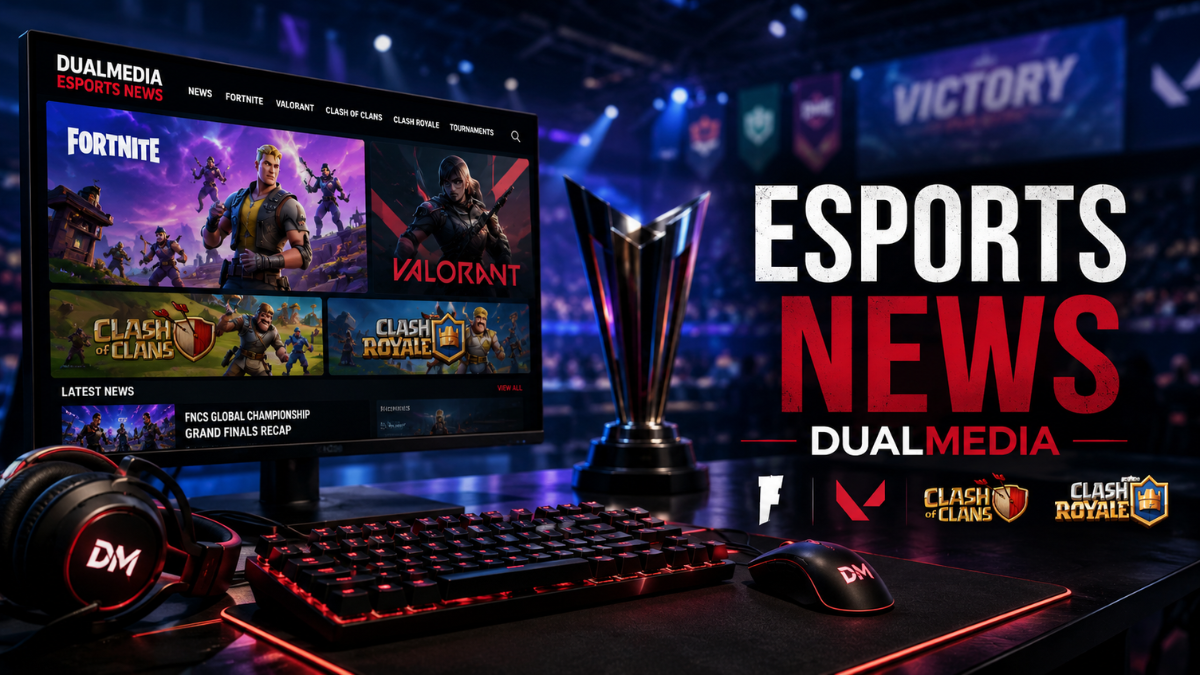
Esports News DualMedia is the competitive-gaming and gaming-media publication associated with DualMedia, a French web and mobile agency based in Paris. Its current coverage centers on Fortnite, Valorant, Clash of Clans, and Clash Royale while also extending into tournament news, gaming technology, strategy, and wider industry developments.
What makes the topic worth clarifying is DualMedia’s history. The organization has documented earlier involvement with competitive players and esports events, but its present public-facing identity is primarily that of a gaming publication. Understanding that distinction makes it easier to judge what DualMedia covers, where its perspective comes from, and when readers should verify a report with an official developer, team, player, or tournament organizer.
What Is Esports News DualMedia?
DualMedia Esports describes itself as the esports branch of DualMedia and publishes news, analysis, gaming guides, results, game updates, competitive developments, and strategy-oriented content. Its official site prominently organizes coverage around Fortnite, Valorant, Clash of Clans, and Clash Royale. The broader gaming section also reaches beyond those four games into hardware, industry developments, tournaments, and other gaming subjects. DualMedia Esports
That makes DualMedia best understood as an esports and gaming media property with strong game-specific verticals, rather than a website dedicated only to professional match results.
The distinction matters because a reader searching for “esports news DualMedia” may encounter descriptions that treat DualMedia as an active competitive team, a news organization, or both at the same time. Historical evidence supports earlier competitive involvement, but that does not automatically prove that DualMedia currently operates active professional rosters across the games it covers.
How DualMedia Esports connects to the French DualMedia agency
DualMedia Esports is connected to DualMedia, a French digital agency working in web and mobile services. The esports site identifies the organization with Paris and links its gaming activity to the agency’s broader digital-media operation. DualMedia Esports
DualMedia also operates a separate technology-oriented publication, DualMedia Innovation News, which focuses on subjects such as artificial intelligence, cybersecurity, crypto, mobile technology, and the web.
The relationship is therefore relatively simple. DualMedia is the broader digital agency, DualMedia Esports is its gaming and competitive-esports publication, and DualMedia Innovation News covers technology more broadly.
Keeping those properties separate improves entity clarity and prevents unrelated technology topics from being attributed to the esports publication.
Was DualMedia actually an esports team?
There is documented evidence that DualMedia has participated directly in competitive gaming.
Its own Fortnite player archive refers to current and former players dating back to the organization’s earlier esports years. The archive contains player profiles, competitive histories, recruitment information, and tournament-related material.
Independent competition records also show DualMedia Esports appearing in Valorant competition. VLR.gg records DualMedia Esports in a European First Strike qualifier in November 2020. Riot Games introduced First Strike as Valorant’s first major tournament series, making this useful evidence of real competitive participation rather than merely an editorial association with the game.
Historical Fortnite reporting likewise identifies players competing under the DualMedia name. This supports the conclusion that DualMedia’s esports background is genuine.
The more careful wording, however, is that DualMedia has documented historical competitive-team experience and now operates primarily as an esports and gaming media property. Saying that it currently competes professionally in every title it covers would require fresh evidence.
What Does DualMedia Cover in Competitive Gaming?
DualMedia’s strongest editorial structure comes from its game-specific coverage.
Rather than treating competitive gaming as one broad category, the site maintains dedicated sections for Fortnite, Valorant, Clash Royale, and Clash of Clans. That allows readers to move directly into the competitive ecosystem that matters to them.
Fortnite news, updates, and competitive strategy
Fortnite has one of the clearest connections to DualMedia’s historical esports activity.
The current publication covers Fortnite updates and competitive developments, while older sections document the organization’s involvement with individual players. That combination means readers may encounter both current editorial coverage and historical material about DualMedia’s earlier competitive scene.
For Fortnite readers, the most useful subjects are likely to include seasonal changes, patches, competitive events, strategy shifts, and changes to the game’s meta.
In competitive gaming, the “meta” refers to the strategies, weapons, characters, compositions, or approaches that are currently considered most effective. Because game updates can change the meta quickly, older strategy articles should always be read with their publication date in mind.
Valorant rosters, patches, VCT, and meta analysis
DualMedia also maintains a dedicated Valorant section that covers areas such as agents, patches, competitive developments, and the Valorant Champions Tour.
This type of coverage is useful because Valorant news rarely exists in isolation.
A balance change to one agent can alter team composition. A map-pool adjustment can change tournament preparation. A roster move can affect roles, communication, and tactical identity. A tournament result may matter less because of the score itself than because it reveals a changing strategic trend.
That is where specialist esports coverage can add value beyond simply reproducing a Riot Games announcement.
Clash of Clans and Clash Royale coverage
Supercell’s Clash of Clans and Clash Royale also have dedicated space within the site.
DualMedia’s Clash of Clans coverage includes updates, strategies, base-related guidance, Town Hall developments, attacks, and competitive topics.
Clash Royale coverage naturally revolves around cards, decks, balance changes, progression systems, and competitive strategy.
These sections matter because they show that DualMedia’s esports focus is not limited to PC shooters or battle royale games. Mobile competitive gaming is part of the publication’s core structure.
Broader gaming and industry coverage
The general DualMedia gaming blog goes beyond those four verticals.
It includes coverage of other games, esports events, gaming hardware, industry economics, releases, and broader changes affecting players and competitive gaming.
This broader scope is useful, but it also means readers should not assume every DualMedia Esports article is about professional esports. Some content belongs more naturally to general gaming journalism.
What Makes Esports News DualMedia Different?
The biggest defensible difference is not that DualMedia has secret access to players or technology that other outlets lack.
Its more credible distinction is the combination of a documented competitive history and a current specialized gaming publication.
Historical player records show that DualMedia previously dealt directly with recruitment, competition, player profiles, and tournament activity. That background can provide useful context when discussing how players approach competitive games.
However, competitive history alone does not guarantee accurate analysis.
A strong esports article still needs current information, clear reasoning, credible sources, and a distinction between confirmed facts and interpretation. The value of an insider perspective depends on how well that knowledge is applied to the specific story being covered.
That is an important difference from some third-party descriptions of DualMedia, which make broad claims about professional trust, exclusive access, advanced analytics systems, and technology partnerships without always providing direct evidence.
How Does DualMedia Verify Esports News?
DualMedia’s current gaming editorial material states that its reporting process gives priority to primary sources such as developer communications and relevant data sources.
That is a useful editorial principle, but it should be described accurately: it is DualMedia’s stated methodology, not an independently audited certification that every article is error-free.
The distinction is important in esports because developing stories move quickly.
If Riot Games changes a Valorant ability, Riot’s patch notes are the primary source. If Epic Games changes Fortnite tournament rules, Epic or the organizer should be checked. If a professional team announces a roster move, the team and player are usually stronger confirmation sources than a reposted rumor.
Specialist journalism becomes particularly useful after that first layer of verification. It can explain why the announcement matters, how it connects with previous results, and what effects it may have on players or competition.
A practical verification chain is therefore straightforward: establish the core fact through the developer, organizer, team, or player, then use specialist reporting to understand the context.
DualMedia also publishes a disclaimer acknowledging that information on the site may contain errors or omissions.
That does not make the publication unreliable. It reinforces an important principle for readers: credibility should be evaluated at the article level, not assumed from the publication name alone.
How DualMedia Covers Breaking Esports News
Breaking esports news creates a tension between speed and accuracy.
Roster changes, tournament rulings, qualification results, balance patches, and player announcements can spread across X, Discord, streams, and community forums before official confirmation appears.
Publishing first may attract attention, but publishing too early creates obvious risks.
The best way to read any breaking esports report is to check what the article actually claims. Is the information confirmed? Is it attributed to an official source? Is it described as a rumor? Has the story been updated since publication?
Publication dates are especially important.
A strategy guide published months ago may still be useful if the game has not changed materially. A roster article from several days ago may already be obsolete. A tournament schedule can become inaccurate if organizers change match times.
Esports content does not age at one uniform rate.
How DualMedia Turns Game Updates Into Strategy Insights
Developer patch notes tell players what changed. Specialist analysis should explain why the change matters.
That is one of the most useful roles an esports publication can perform.
In Valorant, changing an agent’s abilities can affect map control, team composition, site execution, or defensive setups. In Clash Royale, even a small balance adjustment can shift deck matchups. In Clash of Clans, a new troop, defense, or Town Hall mechanic can reshape attack planning. Fortnite updates can change weapon priorities, rotations, loadouts, or tournament strategies.
DualMedia’s current content categories emphasize patches, agents, decks, strategy, competitive metas, and game-specific updates.
The distinction between fact and analysis should remain clear.
A patch value published by a developer is a verifiable fact. Saying that the patch will make one strategy dominant is an interpretation that future competition may prove right or wrong.
That uncertainty is not a weakness. Good analysis explains the reasoning behind the prediction instead of presenting it as certainty.
The Human Side of DualMedia’s Competitive Gaming History
Some third-party articles describe player wellness, mental preparation, and daily professional routines as defining parts of DualMedia’s current editorial operation.
The available first-party evidence supports a narrower conclusion.
DualMedia’s historical player archives contain profiles discussing individual backgrounds, competitive performance, roles, recruitment, and playing style.
That clearly adds a human dimension beyond tournament standings.
What the available evidence does not establish is a large current editorial program built around regular mental-health reporting, professional wellness interviews, or exclusive long-form interviews with leading players and coaches.
Those may be worthwhile areas for future coverage, but they should not be presented as established features without evidence.
This is a useful example of why source verification matters. A claim can sound plausible because it fits modern esports journalism, yet still lack documentation specific to the publication being described.
Does DualMedia Have an Insider Perspective?
Yes, but the phrase needs qualification.
DualMedia’s historical competitive involvement gives it more direct esports context than a publication created solely as a generic gaming-content site. Its archived player pages and competition records show that it has operated within competitive gaming rather than merely observing it from outside.
That background can help with subjects such as player development, recruitment, team structures, tournament pressure, and competitive strategy.
It does not mean every current writer personally competed at a professional level, nor does it prove access to every team or tournament.
The most accurate interpretation is that the organization has documented institutional experience in competitive esports, which can contribute useful context when combined with current sourcing.
Grassroots and Emerging Esports
DualMedia’s archived material also provides evidence of involvement with younger and developing competitive players.
Some player profiles discuss how competitors were recruited or identified through trials and tournament performance. This supports describing DualMedia as having historical exposure to emerging talent rather than focusing exclusively on established professional stars.
Grassroots coverage can be valuable because the next generation of competitive players often develops outside major international leagues.
However, historical player information also creates a freshness problem. Ages, teams, locations, competitive status, and career plans can change.
An archived profile should therefore be treated as a record of a player at a specific point in time, not as a current biography unless it has been updated.
How Technology Is Changing Esports Media Coverage
Modern esports reporting depends heavily on digital technology.
Live streaming allows journalists and fans to watch tournaments as they happen. VODs and replay systems make individual rounds or matches available for closer analysis. Statistical databases provide historical performance data. Social platforms distribute announcements almost instantly.
These technologies affect the entire esports media industry.
They should not automatically be described as proprietary DualMedia tools.
Some competing articles have attributed advanced analytics dashboards, AR and VR experiences, or specialized data partnerships directly to DualMedia. The evidence available for this article does not sufficiently confirm those claims.
That distinction is important.
It is accurate to say that analytics, immersive broadcasting, replay systems, streaming, and augmented reality are changing esports coverage generally. It is not accurate to say that DualMedia itself operates a particular technology platform unless the organization documents that capability.
Where to Follow DualMedia Esports News
The official DualMedia Esports website is the most useful starting point because it gives readers access to the publication’s main gaming feed and dedicated game categories.
DualMedia also maintains an X presence connected to its esports identity.
Its website lists additional social channels, including YouTube and other platforms used for content distribution.
The best channel depends on what the reader needs.
Social platforms are useful for fast alerts and links to developing stories. Full articles provide more room for sourcing and explanation. Game-specific sections are better for readers who want to avoid unrelated gaming subjects.
For important competitive decisions, however, even a fast social post should be checked against the official developer, tournament organizer, team, or player announcement.
Esports News DualMedia Compared With General Gaming Sites
DualMedia sits somewhere between a specialist esports publication and a broader gaming website.
General gaming sites may cover hundreds of releases, entertainment stories, hardware launches, reviews, and industry announcements while dedicating less space to the competitive details of individual games.
Highly specialized esports outlets often focus more narrowly on professional rosters, tournaments, rankings, and match results.
DualMedia combines elements of both models.
Its Fortnite, Valorant, Clash of Clans, and Clash Royale categories provide focused pathways for readers, while its broader gaming blog expands into industry and technology subjects.
That can be useful for readers who want competitive context without following a publication limited entirely to tournaments.
The trade-off is that no secondary publication is the primary authority for every type of information.
Riot Games is closer to official Valorant patches and competition rules. Epic Games is closer to Fortnite changes. Supercell is the primary source for Clash Royale and Clash of Clans updates. Tournament organizers are authoritative for their own schedules and rulings.
DualMedia adds the most value when it interprets those developments and explains their competitive significance.
Is Esports News DualMedia Worth Following in 2026?
For the right audience, DualMedia Esports can be a useful addition to an esports news routine.
It is particularly relevant to readers following Fortnite, Valorant, Clash Royale, Clash of Clans, and broader gaming developments. Its primarily French-language positioning also makes it especially relevant within French and European gaming audiences.
Its historical competitive activity adds context that a purely generic gaming-content website may not have.
At the same time, the strongest reason to follow DualMedia is not the assumption that every article contains exclusive information. Its value is more practical: it combines game-specific reporting, strategy discussion, competitive context, historical esports involvement, and broader gaming coverage in one publication.
Readers should still cross-check information when accuracy directly affects them.
If you are entering a tournament, use the organizer’s rules. If you are reacting to a patch, read the developer notes. If a roster rumor is developing, look for confirmation from the team or player. Then use specialist reporting such as DualMedia to understand the wider implications.
What Claims About DualMedia Should Be Treated Carefully?
Several claims frequently repeated in third-party articles are stronger than the available evidence supports.
Descriptions of DualMedia as universally trusted by professional gamers, a platform with extensive exclusive access to leading players, an operator of proprietary AR or VR experiences, or a partner in sophisticated esports analytics systems should not be repeated as established facts without direct documentation.
The same caution applies to claims about specific global expansion plans or current professional rosters.
This does not mean those claims are necessarily false.
It means they remain insufficiently verified for responsible publication.
That distinction is one of the most important reality checks for this topic. A strong article does not become more authoritative by repeating impressive claims. It becomes more trustworthy by clearly separating what is documented, what is interpreted, and what remains uncertain.
FAQs
What is Esports News DualMedia?
Esports News DualMedia refers to the esports and gaming publication associated with French web and mobile agency DualMedia. Its dedicated coverage includes Fortnite, Valorant, Clash of Clans, and Clash Royale alongside wider gaming and industry topics.
Is DualMedia an esports team or a news website?
Historically, DualMedia has documented competitive players and tournament involvement. Its current public-facing operation is primarily an esports and gaming publication. Historical team activity should not automatically be interpreted as proof of current professional rosters.
Who operates DualMedia Esports?
DualMedia Esports is associated with DualMedia, a French digital agency based in Paris that works across web, mobile, and digital services.
Which games does DualMedia cover?
Its main dedicated game sections cover Fortnite, Valorant, Clash of Clans, and Clash Royale. Its broader gaming blog also publishes about additional titles, tournaments, gaming technology, and industry developments.
Does DualMedia cover Fortnite esports?
Yes. Fortnite is one of DualMedia’s main game categories, and the organization also maintains historical archives connected with former Fortnite players and competitive activity.
Does DualMedia cover Valorant esports?
Yes. Its Valorant coverage includes subjects such as agents, game patches, competitive developments, and VCT-related topics. Historical tournament databases also record DualMedia Esports participating in Valorant competition.
Is DualMedia Esports reliable?
It can be useful for gaming news, context, and analysis. DualMedia states that it checks primary sources, but rapidly changing information should still be verified through developers, teams, players, or tournament organizers when accuracy is important.
Where can I follow DualMedia Esports?
The official website is the clearest source for its complete coverage, while its X account and other social platforms can be useful for discovering updates and newly published articles.
Does DualMedia cover amateur or grassroots esports?
Its historical archives show involvement with emerging and developing competitors. Current grassroots activity should be evaluated based on recent coverage rather than assumed from older team records.
How is DualMedia different from a general gaming website?
DualMedia combines broad gaming reporting with dedicated competitive verticals and a documented history of involvement in esports. This gives it a more competition-focused context than a publication covering games only as general entertainment.
Final Takeaway: What DualMedia Adds to Esports Coverage
Esports News DualMedia is best understood as a French gaming and esports media property shaped by documented earlier involvement in competitive gaming. Its strongest current relevance comes from dedicated coverage of Fortnite, Valorant, Clash of Clans, and Clash Royale, supported by broader gaming and industry reporting.
Its competitive history can provide useful context, but that history should not be confused with proof that DualMedia currently operates professional teams in every game it covers. Likewise, claims about exclusive access, proprietary analytics technology, or major expansion plans deserve verification before being repeated.
For readers, the most practical approach is simple: use DualMedia for specialized reporting, strategy context, game-specific coverage, and interpretation, while relying on Epic Games, Riot Games, Supercell, tournament organizers, teams, and players for definitive announcements when details are still developing.
That balance is what makes specialist esports journalism useful. Official sources establish what happened. Publications such as DualMedia can help explain why it matters.
You May Also Like Voozon Com

Wyvernity Team is a content writing team with 3 years of experience in creating clear, engaging, and SEO-friendly content for Wyvernity.com.