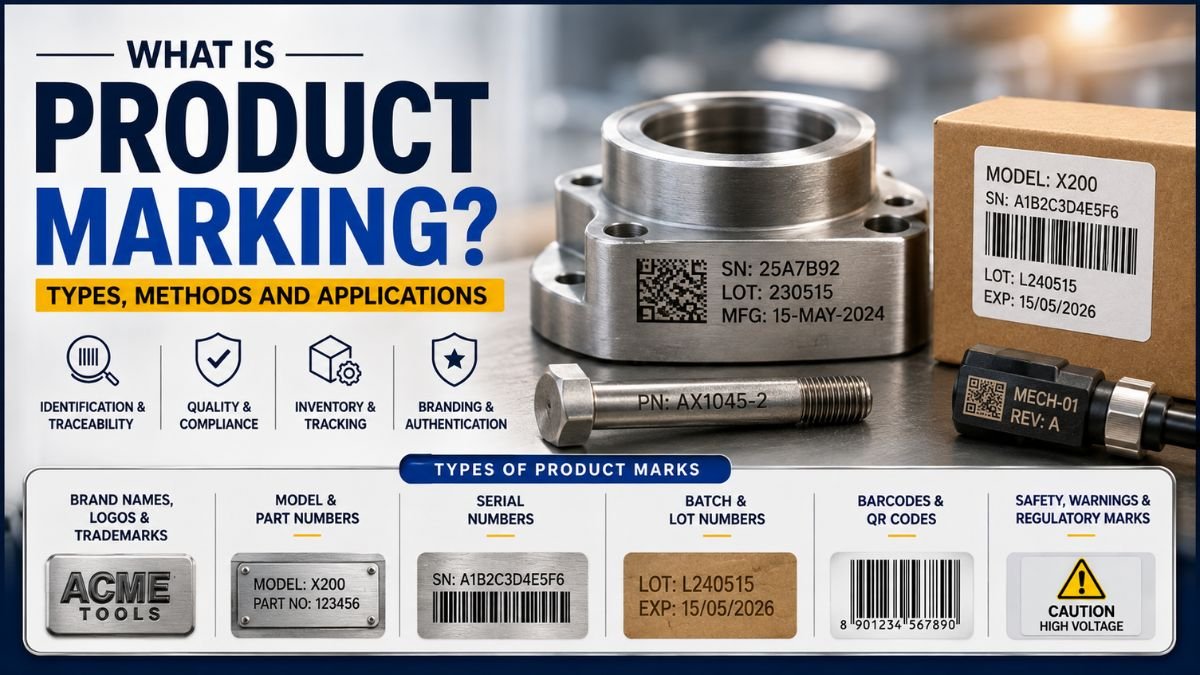
Product marking is the process of placing identifying, traceability, safety, compliance, or branding information on a product, component, label, or package. A product mark may be a serial number, batch code, barcode, QR code, date, logo, warning, model number, or regulatory symbol.
Manufacturers use product marking to identify products, trace them through production and distribution, communicate important information, meet applicable regulatory requirements, support quality control, and help distinguish genuine products from counterfeits.
There is one important distinction that is often overlooked: the type of product mark and the method used to create that mark are not the same thing. A Data Matrix code, for example, is a type of mark. Laser marking, inkjet printing, or dot peen marking may be the technology used to apply it.
Understanding this difference makes it much easier to choose the right product marking solution.
What Is Product Marking?
Product marking means applying information directly to a product or indirectly through its packaging, nameplate, or label so that people or automated systems can identify, understand, track, or verify it.
The information may remain the same for every unit, such as a brand logo or model name. It may also change from one product to another, such as a serial number, production date, expiration date, or batch number.
Machine-readable product markings have become particularly important in modern supply chains. GS1 standards, for example, use barcodes and other data carriers to connect physical products with identifiers and information such as lot numbers, serial numbers, and dates. These systems support automated identification and product tracking between manufacturers, logistics providers, retailers, healthcare organizations, and other supply-chain participants.
Product marking therefore serves two audiences at the same time. Consumers may use it to understand what a product is, when it expires, how it should be used, or whether certain warnings apply. Manufacturers and supply-chain partners use many of the same markings for inventory management, traceability, production control, recalls, maintenance, and authentication.
Why Is Product Marking Important?
Product marking is important because modern manufacturing depends on knowing exactly what a product is, where it came from, and what happened to it during its lifecycle.
Traceability is one of its most valuable functions. A product identifier can connect a physical item with information about its manufacture, batch, location, inspection history, or distribution. GS1 describes traceability in terms of identifying objects, capturing their identifiers and attributes, and sharing relevant information across the supply chain.
This becomes especially important when a defect is discovered. A manufacturer that identifies products only by model may have difficulty isolating affected units. Batch-level marking narrows the issue to a particular production group, while serialized identification can identify an individual item. GS1’s traceability framework specifically distinguishes between class-level, batch or lot-level, and individual serialized identification.
Product marking also supports quality control. Inspection results, manufacturing records, maintenance information, and corrective actions can be connected to serial or lot numbers instead of relying on an item’s appearance alone.
For consumers, marking provides information such as product identity, instructions, warnings, certification information, dates, and manufacturer details. For businesses, it can improve inventory management, service operations, warranty verification, anti-counterfeiting measures, and regulatory documentation.
Types of Product Marks
The easiest way to understand product marking types is to classify them by the information they communicate rather than by the machine that produces them.
Brand Names, Logos and Trademarks
Brand markings identify the manufacturer, brand, or product family. These can appear as printed graphics, engraved logos, molded symbols, embossed names, or laser-created designs.
Although branding is often considered primarily a marketing function, permanent brand markings can also make unauthorized product substitution or relabeling more difficult. In industrial components, branded marks may help technicians identify the manufacturer long after the original packaging has disappeared.
The required durability depends heavily on the product. A logo on disposable packaging does not need the same abrasion, temperature, or chemical resistance as a logo placed on an industrial tool expected to remain in service for twenty years.
Model and Part Numbers
Model numbers and part numbers distinguish one product specification from another.
They are particularly important when several components look almost identical but have different capacities, dimensions, materials, electrical characteristics, or compatibility requirements.
Automotive, aerospace, electrical, industrial equipment, and machinery manufacturers commonly rely on part identification because selecting an incorrect component can create production, maintenance, or safety problems.
Serial Numbers
A serial number identifies an individual product rather than an entire product type.
Serialization provides much greater traceability than simply placing the same model number on every item. Manufacturers can associate a serial number with production records, inspection results, warranty information, maintenance activity, software configuration, or distribution history.
For products with high traceability requirements, serial numbers are often encoded in both human-readable text and machine-readable symbols.
Batch and Lot Numbers
Batch or lot numbers identify groups of products manufactured, processed, or packaged under related conditions.
They are especially useful when quality problems may affect a production batch rather than every unit of a product. Food, pharmaceutical, chemical, medical, automotive, and industrial manufacturers commonly use lot identification for quality management and recall processes.
The practical difference between a serial number and batch number is therefore important. A batch number answers, “Which production group did this item belong to?” A serial number can answer, “Which exact item is this?”
Manufacturing and Expiration Dates
Date marking communicates time-related information such as manufacturing dates, packaging dates, best-before dates, use-by dates, or expiration dates.
The correct wording and legal requirements depend on the product and market. Manufacturers should therefore determine the applicable regulation rather than assuming that the same date-marking rules apply to every product category or country.
From a production perspective, date codes are usually variable data. That makes technologies such as continuous inkjet, thermal inkjet, thermal transfer overprinting, laser coding, and print-and-apply labels useful because the information can change automatically during production.
Barcodes
Barcodes convert identifiers and other data into machine-readable symbols.
Traditional one-dimensional barcodes such as EAN and UPC are widely associated with retail products. Other barcode formats are designed for distribution, logistics, healthcare, and industrial applications.
GS1 notes that its barcodes can encode identifiers as well as attributes such as serial numbers, batch or lot numbers, and dates.
The barcode itself should not be confused with the underlying identifier. For example, a GTIN is an identification number, while a barcode is a data carrier capable of representing that number in machine-readable form.
QR Codes and Data Matrix Codes
Two-dimensional codes can store information in a smaller area than traditional linear barcodes and are useful where space is limited or more data needs to be encoded.
GS1 identifies 2D symbols as data carriers capable of holding more information than 1D barcodes while occupying relatively little physical space.
QR codes are familiar to consumers because smartphones can scan them, but industrial product identification frequently uses Data Matrix codes as well.
Direct part marking is particularly relevant for components that need machine-readable identification throughout their service life. ISO/IEC TR 24720 describes approaches to applying permanent machine-readable symbols directly to components, parts, and products and covers factors such as marking methods, surface preparation, location, and protective coatings. The 2008 technical report remains published but was formally moved toward revision in 2026.
Safety Warnings and Instructions
Some product marks communicate hazards, operating restrictions, handling requirements, electrical ratings, temperature limits, disposal instructions, or other information needed for safe use.
These markings must remain readable for an appropriate period. A warning that disappears during normal cleaning, handling, outdoor exposure, or maintenance may fail its intended purpose even if it looked perfect immediately after production.
Compliance and Certification Marks
Compliance and certification markings deserve special attention because different symbols have different legal meanings.
A manufacturer should never assume that a familiar-looking logo can simply be added to a product. The correct mark depends on the product category, applicable regulation, target market, conformity assessment procedure, and sometimes third-party certification.
CE marking is a good example. CE marking is required only for products covered by EU harmonized rules that specifically require it. When applicable, the manufacturer is responsible for ensuring conformity with relevant requirements before affixing the mark. The European Commission explicitly warns that products outside the applicable CE legislation must not carry CE marking.
CE marking should therefore not be described simply as a general “quality certificate.” It is a conformity marking connected to specific EU product legislation.
The situation in Great Britain also requires current information rather than old assumptions. GOV.UK guidance updated on August 21, 2026 describes both UKCA and CE routes for products placed on the market in England, Scotland, and Wales, subject to the rules that apply to the product.
Other marks work differently. The ETL Listed Mark, for example, indicates that Intertek has independently tested and certified a product to applicable safety standards within the scope of its certification program.
CSA Group certification marks similarly indicate conformity with specified standards associated with the particular certification.
This distinction matters. CE, UKCA, ETL, CSA, and other markings should not all be grouped together as though they represent the same assessment process.
Main Product Marking Methods
Once the required information has been defined, the manufacturer must decide how the mark will actually be produced.
The best method depends on material, production speed, durability, mark size, required contrast, available space, environmental exposure, data variability, maintenance requirements, and total operating cost.
Laser Marking
Laser marking uses focused laser energy to alter a material or surface without using a conventional printing plate or ink.
“Laser marking” is actually a broad category rather than one single process. Depending on the material and desired result, the laser may create annealing, engraving, ablation, foaming, black marking, or a color change. TRUMPF similarly describes laser marking as a collective term covering several different processes whose suitability depends on material and quality requirements.
One of the major advantages of laser systems is permanent, digitally controlled marking without an ink-based printing process. They can create text, serial numbers, codes, graphics, and logos and can be integrated into automated manufacturing systems.
However, “laser marking works on everything” is an oversimplification. The wavelength, material composition, additives, coatings, surface finish, required contrast, and marking parameters all affect the result.
Plastics provide a good example. A laser may cause color change, surface alteration, foaming, or removal of a coating depending on how the material absorbs the wavelength.
Laser Annealing
Laser annealing heats appropriate metals to create a visible surface color change without substantially removing material.
It is particularly valuable when maintaining a smooth surface is important. TRUMPF describes annealing as producing an oxide layer through controlled heating while leaving the surface intact, with steels and titanium among the relevant materials.
This makes annealing attractive for certain medical instruments, consumer products, and precision components where deep grooves would be undesirable.
Laser Engraving and Ablation
Laser engraving removes material to create depth, while ablation can selectively remove coatings or surface layers.
These approaches can produce durable markings but may change the component surface in ways that annealing does not. That difference can matter for dimensional tolerances, corrosion performance, hygiene requirements, coatings, or later processing.
The correct laser process should therefore be selected by testing the actual substrate rather than choosing a machine simply because it is described as a “laser marker.”
Dot Peen Marking
Dot peen marking, also called pin marking or micro-percussion, creates a mark by repeatedly striking the material with a stylus.
The individual impacts form letters, numbers, logos, or machine-readable symbols. Rather than relying on ink, the process physically deforms the surface.
Technomark describes dot peen marking as permanent marking created through successive stylus impacts and material deformation.
Its durability makes dot peen especially useful for metal components, machinery, vehicle parts, castings, fabricated structures, tools, and other products exposed to demanding conditions.
The tradeoff is that it is a contact process. Because the surface is physically displaced, it may not be appropriate where cosmetic appearance, thin walls, delicate components, highly controlled surface finishes, or contamination-sensitive surfaces are critical.
Continuous Inkjet Printing
Continuous inkjet, usually called CIJ, is a non-contact printing technology widely used for variable production codes.
CIJ systems create a continuous flow of small ink droplets. Selected droplets are electrically controlled and directed toward the product to form characters or codes while unused ink is recirculated.
The non-contact design makes CIJ suitable for moving production lines and for products whose surfaces are curved, irregular, or difficult to touch with a printhead.
Common applications include lot codes, dates, production information, identifiers, and short text on bottles, cans, cartons, cables, pipes, components, and other products.
Its main limitation is that the mark depends on ink adhesion and durability. The correct ink must be matched to the substrate and operating environment. Cleaning, solvent use, consumables, printhead maintenance, drying conditions, and chemical exposure can affect long-term results.
Thermal Inkjet Printing
Thermal inkjet, or TIJ, uses controlled heating inside an ink cartridge to eject droplets through microscopic nozzles.
It is commonly chosen when high-resolution text, barcodes, and graphics are important. It can work particularly well on packaging and appropriate porous or non-porous surfaces when the correct ink is selected.
Compared with CIJ, the printhead generally needs to remain closer to the substrate, which can make product positioning more important on irregular or highly variable production lines.
TIJ may therefore be an excellent choice for one application but a poor choice for another. Resolution alone should not determine the technology.
Thermal Transfer Overprinting
Thermal transfer overprinting, or TTO, is commonly used for flexible packaging.
A heated printhead transfers pigment from a ribbon onto the packaging material.
TTO can create high-quality variable information such as dates, batch codes, ingredients, barcodes, and graphics on films, pouches, labels, and flow-wrap packaging.
The process produces excellent results on suitable flexible materials, but ribbon consumption and changeovers become part of operating cost and maintenance planning.
For some packaging applications, newer laser approaches may provide an alternative. However, direct comparison depends on film composition, mark color, production speed, code content, equipment integration, and other manufacturing requirements. Current industry guidance still emphasizes testing the actual packaging material before choosing between TTO and laser.
Labels and Stickers
Labels remain one of the most flexible product marking solutions.
Instead of modifying the product itself, information is printed on a separate material and then applied to the product or package.
Labels can include branding, regulatory information, instructions, barcodes, variable data, warnings, ingredients, and promotional information in a single area.
Their main advantage is flexibility. Manufacturers can change artwork and information relatively easily without changing the underlying product.
Their main weakness is that durability depends on the label stock, adhesive, printing technology, environment, surface preparation, and product lifecycle. Moisture, oils, chemicals, heat, UV exposure, abrasion, cleaning, or poor adhesion can cause a label to fade, peel, or become unreadable.
A label should therefore not automatically be treated as the “cheap option.” For some applications it is the technically correct option; for others, direct part marking provides better lifecycle performance.
Electrochemical Marking
Electrochemical marking creates permanent markings on electrically conductive materials by combining an electrolyte, stencil, and electrical current.
It is particularly associated with metals and can create dark, precise identification marks without the cutting action of mechanical engraving.
The technique can be practical for certain metal tools, components, and small-volume applications, especially when deep engraving is unnecessary.
Its limitations include the need for conductive materials, stencil management, process chemicals, surface preparation, and appropriate control of the electrochemical process.
Mechanical Engraving, Stamping, Embossing and Debossing
Mechanical engraving removes material using a cutting tool and is useful where physical depth and permanence are required.
Stamping uses a die or character set to deform the surface, while embossing raises a design and debossing presses it below the surrounding surface.
These established techniques remain valuable even though laser and digital printing systems receive more attention. For high-volume packaging, molded components, metal nameplates, tags, or simple permanent identification, a mechanical process may still provide the best combination of durability, cost, and production speed.
Modern technology is not automatically better if a simpler process already meets the requirement reliably.
Product Marking Methods Compared
| Marking method | Typical strengths | Important limitations | Common applications |
|---|---|---|---|
| Laser marking | Permanent, precise, digitally controlled, no ink consumable | Material and wavelength compatibility must be tested; capital cost can be higher | Metal and plastic components, electronics, medical products, automotive parts |
| Dot peen | Deep, durable direct marking | Physically deforms surface and creates mechanical contact | Machinery, automotive parts, castings, structural components |
| CIJ | Fast, non-contact, suitable for moving and irregular products | Ink, solvents, adhesion and maintenance must be considered | Dates, lot codes, cables, bottles, cans and packages |
| TIJ | High-resolution text and machine-readable codes | Print distance and substrate compatibility matter | Cartons, labels and packaging |
| TTO | High-quality variable printing on flexible packaging | Uses ribbons and typically requires contact with film | Pouches, wrappers and flexible packaging |
| Labels | Highly flexible and capable of carrying large amounts of information | Adhesion and environmental durability vary | Consumer goods, logistics, chemicals and packaging |
| Electrochemical marking | Permanent marking on conductive metals | Limited to suitable conductive surfaces and requires process consumables | Tools, metal parts and nameplates |
| Mechanical engraving or stamping | Deep, durable and established | Tool wear, contact forces and lower flexibility may matter | Metal parts, tags, plates and industrial components |
The most important conclusion from this comparison is that there is no universally best marking technology. A permanent laser mark may be unnecessary for disposable packaging, while a removable adhesive label may be unacceptable for an engine component expected to remain identifiable after years of service.
How to Choose the Right Product Marking Method
The selection process should begin with the marking requirement, not the machine.
First determine what information must appear. A fixed logo, changing expiration date, serialized Data Matrix code, regulatory symbol, or safety warning creates very different technical demands.
Next consider how long the mark must remain readable. Some marks only need to survive distribution and retail. Others must remain identifiable after years of heat, abrasion, chemicals, sterilization, outdoor exposure, maintenance, or repainting.
Material compatibility is equally important. Stainless steel, anodized aluminum, ABS plastic, glass, cardboard, flexible film, cable insulation, and painted steel respond differently to the same marking technology.
Production conditions should also be considered. A method that works perfectly on a stationary laboratory sample may struggle on a high-speed line where products vibrate, change orientation, or pass the marking station with inconsistent spacing.
Machine readability adds another requirement. A Data Matrix code that looks acceptable to the human eye may still be unreliable for a vision system. Contrast, quiet zones, cell shape, surface reflection, distortion, marking position, and code verification can all influence scanning performance.
Maintenance and operating cost matter as well. Laser systems may reduce dependence on ink or ribbons but require appropriate extraction, guarding, optics maintenance, safety systems, and capital investment. Inkjet systems require inks and maintenance. TTO consumes ribbon. Dot peen systems experience stylus wear. Labels require stock, adhesive management, applicator maintenance, and replacement rolls.
The correct comparison is therefore based on total production requirements rather than machine purchase price alone.
Product Marking in the Automotive Industry
Automotive manufacturing depends heavily on traceability because thousands of components move between suppliers, assembly operations, vehicles, and service networks.
Product marks may identify engines, transmission components, chassis parts, castings, electronic modules, bearings, structural components, and other parts.
Depending on the component, manufacturers may use laser marking, dot peen, labels, inkjet printing, or other direct part marking technologies.
A key challenge is lifecycle durability. Some marks must survive painting, oils, temperature changes, cleaning chemicals, road contamination, or years of mechanical use. That often makes permanent direct part marking more attractive than ordinary printing.
Product Marking in Aerospace
Aerospace parts may require long-term identification across manufacturing, assembly, inspection, maintenance, repair, and replacement.
Space and weight can be limited, while components may face extreme temperatures, chemicals, vibration, and repeated maintenance.
Selecting the marking process therefore requires more than asking whether the mark is visible. The process must also be compatible with the component material and any applicable engineering or regulatory requirements.
For critical parts, manufacturers should validate the marking method rather than assume that maximum marking depth is automatically desirable.
Product Marking for Medical Devices
Medical-device marking illustrates why product identification and regulation cannot be separated.
In the United States, the FDA’s Unique Device Identification system requires device labelers, subject to applicable exceptions and requirements, to place a UDI on device labels and packages. Devices intended for multiple uses and reprocessing may also be subject to direct-marking requirements. The UDI is provided in both human-readable and machine-readable forms.
The purpose extends beyond basic product identification. The FDA states that UDI supports more precise device identification and can improve post-market monitoring, adverse-event analysis, and patient-safety activities.
Marking technology must therefore be selected with considerations such as readability, sterilization, cleaning, corrosion, surface condition, and the intended service life of the device.
Laser processes such as annealing can be valuable for suitable metals when maintaining a relatively smooth surface is important.
Product Marking in Food and Beverage Manufacturing
Food and beverage production often requires high-speed variable coding.
Typical information includes production dates, lot numbers, best-before or use-by information, and internal traceability codes.
Packaging materials vary widely, including glass, plastic bottles, metal cans, cardboard cartons, flexible films, foil laminates, caps, and direct food-contact packages. As a result, no single coding technology dominates every application.
CIJ may be suitable for high-speed non-contact coding. TTO is widely used with flexible film. Lasers can produce permanent marks on compatible packages. Labels may carry larger amounts of product information.
The practical challenge is often not simply producing the code but keeping it readable under actual line conditions, including condensation, product handling, packaging variation, washdown environments, high throughput, or exposure to refrigeration.
Product Marking in Electronics
Electronics manufacturers use product marking for component identification, serial numbers, production tracking, compliance information, branding, and machine-readable codes.
Small components create an obvious challenge: the marking area may be tiny.
Laser marking can be useful on suitable electronic components because high-resolution information can be created without conventional ink. TIJ, labels, pad printing, or other technologies may be better for other surfaces and production processes.
Electronic products may also carry regulatory or certification information, but the exact symbols depend on the product and target market. Manufacturers should verify the applicable rules rather than copying marks from competing products.
Product Marking in Consumer Goods
For consumer products, product marking often serves several functions simultaneously.
A single product or package may contain a brand logo, model information, barcode, recycling information, manufacturing code, instructions, safety warnings, country-of-origin information, and regulatory marks.
This creates a different problem from industrial direct part marking. The challenge may be fitting large amounts of information onto limited packaging space while maintaining readability and visual appeal.
Labels, molded marks, laser engraving, inkjet printing, embossing, and conventional package printing may all be combined within the same product.
Product Marking for Anti-Counterfeiting and Authentication
Product marking can support anti-counterfeiting, but a visible serial number or QR code should not be treated as a complete anti-counterfeiting system by itself.
A counterfeit manufacturer can sometimes reproduce a static logo or copy a legitimate code.
Stronger systems connect unique identifiers with trusted databases, controlled serialization, verification processes, secure supply-chain data, tamper evidence, or other authentication technologies.
The marking is therefore often the physical entry point into a larger identification system rather than the entire security solution.
This distinction is important when companies evaluate QR codes. A QR code can provide convenient access to digital information, but security depends on what identifier it contains, whether it can be duplicated, how the backend validates it, and what happens when the same identifier is scanned repeatedly.
Common Product Marking Mistakes
One common mistake is selecting a marking machine before defining the actual requirement. A manufacturer may purchase a laser because it sounds permanent or buy an inkjet printer because it appears inexpensive, only to discover that the technology does not work reliably with the real substrate or production environment.
Another mistake is assuming that every permanent mark should be as deep as possible. Deep marking can be useful, but additional material displacement or removal can be undesirable on thin, precision, fatigue-sensitive, hygienic, or coated components.
Companies also sometimes focus on the appearance of a barcode without verifying its machine readability. A code should be tested under the actual scanning conditions expected in production and downstream use.
A further mistake is treating regulatory symbols as decorative graphics. CE, UKCA, ETL, CSA, UDI-related information, and similar markings have defined meanings and requirements. Their use should follow applicable regulations or certification programs.
Poor placement can also cause failure. A technically excellent mark may become unreadable after assembly if another component covers it, if the area becomes scratched during manufacturing, or if reflections make automated scanning unreliable.
Finally, businesses sometimes test marks immediately after application but fail to evaluate lifecycle durability. A mark should be tested after realistic exposure to cleaning, heat, abrasion, chemicals, sterilization, weather, bending, packaging friction, or whatever conditions the product will actually encounter.
Direct Part Marking or Labels: Which Is Better?
Neither approach is universally better.
Direct part marking is usually more attractive when identification needs to remain with a component even after packaging, labels, and documentation are removed. It is especially valuable for parts that require lifecycle traceability.
Labels are often better when large amounts of information must be displayed, designs change frequently, multiple colors are required, product surfaces cannot be altered, or packaging already provides a suitable labeling area.
Some products benefit from both. A machine component might carry a permanent Data Matrix code while its packaging carries a larger label with shipping information, warnings, human-readable descriptions, and additional barcodes.
The correct question is therefore not “Should we use direct marking or labels?” but “Which information must remain permanently associated with the product, and which information only needs to remain with the package?”
Permanent Marking Does Not Always Mean Better Marking
It is tempting to assume that the most permanent marking technology is automatically the most advanced choice.
In practice, permanence should match the product lifecycle.
Deep engraving on disposable packaging adds little value. A high-cost laser system may be unnecessary for products whose markings only need to survive a few months. Conversely, a paper label may be inappropriate for a metal part expected to undergo years of cleaning, heat, and maintenance.
The best product marking system is the one that remains readable for the required period, works reliably at the required production speed, meets applicable standards, protects the product, and does so at an acceptable total cost.
That is a more useful decision criterion than simply asking which marking technology is newest.
How to Test a Product Marking Solution Before Implementation
A marking system should ideally be evaluated using the exact production material rather than a generic sample supplied by the equipment vendor.
Testing should reproduce the actual surface condition, including coatings, oils, textures, colors, and manufacturing variation.
The sample should then be exposed to conditions that represent the product lifecycle. For an automotive component, that might include chemicals, abrasion, heat, painting, or cleaning. For flexible packaging, testing may involve bending, sealing, refrigeration, or surface friction. For a medical component, cleaning or sterilization conditions may be relevant.
Machine-readable marks should also be checked using the intended scanners or vision equipment.
Finally, the marking process should be evaluated at realistic production speed. Creating a perfect mark in a demonstration room at low throughput does not prove that the process will remain stable during continuous manufacturing.
This validation stage is one of the most effective ways to prevent expensive mistakes.
What Is the Best Product Marking Method?
There is no single best product marking method for every product.
Laser marking is often a strong choice when permanent, precise, digitally controlled direct marking is required on a compatible material. Dot peen is valuable when deep and durable mechanical marking is appropriate. CIJ works well for high-speed variable coding on moving products. TTO is particularly useful for flexible packaging. TIJ can provide high-resolution digital printing, while labels remain highly versatile when large amounts of information or frequently changing designs are needed.
The correct choice depends on material compatibility, required durability, production speed, mark content, code quality, environmental exposure, regulations, maintenance, consumables, automation requirements, and total cost.
Manufacturers should therefore define the marking requirement first and select the technology second.
Frequently Asked Questions About Product Marking
What is product marking in simple terms?
Product marking is the process of putting identifying or informative data on a product or its packaging. The mark may include a logo, serial number, batch number, barcode, QR code, date, warning, specification, or compliance symbol.
What is the purpose of product marking?
Its main purposes are product identification, traceability, quality control, consumer information, inventory management, regulatory compliance, branding, maintenance tracking, and authentication.
What are the main types of product markings?
Common types include logos and trademarks, model numbers, serial numbers, batch and lot codes, date codes, barcodes, QR codes, Data Matrix codes, safety warnings, technical specifications, and compliance or certification marks.
What are the most common product marking methods?
Common methods include laser marking, dot peen marking, continuous inkjet printing, thermal inkjet printing, thermal transfer overprinting, labeling, electrochemical marking, engraving, stamping, embossing, and debossing.
Is laser marking permanent?
Laser markings can be highly durable, but the result depends on the laser process, substrate, mark depth or surface change, and environmental conditions. Laser annealing, engraving, ablation, and plastic color-change processes create different types of marks, so “laser marking” should not be treated as one identical process for every material.
What is the difference between engraving and marking?
“Marking” is a broad term covering many processes. Engraving specifically involves removing or displacing material to create physical depth. A product can therefore be marked without being engraved.
What is direct part marking?
Direct part marking, or DPM, means applying identification directly to the component instead of placing the information only on a detachable label or package. It is commonly used when identification must remain with the item throughout its lifecycle. ISO/IEC guidance addresses factors involved in creating permanent machine-readable symbols directly on parts and products.
Are CE and UKCA marks quality certificates?
Not in the simple sense sometimes implied in marketing content. CE marking indicates conformity with applicable EU product rules for product categories subject to CE requirements. Current Great Britain guidance provides UKCA and CE conformity routes according to the applicable regulatory framework. Manufacturers should determine the exact legal requirements for their products before using either marking.
Why are barcodes important for product marking?
Barcodes allow machines to capture identifiers and other information quickly and consistently. GS1 standards support the encoding of product identifiers and attributes such as serial numbers, lots, and dates, helping connect physical products with supply-chain information.
Final Thoughts on Product Marking
Product marking is much more than printing a logo or date on a product. It connects physical products with manufacturing records, quality systems, supply chains, regulatory requirements, service information, and digital data.
The first decision should be what information needs to be communicated and how long it must remain usable. Only then should a manufacturer choose between laser marking, dot peen, inkjet, thermal transfer, labels, electrochemical marking, engraving, or another technology.
For short-life packaging, flexible digital printing may be the most practical solution. For a critical industrial component, permanent direct part marking may be more appropriate. For regulated products, the marking method must also preserve the visibility and accuracy of required information throughout the relevant product lifecycle.
Before investing in any marking system, test the actual product material, confirm the applicable compliance requirements, evaluate readability under realistic production conditions, and calculate ongoing maintenance and consumable costs as well as the initial equipment price.
A well-designed product marking system does not simply make a visible mark. It creates reliable identification that remains useful to manufacturers, supply-chain partners, regulators, service teams, and customers for as long as the product requires it.
You May Also Like UGE Schedule Source

Wyvernity Team is a content writing team with 3 years of experience in creating clear, engaging, and SEO-friendly content for Wyvernity.com.