
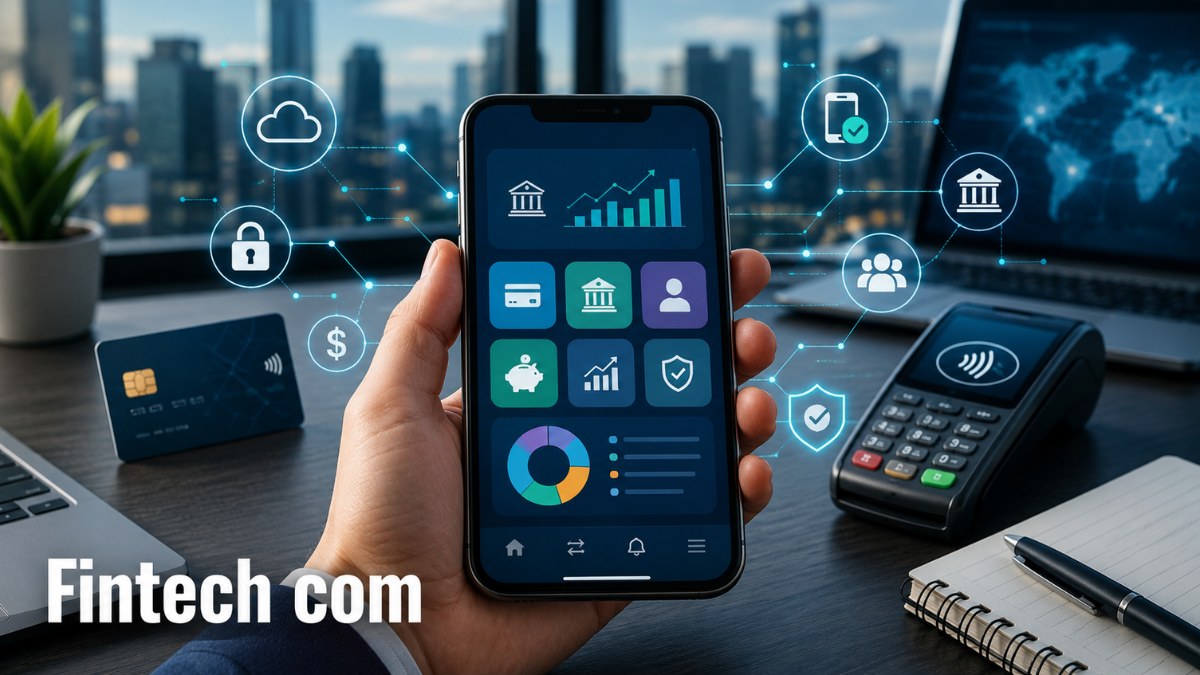
Fintech is the use of technology to deliver, automate, connect, or improve financial services. It allows people and businesses to make payments, manage accounts, borrow, save, invest, obtain insurance, and monitor money through digital platforms.
This Fintech com guide explains what financial technology means, how it works behind the screen, its main applications, and the risks users should evaluate before trusting a financial service with their money or personal information.
There is an important distinction to make at the beginning. Fintech.com is also the domain of Financial-Information-Technologies, a company that provides automated invoice, payment, and accounts-payable technology for businesses, including companies in the hospitality, retail, and beverage-alcohol industries. This article uses “fintech” in its broader industry sense rather than referring specifically to that company.
What Does Fintech com Mean in This Guide?
Fintech is short for financial technology. The Bank for International Settlements describes fintech as technology-enabled innovation in financial services, including new applications, processes, products, and business models.
Fintech is therefore not one application, product, or type of company. It is a broad financial ecosystem involving banks, startups, payment processors, insurers, investment platforms, software providers, data-connectivity companies, regulators, and financial infrastructure.
A consumer-facing fintech company may offer mobile payments, digital banking, personal loans, investment accounts, insurance, budgeting, or cryptocurrency services. Other fintech businesses operate behind the scenes by providing identity verification, account connections, fraud detection, regulatory reporting, cloud infrastructure, payment processing, or transaction monitoring.
Although the term is often associated with smartphones, financial technology existed long before mobile applications. ATMs, card-processing networks, electronic stock exchanges, automated credit systems, and online banking were all important stages in the digitization of finance.
The major change has been accessibility. Financial services that once required a bank branch, financial adviser, paper application, or desktop computer can now be delivered through a smartphone or web browser.
Why Fintech Matters in 2026
Fintech now influences routine financial decisions rather than remaining hidden in the back offices of financial institutions.
A person uses financial technology when sending money from a phone, paying through a digital wallet, depositing a check through a banking app, monitoring household spending, investing online, or applying for credit digitally.
Businesses use fintech to accept payments, issue invoices, manage payroll, control employee expenses, reconcile transactions, monitor cash flow, send money internationally, and obtain working capital.
Fintech also has an important relationship with financial inclusion. The World Bank’s Global Findex 2025 is based on nationally representative surveys of approximately 148,000 adults in 141 economies. It measures how people save, borrow, make payments, manage financial risk, access mobile phones, use the internet, and approach digital safety.
Digital access can make financial services available to people who live far from branches or have traditionally been underserved. However, an application cannot eliminate every barrier.
A person may still need reliable internet access, a suitable device, acceptable identification, digital literacy, affordable pricing, and confidence in the provider. Fintech may remove a branch or paperwork barrier while leaving economic, educational, and regulatory barriers unresolved.
Payment speed is another reason fintech matters. The Federal Reserve’s FedNow Service allows participating US banks and credit unions to send and receive transactions within seconds, 24 hours a day and seven days a week.
Other countries operate their own real-time payment systems. These services can improve convenience and cash flow, but faster payments may also leave less time to identify or stop an incorrect or fraudulent transaction.
Speed should therefore be evaluated together with fraud prevention, confirmation controls, dispute procedures, and customer support.
How Fintech Works Behind the Screen
A fintech service normally contains several interconnected layers.
The first layer is the interface the customer sees. This could be a mobile application, website, payment button, digital card, chatbot, merchant dashboard, or accounting platform.
The second layer is the software that manages identity checks, authentication, customer records, transaction instructions, data analysis, account balances, notifications, and security controls.
The third layer is the underlying financial infrastructure. A fintech provider may depend on banks, card networks, payment processors, custodians, broker-dealers, insurers, credit bureaus, cloud providers, and data-connectivity services.
The customer-facing brand is not necessarily the institution that holds the customer’s money or completes the final transaction.
How APIs Connect Financial Services
An application programming interface, usually called an API, allows approved systems to communicate and exchange information.
With the customer’s permission, an API may retrieve an account balance, import transaction records, verify account ownership, initiate a payment, or combine information from several financial institutions.
For example, a budgeting application may connect to a user’s bank and credit-card accounts. It imports authorized transaction information and organizes the data into spending categories.
The budgeting application provides the interface and analysis, while the financial institutions continue to hold the accounts.
What Is Open Banking?
Open banking allows consumers to authorize approved third parties to access specific bank-account information or initiate certain financial actions.
This can support budgeting tools, payment services, account comparisons, affordability checks, and financial dashboards.
Open finance extends the same principle beyond traditional bank accounts. It may include investments, insurance, pensions, mortgages, and other financial products.
The purpose is not to make financial data public. It is to give the customer greater control over which approved service can access specific information and for what purpose.
The effectiveness of open banking depends on secure technology, informed consent, reliable data, clear liability, and the user’s ability to withdraw permission.
Identity Verification and Financial Security
Financial providers usually verify a customer’s identity before allowing access to sensitive services.
Know Your Customer, commonly shortened to KYC, refers to procedures used to confirm who is opening or operating an account.
Anti-Money Laundering, or AML, controls are used to identify suspicious transactions and reduce the misuse of financial systems.
Authentication methods may include passwords, one-time verification codes, device checks, biometric recognition, security questions, and multifactor authentication.
These controls can reduce fraud, but they are not perfect. Criminals may use phishing, stolen identities, malicious applications, remote-access tools, or social engineering to bypass them.
What Happens During a Digital Payment?
Consider a hypothetical $50 transfer between two friends.
The sender opens a payment application and authorizes the transaction. The service checks the account status, funding source, security signals, and transaction limits.
The payment may be funded through a bank account, payment card, or stored application balance.
The fintech platform then communicates with one or more banks, payment processors, card networks, or account-to-account payment rails. The recipient receives a notification and may see the funds immediately.
However, the visible balance update and final financial settlement are not always the same event. The exact process depends on the service and funding method.
A payment that appears to involve one application may actually pass through several organizations.
The user may interact with a fintech brand, while a partner bank holds the money, an API provider connects the accounts, a payment processor handles the instruction, and a separate network completes settlement.
This is a central reality of fintech: modern interfaces often improve how people interact with finance without completely replacing the infrastructure underneath.
What Are the Main Types of Fintech?
Digital and Mobile Banking
Digital banking allows customers to access financial accounts through applications and websites.
Common services include checking accounts, savings accounts, transfers, digital cards, account alerts, mobile check deposits, bill payments, and financial statements.
Some digital banking services are operated directly by licensed banks. Others are offered through fintech companies that work with regulated banking partners.
Users should identify which legal entity provides the account, where the deposits are held, and which protections apply.
Digital Payments and Money Transfers
Payment technology helps individuals and businesses move money electronically.
This category includes mobile wallets, peer-to-peer transfers, online checkout systems, contactless payments, merchant card processing, payment links, international transfers, and account-to-account payments.
PayPal, Venmo, Cash App, and Zelle are familiar consumer examples. Stripe and Block provide payment infrastructure and merchant tools.
These companies belong within the payment cluster of fintech. They should not be treated as representing the entire financial-technology industry.
Digital Lending and Buy Now, Pay Later
Digital lending platforms allow consumers and businesses to apply for credit online.
Software may manage identity verification, document collection, credit assessment, approval, funding, repayments, and account monitoring.
This category includes personal loans, business financing, online mortgages, microloans, peer-to-peer lending, and buy now, pay later services.
The convenience of an online application does not guarantee affordable credit.
Borrowers should compare the annual percentage rate, interest charges, origination fees, late fees, repayment period, total repayment amount, automatic-payment conditions, and consequences of missed payments.
A small monthly payment can appear affordable while hiding a long repayment period or high total cost.
Wealthtech and Digital Investment Platforms
Wealthtech applies technology to investing and portfolio management.
It includes online brokerages, investment applications, automated portfolios, robo-advisers, portfolio-tracking tools, and financial-data aggregation.
Robinhood is associated with mobile brokerage services, while Betterment is associated with automated portfolio management.
These platforms have different investment products, fee structures, custody arrangements, risk levels, and revenue models.
An easy-to-use interface can improve access to investing, but it can also encourage frequent trading or risk-taking. Investors should judge a service by its costs, safeguards, available investments, suitability, and long-term value rather than by convenience alone.
Insurtech
Insurtech applies technology to insurance products and processes.
It may support quotations, applications, underwriting, risk assessment, policy administration, customer communication, claims submission, and claims processing.
Digital insurance platforms can reduce paperwork and speed up standard tasks. However, automated pricing and eligibility decisions may still depend on assumptions, historical data, regulatory rules, and the quality of information supplied by the customer.
Regtech and Compliance Technology
Regtech is short for regulatory technology.
It helps financial organizations meet legal and compliance obligations. Regtech systems may perform identity verification, sanctions screening, transaction monitoring, fraud investigation, regulatory reporting, recordkeeping, KYC checks, and AML controls.
Consumers may never directly interact with most regtech platforms. However, these systems can influence whether an account is approved, a transaction is delayed, or unusual financial activity is investigated.
Cryptocurrency and Blockchain-Based Finance
Cryptocurrency platforms allow users to buy, sell, store, transfer, or exchange digital assets such as Bitcoin and Ethereum.
This category includes exchanges, wallets, custodians, payment applications, decentralized financial protocols, and token-based services.
Blockchain is the distributed-record technology used by many digital assets. A smart contract is code designed to perform predefined actions when specified conditions are met.
Cryptocurrency is one part of fintech. It is not another word for the entire financial-technology industry.
Most fintech activity continues to involve conventional currencies, banks, card networks, investment institutions, insurers, and established payment systems.
Business Financial Technology
Business fintech includes payment processing, payroll, invoicing, accounting integrations, expense management, business cards, cash-flow monitoring, tax tools, fraud prevention, reconciliation, and international payments.
These services can be valuable to freelancers, e-commerce businesses, SaaS companies, retailers, hospitality businesses, and small organizations that cannot maintain a large internal finance department.
A business may use one platform to accept customer payments, another to manage expenses, and a third to record transactions in its accounting system.
This specialization can improve individual processes, but it may also create more integrations, subscriptions, security dependencies, and reconciliation work.
The most effective setup is not necessarily the one with the greatest number of tools. It is the one that removes an important operational bottleneck without creating unnecessary complexity.
How People Use Fintech in Everyday Life
Consumers encounter fintech when they send money to friends, pay bills, shop online, manage bank accounts, monitor spending, create budgets, save automatically, invest, buy insurance, or apply for loans.
A personal-finance application may combine several accounts into one dashboard. It can organize income, expenses, debts, subscriptions, and savings goals.
The value does not come merely from displaying more information. A useful service should help the person make a clearer financial decision or complete a task more efficiently.
Small businesses use fintech to collect payments, issue invoices, manage payroll, control employee expenses, reconcile sales, apply for financing, and monitor cash flow.
A retailer may use a payment processor to accept a sale, accounting software to record it, an expense platform to categorize operating costs, and a banking dashboard to monitor settlement.
Fintech can reduce manual work, but it can also fragment information across several systems. Businesses should evaluate the entire workflow rather than judging each tool in isolation.
Who Benefits From Fintech?
Individual consumers benefit when financial services become easier to access, understand, or manage.
Freelancers and independent professionals may use fintech for payment collection, invoicing, taxes, expense tracking, and retirement investing.
Small businesses and startups may gain access to payment processing, payroll, financial reporting, working-capital products, and cash-flow tools without developing those systems internally.
Banks and established financial institutions use fintech to improve customer interfaces, automate internal processes, monitor fraud, manage compliance, and compete with digital-first companies.
Investors and financial advisers use digital platforms for portfolio reporting, analysis, trading, risk assessment, and client communication.
Underserved communities may benefit from mobile accounts, digital payments, remittances, alternative service channels, and lower distribution costs.
However, financial inclusion should not be measured only by the number of applications available. Affordability, consumer protection, digital literacy, internet access, identity requirements, and service reliability remain important.
Fintech com vs. Traditional Banking
A fintech company uses technology to provide or improve a financial service, but it is not automatically a licensed bank.
Fintech services are often mobile-first and specialized. A platform may focus only on payments, investing, lending, or budgeting.
Traditional banks normally offer a broader financial relationship that may include deposit accounts, credit cards, mortgages, business banking, branches, telephone assistance, and established deposit infrastructure.
Fintech platforms may release new features more quickly and provide highly personalized interfaces. Traditional institutions may offer broader regulation, more mature support systems, and direct control over the financial accounts involved.
The boundary between the two models is becoming less clear.
Banks develop their own fintech products, purchase financial software, invest in technology companies, and provide accounts or payment access behind third-party applications.
Fintech companies may depend on banks for deposit accounts, lending capital, settlement access, licenses, and financial credibility.
The FDIC advises consumers using third-party financial applications to identify whether a bank is involved, where the funds are held, and whether deposit-insurance requirements are satisfied.
Fintech and traditional banking are therefore not always competing systems. They often operate together.
Fintech is unlikely to replace the entire banking system. It is more realistic to expect financial technology to replace, simplify, or redesign individual processes while continuing to rely on banks, payment rails, custodians, and regulated financial infrastructure.
What Are the Main Benefits of Fintech?
Fintech can reduce the need for branch visits, paper forms, manual data entry, and lengthy administrative procedures.
It can make account information easier to access and provide financial services outside standard business hours.
Digital platforms may combine balances, payments, investments, debts, subscriptions, and business expenses into a clearer interface.
Automated alerts can help users notice unusual transactions, upcoming bills, low balances, or changes in spending patterns.
Businesses may use fintech to connect payments with invoices, categorize expenses, automate payroll, reconcile transactions, and monitor cash flow.
Fintech can also increase competition. A specialized provider may offer a faster or more convenient alternative to a traditional service.
Automation may lower a provider’s operating costs, but those savings are not always passed to customers. One service may be inexpensive for standard use while charging more for withdrawals, foreign exchange, borrowing, or premium features.
Personalization is another potential benefit. An application may adjust reminders, financial insights, savings suggestions, or credit offers based on user data.
The trade-off is that personalization often requires greater access to financial information. Users should decide whether the added convenience justifies the amount of data being collected.
What Fintech Can and Cannot Do
Fintech can improve payment speed, account access, financial tracking, loan applications, automated investing, customer communication, business administration, and fraud monitoring.
It can help detect unusual activity, but it cannot eliminate fraud.
It can simplify a credit application, but it cannot guarantee approval or affordable borrowing.
It can automate investments, but it cannot guarantee profits or prevent market losses.
A budgeting application can categorize transactions, but it cannot completely understand every household priority.
A chatbot can answer routine questions, but it may fail when a customer needs to explain an unusual problem or dispute a complex error.
A digital insurance platform may process a standard claim quickly, but complicated cases may still require documentation, investigation, and human judgment.
The practical value of fintech is not determined by how advanced the technology appears. It is determined by whether the service solves a real problem with acceptable costs, protections, dependencies, and failure procedures.
How Fintech Companies Make Money
Fintech companies use different revenue models depending on the service they provide.
Payment companies may charge merchants or customers transaction fees, processing charges, withdrawal fees, currency-conversion margins, or expedited-transfer fees.
Card providers may earn interchange revenue when customers use their cards to make purchases.
Digital lenders can earn interest, origination charges, late fees, and servicing revenue.
Investment platforms may earn brokerage fees, subscription revenue, management fees, or compensation related to trade execution.
Business platforms may charge monthly software subscriptions, per-user fees, transaction-based charges, or a percentage of processed payments.
Other fintech providers receive referral commissions when users purchase financial products through their platforms.
A service described as free may still create an economic cost.
The provider may earn money through card use, interest on customer funds, foreign-exchange spreads, increased borrowing, frequent trading, product referrals, premium upgrades, or commercial partnerships.
The important question is not only whether an app charges an obvious fee. Users should ask how the business earns money and whether its revenue model encourages decisions that benefit the customer.
What Are the Risks and Limitations of Fintech?
Money May Not Be Protected as Users Expect
Money displayed inside a financial application is not automatically protected in the same way as money deposited directly with an insured bank.
The Consumer Financial Protection Bureau found that funds stored with some nonbank payment applications may be at risk if the company experiences financial distress. Such funds are not always placed in an insured bank or credit-union account and may lack individual deposit-insurance protection.
Payment applications differ. Some arrangements may qualify for pass-through insurance when specific requirements are met, while others may not.
Users should identify the institution holding their funds and read the account agreement rather than relying only on a bank logo or general insurance statement.
Financial Data Creates Privacy Risks
Fintech applications may process identity documents, income data, bank transactions, account balances, spending patterns, device information, location details, and behavioral signals.
This data can support account connections, personalization, credit assessment, and fraud detection.
It also increases the potential consequences of excessive data collection, weak cybersecurity, inappropriate sharing, or a breach.
Users should understand what information is collected, why it is needed, how long it is retained, which third parties receive it, and how access can be removed.
Automated Decisions Can Be Incorrect or Biased
Algorithms can assist with lending, insurance pricing, fraud detection, identity verification, investing, and customer support.
These systems may process more information than a human could review manually, but they can still rely on incomplete data, reproduce historical bias, or make decisions that are difficult to explain.
In the United States, creditors using complex algorithms must still provide accurate and specific reasons when taking adverse action against a credit applicant. Using machine learning does not remove that responsibility.
Consumers should have a way to correct inaccurate information, request an explanation, and challenge an important automated decision.
Customer Support May Be Too Automated
Chatbots and automated help centers are useful for routine questions, transaction updates, and basic navigation.
They are less effective when a customer needs to recover a locked account, dispute an unauthorized transaction, explain an unusual circumstance, or stop an urgent payment.
Automation may reduce operating costs for the provider, but that benefit matters less when customers cannot obtain qualified help during a serious financial problem.
Before relying on a fintech service, users should determine whether human support is available and how complaints are escalated.
Digital Finance Attracts Sophisticated Fraud
Fintech services face phishing, account takeovers, identity theft, malicious applications, fake websites, remote-access scams, and social engineering.
Artificial intelligence can make fraudulent messages, images, voices, and videos more convincing.
The Financial Action Task Force has highlighted the use of phishing emails, messaging applications, and AI-enabled deepfakes in cyber-enabled fraud.
Users should independently verify urgent payment requests, even when a message or voice appears to come from a friend, relative, employer, bank, or government agency.
Faster Payments Can Be Harder to Reverse
Instant payments can improve convenience and cash flow, but they may also reduce the time available to detect a mistake.
Some instant-payment transactions are designed to provide immediate and final settlement. Once money has been sent, recovering it may depend on the cooperation of the receiving institution or account holder.
Confirmation screens, recipient checks, transaction limits, and fraud warnings become more important as payment speed increases.
Digital Access Can Create New Exclusion
App-only services may disadvantage people without a suitable smartphone, stable internet access, acceptable identification, digital confidence, or accessible customer support.
Automated systems may also struggle with unusual income patterns, limited credit histories, disabilities, language barriers, or situations that do not fit standard digital workflows.
A service can be technologically advanced while remaining unsuitable for part of its intended audience.
How Fintech Is Regulated
There is no single global fintech law.
Regulation generally follows the financial activity being performed rather than the company’s marketing label.
A fintech provider may be subject to banking, payment, lending, securities, investment, insurance, privacy, cybersecurity, consumer-protection, KYC, or AML requirements.
A platform offering several products may operate through multiple licensed entities and regulators.
Rules differ between countries and markets. Deposit insurance, payment protection, lending disclosures, privacy rights, cryptocurrency treatment, and complaint procedures in one country may not apply elsewhere.
Consumers should identify the regulator responsible for the specific service in their jurisdiction.
The relevant authority may differ depending on whether the product is a deposit account, loan, insurance policy, investment service, payment platform, or cryptocurrency exchange.
Regulation does not eliminate every risk. It establishes obligations, supervisory processes, and accountability mechanisms.
Users must still compare prices, understand financial products, protect their accounts, and report suspicious activity promptly.
How Artificial Intelligence Is Changing Fintech
Artificial intelligence is used in financial services for document processing, transaction categorization, fraud detection, credit assessment, compliance monitoring, customer support, forecasting, and financial analysis.
Machine-learning systems can analyze large volumes of data and identify patterns that may be difficult to detect manually.
Generative models can summarize financial documents, explain account activity, prepare support responses, and provide conversational interfaces.
General-purpose systems such as ChatGPT, Gemini, and Claude are not themselves fintech companies. They may, however, be integrated into financial applications or used by consumers to ask financial questions.
An AI explanation should not automatically be treated as regulated or personalized financial advice.
Generative models can produce incomplete, outdated, biased, or inaccurate answers, even when the language sounds confident.
AI agents may eventually perform more complex tasks. An approved agent could compare financial services, prepare a transfer, manage bills, or initiate a payment within defined limits.
This creates important questions about consent, authentication, spending limits, liability, error correction, privacy, and human oversight.
The BIS notes that AI can improve back-office processing, regulatory compliance, fraud detection, and customer service. It also identifies risks related to financial stability, cybersecurity, model dependence, and AI-enabled fraud.
AI should therefore be treated as a tool within fintech rather than a replacement for legal responsibility, professional judgment, or consumer control.
Future Fintech Trends and Practical Implications
Real-time payments will continue to make account-to-account transfers faster and more widely available.
Embedded finance will place payments, lending, insurance, and banking functions inside nonfinancial platforms.
A customer may receive financing during an online purchase, buy insurance while booking a journey, or access payments inside business software without visiting a separate financial website.
This can reduce friction, but it may also make it harder to identify the actual financial provider, total cost, data-sharing arrangement, and regulator.
Open finance may allow users to connect a wider range of accounts and services. Its practical value will depend on secure consent, reliable data, interoperability, cybersecurity, and the ability to revoke access.
Tokenization may allow money and other assets to be represented and processed on programmable platforms.
In 2026, the BIS reported that Project Agorá had demonstrated how tokenized commercial-bank deposits and tokenized central-bank reserves could be combined on a shared platform for wholesale cross-border payments. The project also explored the use of smart contracts for workflow logic, compliance requirements, and conditional payment instructions.
These developments do not mean that all financial activity will immediately move to blockchain-based systems.
Adoption will depend on regulation, privacy, interoperability, financial stability, technical reliability, operating costs, and trust.
The strongest future fintech products may not be those with the most features. They are more likely to be the services that combine useful automation with transparent pricing, understandable decisions, secure infrastructure, and effective human support.
How to Evaluate a Fintech App or Company
Begin with the financial problem you need to solve.
A product should provide a clear benefit, such as cheaper payments, easier budgeting, faster invoicing, improved expense control, better financial visibility, or more convenient account access.
Confirm the company’s legal name and official website. Fraudulent applications and websites may imitate legitimate businesses.
Identify any bank, payment institution, lender, broker, custodian, or insurer involved in providing the service.
Check whether the relevant provider is licensed or regulated for the activity it performs.
Do not assume that the presence of a bank partner turns every product offered by a technology company into an insured bank account.
Determine where your money will be held and what protection applies.
Review withdrawal rules, transaction limits, account-freeze procedures, service interruptions, and the process used if the company closes.
Compare the total cost rather than one advertised fee.
Consider subscriptions, annual percentage rates, interest, origination charges, currency-conversion spreads, withdrawal fees, card charges, late fees, premium features, and early-access costs.
Review the privacy policy and account permissions. Understand which information the service collects, why it needs the data, who may receive it, and how you can remove authorization.
Look for multifactor authentication, device controls, transaction alerts, account-recovery protections, and a clear process for reporting fraud.
Test customer support before depositing a large amount of money or depending on the service for an essential business function.
Find out whether a human representative is available and how unresolved complaints are escalated.
Independent reviews may reveal repeated problems. Focus on recurring patterns involving withdrawals, account restrictions, hidden fees, security, and customer support rather than relying on one testimonial or complaint.
Avoid services promising guaranteed profits, risk-free investments, instant wealth, or credit approval without meaningful terms.
How to Use Fintech Safely
Download financial applications through the provider’s verified website or a trusted application store. Check the developer name because fake applications may imitate legitimate brands.
Use a unique password for every financial account and enable multifactor authentication.
Never share a password, one-time code, recovery phrase, or remote access to your device.
Keep the application, browser, and operating system updated.
Avoid accessing financial accounts through unsecured public Wi-Fi, particularly when moving money or changing security settings.
Turn on transaction alerts and review account statements regularly. Prompt attention can reduce the damage caused by unauthorized activity.
Before accepting credit, read the annual percentage rate, interest charges, fees, repayment schedule, late-payment consequences, and total amount repayable.
Verify unusual payment requests through a separate communication channel. Do not send money simply because a message, call, image, or video appears to come from someone you trust.
Close accounts that are no longer needed. Remove linked-bank permissions, download necessary records, and check what information the provider retains after closure.
Common Misconceptions About Fintech
Fintech is not limited to mobile banking. It also includes payments, lending, investments, insurance, regulatory compliance, personal-finance tools, cryptocurrency services, and business software.
Every fintech company is not a bank. Some are licensed financial institutions, while others provide technology or operate through regulated partners.
Fintech services are not always cheaper than traditional alternatives. A provider may remove one visible charge while earning money through subscriptions, spreads, interest, premium access, referrals, or transaction activity.
Cryptocurrency and fintech are not interchangeable terms. Cryptocurrency is one category within the broader financial-technology industry.
Automated financial advice is not automatically accurate or unbiased. The result depends on the model, available data, assumptions, safeguards, and user circumstances.
Fintech is not only for younger consumers. Older adults, families, businesses, charities, investors, and established financial institutions all use digital financial services.
Regulation does not mean every fintech service is equally safe. The applicable rules depend on the company, activity, legal entity, and jurisdiction.
Conclusion
The central lesson from this Fintech com guide is that financial technology should be judged by the problem it solves, not by how modern its interface appears.
Fintech can make banking, payments, borrowing, investing, insurance, and business administration faster and easier to access. It can also introduce hidden costs, data dependencies, weak support, automated decision risks, unclear account protection, and new opportunities for fraud.
Before choosing a fintech service, identify the legal provider, determine who holds the money, understand how the company earns revenue, and confirm which protections apply.
Review the complete cost, privacy terms, security controls, withdrawal process, complaint procedure, and account-closing conditions.
A fintech product is worth using when it provides a measurable benefit without requiring the user to surrender reasonable control over money, personal data, costs, or financial decisions.
You May Also Like Google Block Breaker
FAQs
What is fintech in one sentence?
Fintech is the use of technology to provide, automate, connect, or improve financial services.
Does fintech apply only to banking?
No. Fintech also includes payments, lending, insurance, investing, budgeting, cryptocurrency, regulatory compliance, and business financial operations.
Is mobile banking an example of fintech?
Yes. Mobile banking is one of the most widely used forms of financial technology.
Is PayPal a fintech company?
PayPal is generally classified as a fintech company because it uses digital technology to provide payment and money-transfer services.
Are fintech applications safe?
Some fintech applications use strong security systems and regulated financial partners, but safety varies by provider. Users should verify the company, account structure, data practices, fees, protections, and dispute procedures.
Can fintech help people without traditional bank access?
Fintech can improve access through mobile accounts, payment services, remittances, savings tools, and alternative service channels. Its effectiveness still depends on affordability, connectivity, identification, digital literacy, and consumer protection.
How do fintech companies make money?
They may earn revenue from transaction fees, subscriptions, card interchange, lending interest, investment-management charges, currency-conversion spreads, referrals, premium features, and business-software contracts.
What is the difference between fintech and cryptocurrency?
Fintech is the broad use of technology in financial services. Cryptocurrency and blockchain-based products form one part of the wider fintech ecosystem.
Can fintech replace traditional banks?
Fintech can replace or improve individual banking processes, but many financial applications continue to depend on banks, custodians, payment systems, licenses, and regulated infrastructure.
What should I check before choosing a fintech service?
Check the company’s identity, regulatory status, partner institutions, total fees, account protection, data practices, security controls, withdrawal rules, customer support, and dispute process.

Wyvernity Team is a content writing team with 3 years of experience in creating clear, engaging, and SEO-friendly content for Wyvernity.com.