
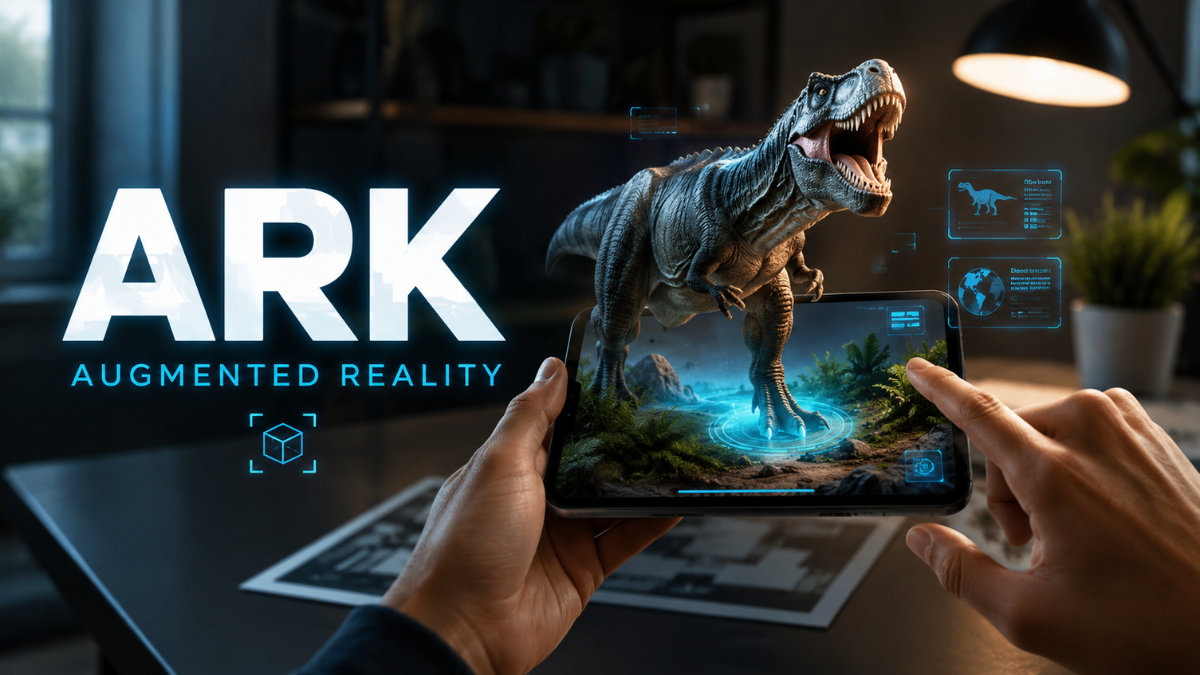
ARK augmented reality is an AI-powered approach to AR that helps virtual objects understand and fit into real-world spaces more naturally. Instead of simply placing digital content on top of a camera view, ARK uses knowledge inference, memory integration, scene understanding, and generative AI to create more realistic augmented reality experiences.
In real use, this matters because users quickly notice when a virtual chair floats, clips through furniture, loses scale, or ignores the room around it.
What Is ARK Augmented Reality in Simple Terms?
ARK augmented reality means augmented reality supported by AI knowledge, memory, and scene understanding. It helps digital objects behave as if they belong inside a real-world environment instead of looking pasted onto a screen.
Traditional augmented reality can detect a flat surface, such as a floor or table, but it may not understand the purpose of that surface. ARK augmented reality technology goes further by using foundation models, computer vision, spatial mapping, and generative AI signals to understand what the camera sees and what should happen next.
From what I’ve seen in real AR demos, the biggest difference is not the virtual object itself. The difference is how naturally that object fits into the space. A virtual grey armchair placed beside a sofa feels useful when it respects scale, lighting, depth, and walking space. The same object floating above the floor feels like a broken demo.
A useful definition is this: ARK augmented reality is an AI-powered AR framework that uses knowledge, memory, and scene understanding to place or generate virtual content more naturally inside physical environments.
Why ARK Augmented Reality Matters in 2026
ARK augmented reality matters in 2026 because AR is moving away from simple overlays and toward intelligent spatial computing. Users now expect AR experiences to understand rooms, people, objects, movement, lighting, and intent.
This shift connects ARK AR with AI agents, Google AI Overviews, Google AI Mode, multimodal search, YouTube explainers, SaaS apps, Shopify stores, WordPress content, and e-commerce product visualization. People are not only asking what augmented reality is. They are asking how AR can help them shop, learn, train, design, play, and make decisions faster.
In real use, this is where ARK becomes more valuable than a normal AR filter. A retail brand can show how furniture looks in a customer’s living room. A healthcare trainer can place a medical overlay on a mannequin. A teacher can turn a flat classroom lesson into an interactive 3D scene.
A common mistake is treating ARK augmented reality as just another futuristic keyword. The real value is practical. It improves object placement, reduces manual setup, supports smarter training simulations, and helps virtual content respond to real physical surroundings.
Core Concepts Behind ARK Augmented Reality
The core concepts behind ARK augmented reality include knowledge inference, memory integration, scene reconstruction, depth sensing, occlusion, object recognition, real-time rendering, and AI-generated 3D scene generation.
Knowledge inference helps the system understand meaning. A table is not only a flat surface. It may be a place for a product demo, training guide, game object, or classroom model. Memory integration helps the system reuse learned context instead of treating every new room like a blank scene.
Scene understanding allows ARK AR to read walls, floors, furniture, people, and movement. Depth mapping and LiDAR-supported sensing help the system estimate distance and object position. Occlusion makes virtual objects appear behind or in front of real objects correctly, which makes the experience feel more believable.
The practical reality is simple. ARK works best when these concepts serve one clear user goal. The theoretical version says ARK can understand any space. The real-world version works best when the app solves a focused problem, such as placing furniture, guiding a repair, supporting a classroom lesson, or improving a product preview.
How ARK Augmented Reality Works in Real Use
ARK augmented reality works by combining camera input, spatial mapping, knowledge inference, and AI-generated content. The camera reads the environment, the system identifies surfaces and objects, and AI helps decide where digital content should appear.
In a smartphone AR demo, the user may scan a living room and place a virtual chair. A basic AR app may only look for a floor. An ARK-style system should also consider the sofa, table, walking space, object scale, lighting, and user intent.
For developers, the workflow often includes ARKit, RealityKit, Unity, Lens Studio, 3D asset libraries, analytics tools, and AR testing tools. For AI-driven content, tools like ChatGPT, Google Gemini, GPT models, DALL-E, and other generative models can support prompt creation, scene planning, content generation, and user guidance.
In real use, what actually works is starting small. One room, one object, one action, and one clear success metric is better than trying to build a full metaverse space in the first version.
How ARK Places Virtual Objects in Physical Spaces
From what I’ve seen, users judge AR quality within seconds. They may not know the words scene reconstruction or depth sensing, but they instantly notice when an object floats, shakes, clips through a chair, or appears at the wrong size.
ARK augmented reality improves placement by connecting AR scene understanding with knowledge-based context. It not only asks where a virtual object can go. It asks where the object should go in a way that makes sense.
For example, a virtual chair in a living room should face the right direction, match the room’s scale, avoid blocking pathways, and sit naturally on the floor. A medical training overlay should stay aligned with the body or mannequin. A retail product try-on should respond to motion, lighting, and user position.
The overlooked tactic is quality control. Even strong AI-powered augmented reality feels weak if the 3D model has poor texture, wrong shadows, bad scale, or slow tracking. Good ARK AR applications need strong design, not only strong AI.
ARK Augmented Reality vs Traditional AR
ARK augmented reality differs from traditional AR because it adds AI-based knowledge, memory, and scene logic. Traditional AR mainly places virtual objects on detected surfaces. ARK-style AR tries to understand the environment before deciding how content should behave.
Traditional AR answers where an object can be placed. ARK augmented reality answers where it should be placed and why it fits there.
This difference matters for gaming simulation, immersive training, e-commerce product previews, AR retail experiences, healthcare training, education platforms, real estate staging, and metaverse creation. A normal AR app can show a virtual robot in a room. An ARK AR framework can help that robot react to furniture, users, movement, and context.
The contrarian insight is that better graphics are not the biggest upgrade. Better context is. Many AR experiences fail because the virtual object looks good in a controlled demo but behaves badly in real rooms.
ARK vs ARKit vs Mixed Reality
ARK, ARKit, and mixed reality are related, but they are not the same. ARK augmented reality is best understood as an AI-powered approach to scene understanding and content generation. ARKit is Apple’s development framework for building AR apps on supported iOS devices. Mixed reality is the broader experience where digital and physical worlds interact more deeply.
In practical projects, ARKit, RealityKit, Unity, or similar platforms can provide the technical base. ARK-style intelligence can improve how the app understands the scene, adapts to the user, and responds to real-world objects.
Mixed reality headsets, smart glasses, AR glasses, mobile apps, iOS apps, Android apps, and wearable AR devices can all benefit from stronger scene understanding. Apple Vision Pro, Magic Leap, Spectacles, and Vuzix-style smart glasses show how spatial computing is expanding beyond simple phone-based AR.
A common mistake is using ARK, ARKit, mixed reality, virtual reality, and metaverse as if they mean the same thing. They do not. Clear definitions help readers, search engines, and AI agents understand the topic correctly.
Main Advantages of ARK Augmented Reality for Users and Developers
The main advantages of ARK augmented reality are more realistic object placement, stronger immersion, faster 3D scene creation, smarter training simulations, and better product visualization.
For users, ARK AR makes virtual content feel more useful. A product preview becomes easier to trust. A training overlay becomes easier to follow. A game character becomes more believable when it reacts to the real room.
For developers, ARK augmented reality technology can reduce repetitive setup work. Instead of manually designing every possible room variation, teams can use AI agents, foundation models, and generative AI workflows to assist with scene generation, scene editing, content automation, and real-time interaction.
For businesses, this creates value across Shopify stores, SaaS apps, e-commerce websites, WordPress sites, local retail spaces, showrooms, classrooms, hospitals, warehouses, and training centers.
The practical advice is to connect every AR feature to a real user decision. If the feature helps someone understand, compare, test, buy, learn, or act faster, it has value. If it only looks impressive, it may not be worth building.
Practical Uses of ARK Augmented Reality in Gaming, Training, Retail, and Education
ARK augmented reality has strong use cases in gaming, training, retail, education, real estate, healthcare, industrial work, and metaverse spaces.
In gaming, ARK can help create smarter AR game worlds where characters understand furniture, walls, movement, and player position. In training, ARK can place interactive overlays on tools, machines, bodies, or simulated environments. In retail and e-commerce, ARK can help users preview furniture, shoes, accessories, decor, or equipment in their own space.
In education, ARK can make lessons more visual by placing 3D models into classrooms or home learning spaces. In healthcare training, AR overlays can guide students through simulated procedures without relying only on flat screens or printed diagrams.
Local and vertical SEO signals matter here. A local furniture store in Singapore, Tokyo, Sydney, or Montreal could use AR product visualization to improve showroom visits and online confidence. A healthcare training center could use ARK-style simulation content to support hands-on learning. A real estate brand could use AR staging to show empty properties with virtual furniture.
In real use, the best ARK AR applications solve a clear problem. They are not built just to show that AR is possible.
What Practitioners Do Before Building an ARK AR Experience
Before building an ARK augmented reality experience, practitioners start with the user task. They decide whether the experience is for learning, shopping, gaming, training, navigation, product visualization, or sales support.
A strong practitioner AR workflow usually begins with a small prototype. The team chooses a device, maps the physical space, prepares 3D assets, tests object placement, checks occlusion, studies lighting, and validates the user flow.
UX designers focus on how quickly the user understands what to do. AR developers focus on tracking, depth, scene understanding, and performance. SEO and content teams focus on how the experience can support Google Search, YouTube, social media, Google Discover, and AI Overview visibility.
From what I’ve seen, the first ARK prototype should not try to do everything. It should prove one useful action, such as placing a virtual chair, guiding one repair step, showing one product feature, or explaining one classroom concept.
Common Misconceptions About ARK Augmented Reality
One common misconception is that ARK augmented reality is only for games. Gaming is important, but ARK AR also fits healthcare training, education, retail, e-commerce, real estate, industrial training, and local business experiences.
Another misconception is that AI can fix poor AR design. It cannot. AI can improve scene understanding and content generation, but poor onboarding, bad 3D assets, weak camera tracking, and confusing user flows will still hurt the experience.
Some users also confuse ARK augmented reality with ARK: Survival Evolved, ARK Invest, or branded AR tools. In search behavior, the phrase can have mixed intent, so content should explain whether it is discussing the research concept, an AR/AI framework, or a broader AI-powered augmented reality approach.
The contrarian insight is that phones still matter. Many people talk about headsets and smart glasses, but mobile apps remain important because users already have smartphones in their hands.
Top Mistakes and Risks to Avoid With ARK Augmented Reality
The biggest mistake is treating ARK augmented reality like magic. Even advanced AR depends on device quality, camera input, lighting, depth data, object tracking, 3D asset quality, and clear UX.
Privacy is another serious issue. AR apps may process rooms, people, objects, location signals, and camera data. If users do not understand why an app needs access, they may leave before the experience starts.
Another mistake is overloading the screen. Too many interactive overlays can make a training app, shopping tool, or classroom experience harder to use. AR should reduce confusion, not add more visual noise.
For AI search visibility, the mistake is writing generic claims. Saying ARK is the future is not enough. Strong content should explain what ARK is, how it works, where it is used, what risks exist, and when a business should or should not invest in it.
What Works in Real Projects?
The theoretical version of ARK augmented reality is broad and ambitious. It imagines AI understanding any environment, generating useful 3D scenes, and adapting instantly to every user.
The practical version is more focused. It works best when the task is clear, the environment is tested, and the user’s goal is easy to understand.
For example, creating a complete AI-powered classroom simulation is complex. Placing one interactive 3D model on a desk is more realistic. Building a full virtual retail store is expensive. Letting users preview one product in their room is a stronger first step.
A common mistake is building for the perfect demo room. What actually works is testing in messy rooms, small rooms, bright rooms, dark rooms, crowded spaces, and normal user conditions.
The best ARK augmented reality project may look simple on the surface. The intelligence is hidden in the placement, timing, object behavior, and user flow.
Is ARK Augmented Reality Worth It in 2026?
ARK augmented reality is worth considering in 2026 if your project needs realistic placement, scene understanding, AI-assisted content generation, or real-time interaction with physical surroundings.
It is especially useful for e-commerce brands, SaaS platforms, AR developers, educators, healthcare trainers, game developers, real estate companies, retail technology companies, and mixed reality teams.
It may not be worth it if a normal image, video, 3D viewer, or product page can solve the problem more simply. AR should not be added only because it sounds advanced.
The best decision question is not whether ARK AR is exciting. The better question is what user problem it solves. If it helps customers buy with more confidence, helps learners understand faster, helps workers train more safely, or helps users interact with space more naturally, then ARK augmented reality has a strong reason to exist.
ARK Augmented Reality, AI Agents, and Google AI Search
The future of ARK augmented reality is connected to AI agents, generative AI, multimodal AI, Google AI Overviews, AI Mode search, spatial computing, wearable AR, and vertical search.
AI agents may help users create AR scenes with natural language. A user could ask an app to place a smaller sofa in a living room, show a repair step on a machine, generate a classroom model, or adapt a retail product preview based on room size.
Generative AI will also make AR content creation faster. Instead of manually building every 3D scene, creators may use foundation models, large language models, and generative models to plan, edit, and personalize AR scenes.
For Google Search, content around ARK augmented reality should be structured for answer-first extraction. Clear definitions, entity-rich headings, concise explanations, comparison sections, experience signals, and practical workflows help AI systems understand the page.
For multi-platform visibility, one ARK article can become a YouTube explainer, LinkedIn post, Instagram carousel, TikTok script, Shopify buying guide, SaaS landing page, WordPress blog, and FAQ section.
Conclusion
ARK augmented reality is not just another AR overlay. It is an AI-powered way to make virtual content understand real spaces, adapt to new environments, and support practical use cases like gaming, retail, training, education, healthcare, real estate, and mixed reality.
The strongest ARK AR strategy in 2026 is practical, not flashy. Start with one use case, one device, one environment, and one measurable user action. Test object placement, occlusion, lighting, scale, privacy, and user flow before expanding.
You May Also Like Auztron Bot
FAQs
What is ARK augmented reality?
ARK augmented reality is an AI-powered AR approach that uses knowledge, memory, and scene understanding to place virtual objects more naturally in real-world environments.
How does ARK augmented reality work?
ARK augmented reality works by combining camera input, spatial mapping, knowledge inference, and generative AI so digital objects can understand surfaces, rooms, movement, and user intent.
Why does ARK augmented reality matter in 2026?
ARK augmented reality matters in 2026 because AR is shifting from simple overlays to smarter spatial computing experiences powered by AI agents, foundation models, and multimodal AI.
How is ARK augmented reality different from traditional AR?
Traditional AR usually places digital objects on detected surfaces, while ARK augmented reality adds AI-based scene understanding, memory, and context so virtual content behaves more realistically.
What are the main benefits of ARK augmented reality?
The main benefits of ARK augmented reality include better object placement, stronger immersion, faster 3D scene generation, smarter training simulations, and more realistic product visualization.
Where is ARK augmented reality used?
ARK augmented reality is used in gaming, retail, e-commerce, healthcare training, education, real estate, industrial training, metaverse spaces, and mixed reality applications.
What is ARK AR object placement?
ARK AR object placement means using AI, depth sensing, occlusion, and spatial mapping to position virtual objects so they look stable, scaled, and natural in a physical room.
Is ARK augmented reality the same as ARKit?
ARK augmented reality is not the same as ARKit. ARKit is Apple’s AR development framework, while ARK is better understood as an AI-powered approach to smarter AR scene understanding and generation.
What is the biggest mistake with ARK augmented reality?
A common mistake is treating ARK augmented reality like magic. In real use, it still needs good lighting, strong 3D assets, device testing, privacy planning, and a clear user purpose.
Is ARK augmented reality worth it?
ARK augmented reality is worth it when a project needs realistic placement, AI-assisted scene generation, interactive training, product visualization, or spatial experiences that normal images and videos cannot deliver.

Wyvernity Team is a content writing team with 3 years of experience in creating clear, engaging, and SEO-friendly content for Wyvernity.com.