
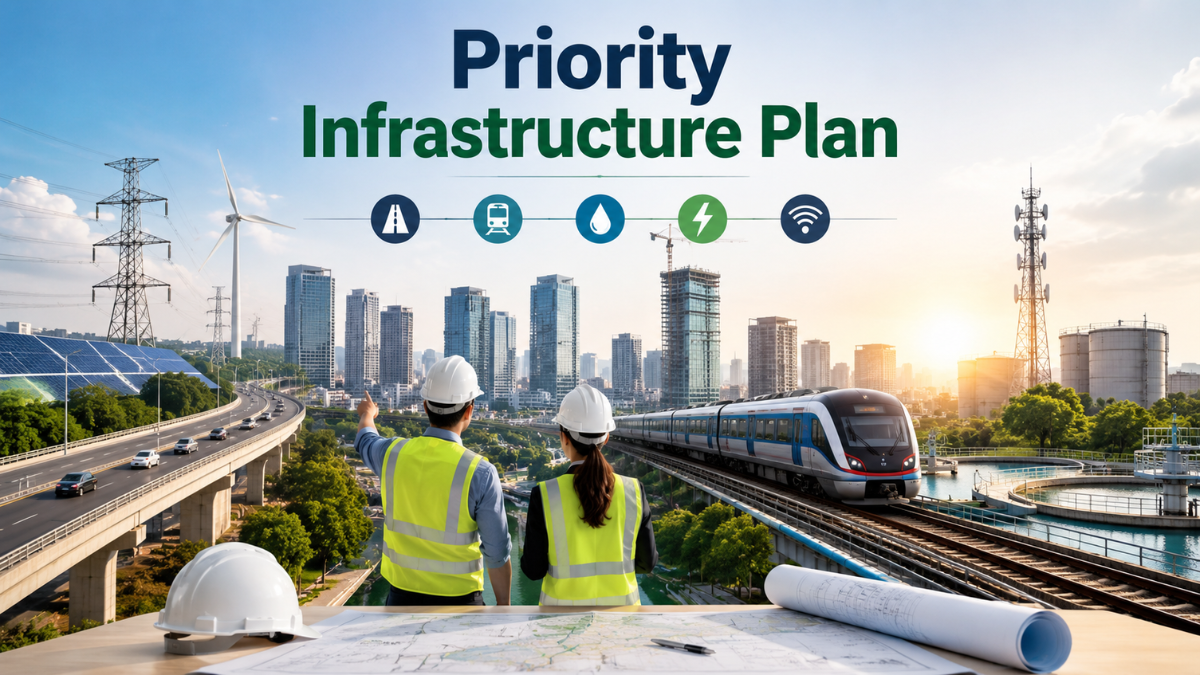
Introduction: What Is a Priority Infrastructure Plan?
A Priority Infrastructure Plan (PIP) is a strategic framework used by governments, regional authorities, and infrastructure planners to identify, evaluate, and prioritize the infrastructure projects that deliver the greatest long-term value. It helps decision-makers determine where limited public funds, private investment, and development resources should be directed to support economic growth, public services, resilience, and sustainable development.
Infrastructure decisions made today influence how communities function for decades. Roads, rail networks, energy systems, water facilities, telecommunications networks, and urban development projects affect employment, business growth, housing availability, environmental resilience, and quality of life.
A well-designed Priority Infrastructure Plan does not simply create a list of construction projects. It provides a structured approach for deciding which projects matter most, why they matter, when they should be delivered, how they should be funded, and what outcomes they should achieve.
As cities grow and governments face increasing challenges from climate change, population growth, aging infrastructure, and technological transformation, priority-based planning has become essential for building stronger and more adaptable communities.
Why Priority Infrastructure Plans Matter
Infrastructure investment requires significant financial resources, long planning periods, and coordination between multiple organizations. Without a clear prioritization process, governments may invest in projects that provide limited public benefit while delaying critical improvements.
A Priority Infrastructure Plan helps solve this challenge by creating a transparent decision-making framework.
The main purpose is to ensure that infrastructure investments:
- Address the most urgent community needs
- Support economic development goals
- Improve public services
- Reduce long-term risks
- Strengthen environmental resilience
- Deliver measurable social and economic value
For example, a growing city may need new housing, transportation improvements, drainage upgrades, and expanded energy capacity. A Priority Infrastructure Plan helps determine which investment should happen first based on population growth, economic impact, cost, urgency, and available resources.
The Core Components of a Priority Infrastructure Plan
A successful Priority Infrastructure Plan usually includes several connected elements that guide infrastructure decisions from planning to implementation.
Strategic Infrastructure Assessment
The first step is understanding existing infrastructure conditions.
Governments and planners evaluate:
- Current infrastructure capacity
- Aging or failing systems
- Population growth trends
- Future demand forecasts
- Economic development requirements
- Environmental risks
This assessment identifies where infrastructure gaps exist and which areas require immediate attention.
For example, an expanding urban area may have sufficient road capacity today but insufficient wastewater treatment capacity for future population growth. A priority plan identifies this future risk before it becomes a major problem.
Priority Project Identification
Not every infrastructure project can receive immediate funding. A Priority Infrastructure Plan creates criteria for ranking projects based on their importance.
Common evaluation factors include:
- Economic benefits
- Public safety improvements
- Community impact
- Environmental performance
- Strategic importance
- Cost effectiveness
- Implementation feasibility
High-priority projects are typically those that solve major problems, support economic activity, or create benefits across multiple sectors.
Infrastructure Funding Strategy
Infrastructure projects often require large investments. A Priority Infrastructure Plan outlines potential funding approaches, including:
- Government budgets
- Infrastructure funds
- Development banks
- Private investment
- Public-private partnerships (PPPs)
A clear funding strategy helps prevent projects from being delayed because of financial uncertainty.
It also provides investors with greater confidence because they can understand government priorities and future development plans.
Project Timeline and Delivery Phases
Infrastructure development usually happens over many years. Priority plans organize projects into realistic delivery stages.
Typical categories include:
Immediate priorities: Projects requiring action within the next one to two years.
Medium-term priorities: Projects planned for delivery within several years.
Long-term priorities: Major infrastructure investments requiring extended planning, approvals, and funding.
This approach allows governments to balance urgent needs with long-term development goals.
Major Sectors Covered by Priority Infrastructure Plans
Priority Infrastructure Plans often cover multiple sectors because infrastructure systems are interconnected.
Transportation Infrastructure
Transportation is one of the most common priorities because mobility affects economic productivity, trade, and daily life.
Projects may include:
- Roads and highways
- Rail networks
- Public transportation systems
- Airports
- Ports and logistics corridors
Effective transportation planning reduces congestion, improves access to employment, and strengthens regional competitiveness.
However, transportation projects must be evaluated carefully. Expanding road capacity, for example, may improve mobility but can also increase environmental impacts if not combined with sustainable transport strategies.
Energy Infrastructure
Reliable energy systems are essential for households, businesses, and industries.
Priority energy projects may include:
- Renewable energy facilities
- Electricity transmission upgrades
- Energy storage systems
- Grid modernization
- Power generation improvements
Modern infrastructure planning increasingly focuses on energy resilience and sustainability. Renewable energy integration, smart grids, and improved efficiency are becoming important considerations in long-term infrastructure strategies.
Water, Wastewater, and Flood Management
Water infrastructure directly affects public health, environmental protection, and economic stability.
Priority projects may involve:
- Drinking water systems
- Wastewater treatment facilities
- Stormwater management
- Flood protection systems
- Water conservation infrastructure
Climate change has increased the importance of resilient water infrastructure. Communities must prepare for extreme rainfall, drought conditions, and changing water demand.
Digital Infrastructure
Digital connectivity has become a critical part of modern infrastructure planning.
Priority digital infrastructure projects may include:
- Broadband expansion
- Data infrastructure
- Smart city systems
- Digital government platforms
- Advanced communication networks
Reliable digital infrastructure supports education, healthcare access, remote work, business innovation, and economic inclusion.
Urban Development Infrastructure
As cities expand, infrastructure planning must support sustainable urban growth.
Priority urban projects may include:
- Housing infrastructure
- Public spaces
- Community facilities
- Transit-oriented development
- Smart city technologies
A coordinated approach prevents situations where new developments are built without adequate transportation, utilities, or public services.
How Governments Evaluate Infrastructure Projects
Selecting infrastructure priorities requires more than political preference or public demand. Many governments use structured evaluation methods.
Social Cost-Benefit Analysis
Social Cost-Benefit Analysis (SCBA) evaluates whether the overall benefits of a project justify its costs.
It considers factors such as:
- Economic productivity
- Time savings
- Environmental effects
- Social benefits
- Long-term costs
A project with a strong social return may receive priority even if direct financial returns are limited because it creates wider public benefits.
Multi-Criteria Decision Frameworks
Some infrastructure decisions cannot be evaluated only through financial calculations.
Multi-criteria approaches consider several dimensions, including:
- Economic performance
- Environmental impact
- Social outcomes
- Risk reduction
- Strategic importance
These frameworks help decision-makers compare projects when information is incomplete or when benefits are difficult to measure financially.
Benefits of a Priority Infrastructure Plan
More Efficient Public Investment
A Priority Infrastructure Plan helps governments focus resources on projects that create the greatest value.
Instead of spreading funding across too many initiatives, authorities can concentrate investment where it produces meaningful results.
Stronger Economic Growth
Infrastructure investment supports economic development by:
- Creating employment
- Improving business productivity
- Reducing transportation costs
- Supporting trade
- Attracting investment
Businesses are more likely to invest in regions with reliable infrastructure systems.
Improved Quality of Life
Infrastructure directly influences daily experiences.
Well-planned infrastructure can provide:
- Faster transportation
- Reliable electricity
- Cleaner water
- Better digital access
- Safer communities
These improvements contribute to stronger communities and improved living standards.
Better Climate Resilience
Modern Priority Infrastructure Plans increasingly include climate adaptation.
Resilient infrastructure may involve:
- Flood-resistant systems
- Sustainable energy solutions
- Climate-aware urban planning
- Disaster preparation measures
The goal is not only to build new infrastructure but to ensure that infrastructure continues functioning under future challenges.
Challenges in Implementing Priority Infrastructure Plans
Although priority planning improves decision-making, implementation remains complex.
Funding Limitations
Large infrastructure projects often require significant investment.
Common financial challenges include:
- Budget constraints
- Rising construction costs
- Funding delays
- Competing government priorities
A strong plan must consider not only what should be built but also what can realistically be financed.
Regulatory and Approval Delays
Infrastructure projects often require:
- Environmental reviews
- Land approvals
- Community consultation
- Technical assessments
Poor coordination between agencies can increase timelines and costs.
Changing Political Priorities
Infrastructure projects often continue across multiple government terms. Changes in leadership or policy direction can affect funding commitments and project schedules.
Long-term planning requires stable governance and transparent decision-making.
Environmental and Social Concerns
Infrastructure development can create environmental and community impacts.
Planners must consider:
- Ecosystem protection
- Land use conflicts
- Community displacement
- Resource consumption
The most successful projects balance development goals with environmental responsibility.
How to Create an Effective Priority Infrastructure Plan
A practical infrastructure planning process usually follows several stages.
Step 1: Assess Current Infrastructure Conditions
Identify existing strengths, weaknesses, and future risks.
Step 2: Define Strategic Goals
Connect infrastructure investment with broader objectives such as economic growth, sustainability, and community development.
Step 3: Evaluate Potential Projects
Rank projects using transparent criteria such as impact, cost, urgency, and feasibility.
Step 4: Develop Funding and Delivery Plans
Determine financing sources, timelines, responsible organizations, and implementation requirements.
Step 5: Measure Performance
Track whether completed projects achieve expected outcomes.
Performance measurement helps improve future infrastructure decisions.
Common Mistakes in Infrastructure Prioritization
Even well-intentioned plans can fail if important factors are ignored.
Common mistakes include:
- Prioritizing politically attractive projects over high-impact projects
- Underestimating maintenance costs
- Ignoring future population changes
- Failing to consider climate risks
- Creating plans without realistic funding strategies
Infrastructure success depends not only on construction but also on long-term operation and maintenance.
The Future of Priority Infrastructure Planning
Infrastructure planning is changing as technology and environmental challenges evolve.
Future Priority Infrastructure Plans are likely to focus more on:
Smart Infrastructure
Sensors, artificial intelligence, and data analytics can help governments monitor infrastructure performance and improve decision-making.
Sustainable Development
Green infrastructure, renewable energy, and low-carbon transportation will become increasingly important.
Resilient Infrastructure Systems
Future infrastructure must withstand extreme weather, population changes, and economic uncertainty.
Greater Public-Private Collaboration
Public-private partnerships will continue to play an important role by combining government objectives with private-sector investment and expertise.
Conclusion: Why Priority Infrastructure Plans Shape the Future
A Priority Infrastructure Plan provides a roadmap for building stronger, more sustainable, and more connected communities. By identifying the projects that deliver the greatest economic, social, and environmental benefits, governments can use limited resources more effectively.
The value of infrastructure planning extends beyond construction. It influences how people travel, work, communicate, access services, and experience everyday life.
The most effective Priority Infrastructure Plans combine strategic thinking, evidence-based evaluation, realistic funding, and long-term resilience. As communities face increasing pressures from urban growth, climate change, and technological transformation, these plans will play a central role in shaping the future.
FAQs
What is a Priority Infrastructure Plan?
A Priority Infrastructure Plan is a strategic framework used to identify, evaluate, and prioritize infrastructure projects based on their economic value, social benefits, urgency, and long-term development impact.
Why are Priority Infrastructure Plans important?
They help governments and organizations direct limited resources toward projects that provide the greatest public benefit while reducing inefficient spending.
What projects are usually included in a Priority Infrastructure Plan?
Priority plans commonly include transportation, energy, water systems, digital networks, urban development, and climate resilience projects.
How are infrastructure projects prioritized?
Projects are usually evaluated using factors such as economic impact, social benefits, environmental effects, cost, feasibility, and strategic importance.
Can private companies participate in Priority Infrastructure Plans?
Yes. Many infrastructure programs involve public-private partnerships where private organizations provide financing, technology, or operational expertise to support major projects.
You May Also Like Altrincham

Wyvernity Team is a content writing team with 3 years of experience in creating clear, engaging, and SEO-friendly content for Wyvernity.com.