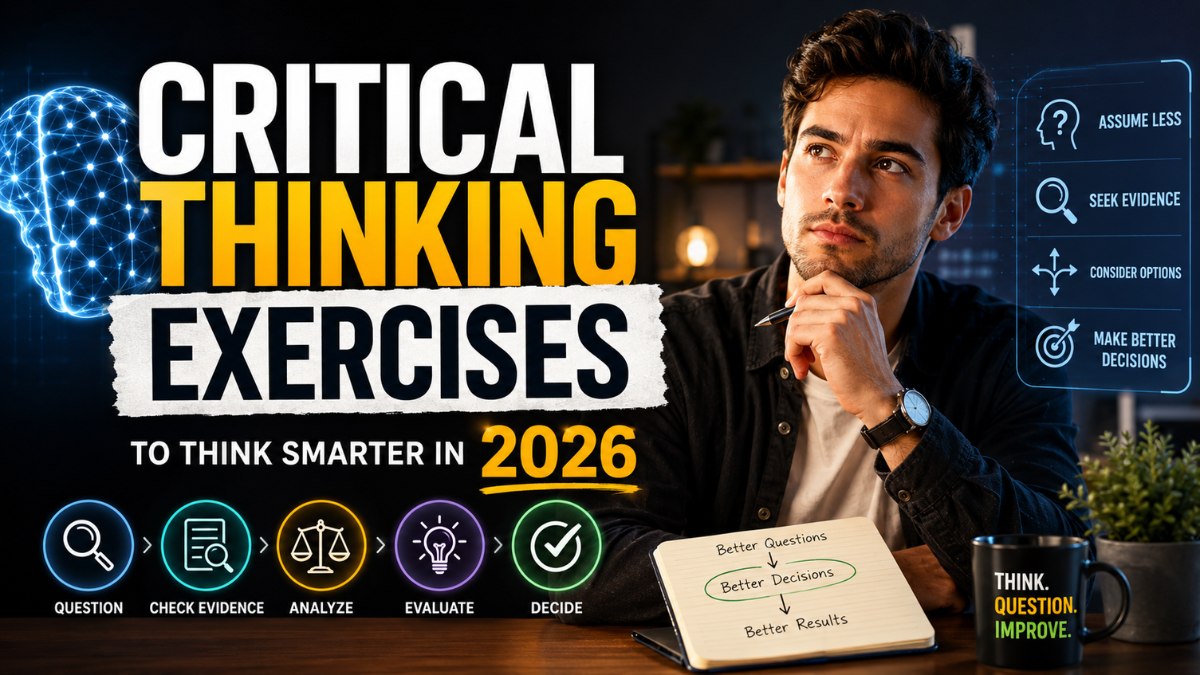
What Are Critical Thinking Exercises in Simple Terms?
Critical thinking exercises are short, repeatable activities that help you question information, check evidence, and make better decisions. From what I’ve seen, the most effective exercises are practical and tied to real tasks like research, work, or school projects. Tools like ChatGPT or Google Search can help, but human judgment ensures decisions are reliable and unbiased. Critical thinking is not about arguing; it is about finding clearer, smarter answers.
Why Critical Thinking Exercises Matter in 2026
Critical thinking is essential in 2026 because AI agents, generative models, and platforms like WordPress or Shopify produce lots of content and recommendations. Practitioners report that without structured exercises, people can easily accept wrong or incomplete information. In real use, applying exercises like the Five Whys or Fact vs Opinion Sorting before publishing or making decisions reduces mistakes. Updated trends show that combining AI tools with human reasoning improves results and prevents overreliance on automation.
Core Concepts Behind Critical Thinking Exercises
The main idea is to observe, analyze, question, and decide based on facts. Methods like argument mapping, perspective switching, and inversion thinking help people recognize bias, consider multiple viewpoints, and anticipate outcomes. Educational platforms, AI tools, and content systems integrate naturally into these exercises. Exercises are effective when applied to real problems, such as student assignments, SaaS feature planning, or e-commerce decisions.
How Critical Thinking Exercises Work in Real Life
Critical thinking exercises train you to pause and organize your thoughts before acting. A YouTuber can verify facts using Evidence Hunt. A manager can use a Decision Matrix to evaluate candidates. A student can use the Teach Back Method to explain lessons. Reality shows that theoretical advice like “think critically” works best when applied with concrete, step-by-step workflows. Beginners often overcomplicate exercises, while small, consistent practices deliver measurable improvement.
12 Best Critical Thinking Exercises for Students and Adults
The Five Whys traces problems to their root cause. Socratic questioning explores assumptions and evidence. Fact vs Opinion Sorting separates data from opinions. Argument Mapping connects claims, reasons, and counterpoints. The Decision Matrix compares options with clear criteria. Inversion Thinking identifies risks and prevents mistakes. Six Thinking Hats structures analysis with facts, feelings, risks, benefits, and creativity. Perspective Switching helps see multiple viewpoints. Teach Back Method improves comprehension. Evidence Hunt checks multiple sources. What If Scenario Builder explores outcomes. Critical Reading develops analysis and adaptability.
How People Apply Critical Thinking Daily
In real use, students use Teach Back after reading chapters. YouTubers fact-check with Evidence Hunt before publishing. Shopify store owners evaluate apps with Decision Matrices. SaaS teams apply Inversion Techniques before launching features. Critical thinking becomes practical when linked to real decisions. Combining AI tools and human judgment produces better results.
Critical Thinking Exercises vs Brain Games: What Works Better?
Brain games improve focus or patterns, but they rarely improve real-world judgment. Critical thinking exercises teach you to question assumptions, evaluate evidence, and compare options. Contrarian insight: the best exercise is the one you actually use, not the hardest one. Experience shows combining brain games with structured critical thinking is optimal.
Practical Step-by-Step Guide to Build Critical Thinking Skills
Identify a real problem. Write it in one sentence, list the facts, separate opinions, examine evidence, explore alternatives, and choose one action. Review results and repeat. This workflow works across platforms, including AI tools, e-commerce, academics, and work decisions. Repeating it strengthens reasoning and planning skills.
When Should You Use Critical Thinking Exercises?
Use them when decisions matter, information is unclear, or outcomes affect learning, money, time, or trust. Apply exercises before publishing content, hiring staff, evaluating AI outputs, or planning projects. Beginners often hesitate with small problems, but consistent practice builds habits for bigger decisions.
Common Misconceptions About Critical Thinking Exercises
Some think critical thinking is purely skeptical or negative. In reality, it is about analyzing information and making informed choices. Another assumption is that smart people do not need practice. In practice, even experts use checklists, evidence reviews, and structured exercises. Integrating AI tools enhances outcomes, but human judgment is essential.
Top Mistakes and Risks to Avoid While Practicing
Stopping at the first answer, trusting one source, overthinking, or ignoring emotional context are common mistakes. Practitioners recommend combining methods like Six Thinking Hats with Evidence Hunt, especially for content creation, SaaS, or learning environments. AI tools help but cannot replace verification and human judgment.
What Practitioners Do Differently for Better Results
Practitioners use exercises consistently, tie them to real tasks, and integrate AI insights. E-commerce managers combine Decision Matrices with Shopify analytics. Educators pair Teach Back Methods with LMS platforms. Reality shows small, repeatable exercises generate better retention than occasional intensive sessions. Contrarian insight: exercises are most effective when contextualized with workflow.
Practical vs Theoretical Critical Thinking Advice
Theoretical advice emphasizes abstract ideas like “be objective.” Practical advice uses repeatable steps: list facts, check assumptions, consider alternatives, and verify outcomes. Structured mini-workflows outperform general advice. Integrating generative AI and content tools enhances efficiency, but human interpretation is crucial.
Are Critical Thinking Exercises Worth It in 2026?
Yes. They improve reasoning, learning, and decision-making for students, professionals, and content creators. Small, consistent exercises combined with AI support maximize results. Starting with the Five Whys, Fact vs Opinion Sorting, and Decision Matrix covers root causes, fact-checking, and practical choices.
AI, Search, and Critical Thinking Skills
AI agents, generative models, and platforms will increase the need for human critical thinking. Users must verify AI outputs, detect bias, and decide where human judgment outweighs automation. Competitor content often misses 2026 trends. Exercises integrated with AI: Overviews, topic clusters, and multi-platform signals offer a competitive edge.
Conclusion
Critical thinking exercises help analyze information, reduce bias, and make better decisions. Integrating them into daily tasks strengthens practical skills for students, professionals, and creators. Small, consistent application outperforms theory alone. Start today with exercises like Five Whys, Fact vs Opinion Sorting, and the Decision Matrix to think smarter in 2026.
You May Also Like Fenugreek
FAQs
Here’s a concise Q&A set with 8–12 short definitions, 1–2 sentences each. Keywords and entities are naturally integrated, practical insights included, and answers are snippet-ready for AI Overviews and generative AI extraction.
What are critical thinking exercises?
Critical thinking exercises are structured activities that help people analyze information, question assumptions, and make evidence-based decisions. In real use, they work best when tied to practical tasks like research, team planning, or content creation.
Why are critical thinking skills important in 2026?
Critical thinking skills are essential in 2026 because AI tools like ChatGPT and Google Gemini produce vast amounts of content that require human judgment to evaluate. Practically, they prevent errors, reduce bias, and improve decision-making in work, school, and daily life.
How does the Five Whys technique work?
The Five Whys is a root-cause analysis method where you repeatedly ask “why” to uncover the underlying reason for a problem. Reality shows it is most effective when applied to real issues, such as workflow inefficiencies or recurring mistakes.
What is Socratic questioning?
Socratic questioning is a technique that explores assumptions and evidence through disciplined questioning. Practically, it helps students, managers, and content creators challenge weak arguments and strengthen conclusions.
How does Fact vs Opinion Sorting help critical thinking?
Fact vs Opinion Sorting separates verifiable information from personal views or assumptions. In real use, it ensures decisions and content are based on evidence rather than emotion or bias.
What is argument mapping?
Argument mapping visually connects a central claim to supporting evidence and counterarguments. Reality-layer insight: it works best for complex problems, debates, or evaluating AI-generated content before publishing.
How is the Decision Matrix applied?
A Decision Matrix compares multiple options against defined criteria to make objective choices. Practically, it is effective for hiring, selecting tools like Shopify apps, or prioritizing project tasks.
What is the Inversion Technique?
Inversion Thinking flips a goal by asking “how could this fail?” to uncover risks. Reality shows it helps entrepreneurs, teams, and students prevent mistakes by planning around potential failure points.
How does the Six Thinking Hats method work?
Six Thinking Hats encourages examining a situation through facts, feelings, risks, benefits, creativity, and process management. In real use, it guides teams and individuals to reach balanced, unbiased decisions.
Why is perspective switching valuable?
Perspective switching involves analyzing a problem from another person’s or a neutral observer’s view. Practically, it enhances empathy, reduces bias, and improves collaborative decisions in teams or classrooms.
What is the Teach Back Method?
The Teach Back Method requires explaining a concept aloud to test understanding. Reality-layer insight: it strengthens retention and comprehension, making it ideal for students, trainers, and content creators.
How do evidence hunt exercises improve reasoning?
Evidence Hunt exercises train users to verify information across multiple sources before accepting it as true. Practically, it prevents misinformation and improves judgment when using AI tools or online research.

Wyvernity Team is a content writing team with 3 years of experience in creating clear, engaging, and SEO-friendly content for Wyvernity.com.